
 Customer Support


ON-DEMAND WEBINAR
Setting the Standard From Day One:
Fair Housing Compliance & the New Hire Experience
Every phone call, email, and property tour is an opportunity to welcome a new resident—or a potential Fair Housing violation. In this webinar, we explored how the 2026 legislative landscape is shifting, with new executive orders and HUD updates redefining key areas like disparate impact and resident screening.
One of the biggest risks organizations face isn’t intentional bias—it’s the unintentional “onboarding gap.” When new hires are rushed into the field without proper Fair Housing training, they rely on guesswork instead of guidance. This session highlights why compliance must be built into the new employee experience from day one—not treated as a check-the-box activity months later.
Grace Hill’s Krisann Gaiko was joined by industry expert Doug Chasick, aka “That Fair Housing Guy™,” to break down what multifamily teams need to know to stay compliant in 2026.
We were also joined by Nikki Chambers of Hanover Company, who shared a real-world success story on training compliance in PerformanceHQ. Learn how her team uses Grace Hill’s Onboarding Pathways to:
- Operationalize compliance from day one.
- Standardize the experience across different roles and regions.
- Bridge the gap between being "hired" and being "ready."
Hello everyone and welcome to today's session, Setting the Standard from Fair Housing Compliance and the New Hire Experience. I'm Krisann Gaiko and I'll be your host today for Grace Hill's most popular webinar of the year. We all know it's fair housing month, this is really important because every interaction that you have is an opportunity to either welcome a resident or potentially trigger a fair housing violation. With twenty twenty six shifting legislation, landscape, and updated HUD mandates, the stakes for compliance have never been higher. The primary risk is not typically intentional bias. It's usually an onboarding gap. So when new hires begin without immediate training, they end up having to rely on guesswork, and that guesswork creates liability. So to protect your assets and your reputation, fair housing training training has to be the cornerstone of the new employee experience. So before we dive in, I just have a few quick things to mention. First, we're recording this session, and we'll send the replay directly to your inbox tomorrow. And then we wanna hear from you today. So when you have questions, drop them into the q and a box at the bottom of your screen at any time throughout, and we'll check those periodically. And we'll either answer them during if it applies to what we're talking about, or we'll try to get as many as we can at the end. And then finally, please stay to the end because at the end, we're gonna give you access to a newly updated fair housing toolkit. We have been hard at work creating this for you to use. There's guides, templates, activities. There's some great videos, created by the one and only Stephanie Anderson. So make sure that you stay so that you can push this out to your team so that they can confidently navigate all of your housing requirements. So, again, if you're joining just now, my name is Krisann Gaiko, and I am the senior VP of learning and enablement here at Grace Hill. I work with a team of people, in internal people as well as outside experts to ensure that our training and our policy content is the most up to date and accurate according to the federal regulations. One of the experts that I have here with me today is Doug who is also known as that fair housing guy. He's got me beat for a number of years in the industry. He's been in our industry for fifty years, starting out as a resident manager and working up to president or CEO of five different real estate companies throughout his career. He is a senior instructor for the National Apartment Association Education Institute where he has coauthored courses and workshops. He's also earned the NAAEI ACE and Legends of the Industry Awards to name just a few. Thank you for joining us, Doug. I'll come back to you in a minute. Next, it's my pleasure to introduce one of our power users and a fantastic trainer and industry professional, Nikki Chambers. Nikki is the director of systems and training at Hanover Company where she is responsible for software support and training, process innovation and implementation, customer service training, procurement, and oversight of their property management global services team. Wow, Nikki. You're a busy woman. Later, she is gonna show us how she prioritizes fair housing training by structuring her onboarding processes using Pathways and PerformanceHQ. So now we're gonna start with a poll. We wanna see where our audience falls on the timing of fair housing training at your company. So I want you to answer the poll. When does fair housing start at your company? Is it on day one? Is it the first week, first month? Is it thirty to ninety days? Please tell me that your answer is not what is fair housing training. Oh, I see someone put that in. Y'all are so silly. Anyway, I'll give you guys about another ten seconds or so. Looks like day one is dominating, which is kind of what I thought. A lot of times we hear it's in the first three days. That counts as the first week. So okay. I think that's good. Are we ready to share the poll results? So we've got seventy six percent saying that it happens on day one. And I will tell you that my daughter took her very first job in property management, and yesterday was her first day. And I asked her what she did, and she said she did fair housing and sexual harassment training. And I said, I'm not surprised. So moving on, our next slide, prompt and thorough Fair Housing is so important and we all know that. But did you know, and I'm sure many of you do, but if you don't, the violators of Fair Housing related laws, including the federal fair housing act, can be huge. So several penalties of more than twenty six thousand dollars for your first offense. And then if you go on to have a second within five years, you can have up to sixty five thousand dollar penalty. And if you violate it three or more times within seven years, you can be fined a hundred and thirty one thousand dollars. And remember, these are just the fine for a fair housing complaint. Typically, there's an injunction issued. You have to pay reimbursement of actual damages, meaning like reimbursement of expenses that the complainant may have had to incur, and they force you to take training as well. So it's better to take training proactively than to be forced to take it. So you've got fines, punitive damages, actual damages, don't forget about attorney fees, the injunction, and the training. So it's a lot. And also keep in mind that these are just the HUD fines. Some of these settlements can get really big. So on this next slide, I've got just a sampling. We pulled some actual cases and anonymized them that took place over twenty twenty five. And as you can see, there's some pretty big fines in here. And I think it's also important to note that while the fines are are pretty rough and hard to handle for a company, you also have reputational damage, that takes place when this occurs, and that can go on for years to try to to repair that damage. So this is just a really important topic. And with that, on to the next slide, our regulatory environment has changed a lot. As we all know, the Trump administration has made a lot of changes. Some of those things include rollback, but others, are where they've actually proposed new regulation. And so that is why I asked my friend Doug to join us for this webinar so that he can give us a good understanding of what's going on with HUD and Fair Housing today. Doug, can you give us any pearls of wisdom? Well, I guess the first pearl of wisdom would be don't be surprised when you go to w w w hud dot gov if you get a four zero four page not found error instead of the document that you thought you were looking for. Because HUD, since September of last year, has been withdrawing and rescinding guidance at an actual frightening pace. And what that does essentially is remove the guardrails from us as operators where we relied on this guidance, and now HUD is saying, you know what? We're gonna let the courts decide. So, folks, you're on your own. And whether we're talking about the way that we interact with people or we're whether we're talking about the fact that HUD has decided to no longer pursue any complaints based upon disparate impact, Some of you may have heard that we have sixteen attorneys general suing HUD right now over the fact that they've withdrawn their support of the fair housing assistance program, which basically means that when a state or a local fair housing enforcement agency pursues a claim that's not specifically listed as a discrimination due to different treatment claim, they're not gonna get reimbursed because the federal government is not recognizing disparate impact even though the supreme court says, hey. That's a real thing. So it has gotten it has gotten really scary out there as far as what's going on. Disparate impact also obviously informs our policies and procedures when we talk about things like criminal background checks or legal source of income. When it comes to affordable housing, there's been some really surprising changes. One of the biggest ones is that previously, when you were on a public housing, a project based section eight, any asset that was receiving federal funding, you had to give a thirty day grace period before you played the eviction card. HUD has rescinded that regulation and said from now on, you're only subject to whatever the local landlord tenant act is, which frequently is three days or five days. They've decided to once again try to implement work requirements as well as shortening the period of time that people are eligible for the section eight housing choice voucher program. Under criminal background, they've now said, you know what? It's okay to consider arrests even though previously that was an area that you never wanted to go into. And another one of the really substantial changes is where they would prorate assistance based on the makeup of your household for people who were US citizens or here legally versus folks who were not documented. Now they're saying that if you have any individuals in the household who are undocumented, we're not gonna give any assistance. So what that's done for us as operators is created a lot of uncertainty. Just just a lot of uncertainty, and it's scary. It is. You know, a couple questions that I have for you is you know, with regard to, verification and citizenship, how how does that impact owner operators? Is it now the onus on the the landlord to to verify the citizenship, or are they just saying, we're gonna prorate your assistance or completely deny it? That's a great question. And let me let me reinforce the distinction of this is only for public housing project based section eight housing. This doesn't apply to market rate or to straight tax credit deals where we've always said, hey. We're not the immigration police. We're professional property managers. So if you're on one of these federally funded properties, then it is your responsibility to be verifying citizenship status. Wow. That's a lot. Yeah. We we have a question, in the chat about you were talking about the, criminal background changes, and, we have a question from Kelly who who asked which types of arrests are they allowing? Any any arrest, which is so unusual because an arrest is an allegation. It hasn't been adjudicated. It hasn't been decided. And yet they're saying now you can consider an arrest. And they're not only saying considering arrests for when you are vetting somebody who's applying for the apartment, but they're saying after the fact, once they were they're a tenant, if they're arrested, you can take that into consideration on recertification. Wow. And it used to be that it was just a conviction. Absolutely. Yeah. And that's been that way for a long time. It was like that when I worked on-site. What if I'm not on a HUD property? Most communities are doing criminal non HUD market rate communities are doing criminal background screening. Should they continue? Yeah. Well, first of all, I just wanna make it real clear that we want everyone to follow company policy. Whatever your company policy is, you may find things that become a subject of discussion after the session, but follow the company policy. It depends on the jurisdiction. There are some places where you can look back three years, five years, seven years. There are some jurisdictions you're not allowed to look back at all. There are some jurisdictions that limit the types of offenses that you're allowed to look at. You really need to know what your local laws are Governing criminal background. Great. This is good information. Couple of questions about this is all going back to verification of citizenship. So there's there's two questions that are related. And so one is that, are we expected to verify citizenship, which I think you just said, if you're a HUD property, you are. And then and then the the follow-up is, what's the documentation that we would need in order to confirm, you know, verify citizenship? And then also this one says this is the related question that says, work in affordable housing. Does that mean everyone has to have a Social Security number to be able to apply? Well, I'll take the last one first because that's the easiest. And the answer is no. That if the person has a taxpayer identification number, that's fine as well. Social Security or a taxpayer identification number, those two things are typically considered proof of citizenship. As far as the previous section with regard to documentation, that's that's something that right now is kind of up in the air. If you have a Social Security number, you have a green card, if you have a long term work visa, if you have a taxpayer identification number, an ITIN, those are things that are considered. That question though for sure is something you should, discuss with your company attorney as to what you're gonna require. And, I wanna stress that it's only a requirement for project based section a, public housing, federally funded. If you're subject to section five zero four, then it means you. Right. Well, another question about the background check. This is, asking, are there resources that you know of, Doug? And I know this is a big pain point for our customers. I'm actually working on trying to help solve this for the industry. It's a big lift, but people struggle with having knowledge of, both state and local, but particularly local, laws or ordinances. Is there are there any resources that you can recommend, for that people would be able to use reliably to find out, what those laws and requirements are in their states and municipalities? When you're talking about laws, are you talking about what we're allowed to check, or are you talking about what what offenses, what's a what's a felony, what's a misdemeanor? Because NAA question. NAA has a great resource to find out what the protected status is by location. Yeah. This is a question from David. David is on here. David. You have any more on that, we can I knew we would get a lot of questions here? So we I wanna make sure we have time, but I also wanna make sure that we get as many of these questions answered as we can. Yeah. Let me let me check when when as when I'm done speaking, I'll Yeah. Pop open and and see what I can find. Okay. Yeah. David's saying both. He says both, I guess. And then here's another one. We'll do we'll do one more, and then we'll we'll keep moving forward. If an arrest that involves sexual misconduct if so if they're arrested for something involving sexual misconduct, then they're later found guilty, can the lease be terminated? That that's above my pay grade. That would that would be that would be a question for an attorney. I'd I'd Yeah. Be I'm reluctant to hazard a guess on that one. Yeah. I I agree with that. I I get asked a lot of questions like that, just because of the role that I'm in, and there's a lot of times where I go, you're gonna have to contact your attorney because you don't wanna do something that's gonna put your company at risk. Yeah. Real real quickly, Krisann, what what I tell people is that fair housing compliance these days is a function of risk management. So what you have to determine is what is your risk tolerance. Another way of putting it is, do you wanna be a test case? Do you wanna be featured in one of these webinars? Okay? Or do you wanna be playing it safe and be conservative? It's an individual business decision that has to be made in consultation with an attorney and a fair housing attorney, not just a landlord tenant attorney. Right. Right. Okay. We'll do one more. I lied because this one's for this one this one's from Tracy. We are about to go through a rehab and will need to recertify all residents. At the time of completing the packet, if they do not have a Social Security number, do they have to move? Well, okay. First of all, again, it's not just the Social Security number. It can be a taxpayer identification number. If they are federally funded, okay, if they're project based, then given HUD's position, I'd say yes. On the other hand, if their market rate or if they're a section forty two tax credit deal, I would say no because you're inviting a complaint based on national origin. Wow. It's really tricky. Interesting. Let's go ahead and keep moving on. I would love, Doug, to this is great HUD info. I know we could just talk for hours about all of this, but we'll keep moving forward. Wanna talk about some of the things that impact not just, HUD communities, but also market rates. So the things that affect us all, I would like to talk about fee transparency first and then disparate impact. Doug, can you give us a little bit of knowledge here? Well, the fee transparency is more of an ops type of subject than a fair housing subject, and the way that fee transparency could enter into the fair housing arena would be via disparate impact. But fee transparency is basically saying, listen. What we are looking for is that everybody knows upfront before they sign anything what is it gonna cost them. And for the most part, that makes a lot of sense. However, there are some issues. For example, if your property is not submetered and you're charging back what water usage is or what other utility usage is, it's hard to set a fixed amount. So while this legislation is basically welcomed, it has to be tweaked to allow for those variable costs that are gonna occur during the life cycle of the resident. When we're talking about disparate impact, here's the deal. The Fair Housing Act is alive and well. The Supreme Court has said disparate impact is a real thing. And even if HUD decides not to accept any complaints based upon disparate impact, an increasing number of states and local jurisdictions are codifying that into law so that it is protected at the local and state level. Disparate impact is real, and we've got to be aware of the fact that when you treat everyone the same without regard to the fact that some people disproportionately experience discrimination, you're gonna get into fair housing trouble. And, well, it may not be at the national level these days. It could absolutely be at the state or local level. Yeah. Absolutely. I mean, we see that happen all the time in in a lot of the, we we have a a team that monitors all of the cases that are out there, and so we see a lot of that. I I wanna go back to, fee transparency for a little bit because it's a big buzz in the industry. And, you know, I was just at a conference recently, and I've I've heard a number of people talking about, you know, the various state that has passed laws. You know, I heard, at this conference that Connecticut law is actually pretty clean and simple, and, you know, the the people who are operating there feel like it's it's working. And then other states have, adopted different legislation. And so, you know, what we really wanna try to do as an industry, I think the consensus is rather than to come in and and say, we're gonna try to fight Washington. What we really wanna do is support the industry's effort, in Washington to work together with our legislators to come up with laws and regulations that are good, that work for everyone, that work not only for our valued residents, but also for the owner operators and don't impose such onerous burdens that we can't stay compliant. One of the comments was made, you need to look at your fees. And if you're not proud of your fees, if you can't if you can't talk about them proudly with anyone, you probably need to reexamine them. And Doug told us a story during the practice about about the administrative fee. Did you wanna tell that, Doug? Well, yeah. It was it was sad. I was teaching a CAM class a while back in a city that shall remain nameless, and people were charging a three hundred dollar administrative fee. And I asked, well, what does it cover? Three quarters of the class didn't know what it covered. They just knew it was three hundred bucks and it was administrative fee. How do you defend that? How do you defend that? Just because the market allows it doesn't mean it's okay. And those are the types of things that bring that regulatory microscope down on us. Exactly. I I will tell you, I was shopping properties just recently, and I asked about some fees because I just wanted to see if they were able to answer them. And they didn't they were not. That I could tell that it kinda tripped them up, and they ended up calling the supervisor. They called me back. It took a couple of days. And then even the response that was given from the supervisor didn't really make sense to me. So if you're a if you're a company leader, make sure your teams are trained to explain those fees properly and that, of course, you're making sure that you're advertising those and putting those out, for your prospects to see. And then with regard to disparate impact, you know, I think it's just important to remember, you've gotta have your people trained. And the fair housing training that we offer is very thorough. We have an initial course that they would take that covers everything. We've got, refreshers and boosters. We've got a a course specifically about assistance animals because that's one of the one of the biggest, areas where we find claims. We've got one on reasonable accommodation. So these are really important, to get your teams trained up. So, you know, we know it's important to train your people, and we know that it's difficult. We heard our customers tell us loud and clear that sometimes leaders lose sleep at night because they don't know, you know, as a regional manager, they don't know if their if their teams on-site have taken fair housing training or sexual harassment training. They don't know where they are because the industry lacks a really good tool, that pulls that all together. And so that is why we build onboarding pathways. And so, you know, if if you look at this next slide, you know, a study done by the Society for Human Resource Management says companies that fail to implement an effective onboarding program experience higher turnover, and it it results in substantial financial losses. So with poor onboarding programs, the stats show they have about a fifty percent higher turnover rate compared with those that have structured programs. And then twenty percent of that turnover takes place within the first forty five days of employment. So that's why it's really important for you to get them onboarded quickly so that they can be confident and competent in doing their jobs and be successful and have long wonderful careers in this industry. And so, again, that's why we built onboarding pathways with templates available to you. We've got templates for the first ninety days that we have created. It also costs up to forty percent of an employee's base salary to hire a new one with benefits, and then it takes approximately three to eight months for a new hire to become fully productive at work. And so our goal here is to really change that, with providing you with this wonderful tool. So with that, I am going to ask Nikki to talk to us a little bit. She is one of our beta customers for onboarding pathways, and I just wanted her to kind of tell us a little bit. What you're seeing right now is a a video loop of her old the old way that she handled onboarding. And so, Nikki, will you tell us a little bit about how that impacted your teams, how you managed it, what were some of the pain points with with using an Excel spreadsheet to manage onboarding? Well, we had tried several different things. We tried different softwares. We tried automated reminders. We tried everything. And, really, we found that going back to the basics was kind of the best way forward. And so an Excel spreadsheet with, you know, all the things we wanted. Well, the hard part of this is while very well intentioned, it's a very long sheet. You can see by, like, scrolling. I think it's almost three hundred rows, and it's every touch point that we want them to be able to have some sort of exposure to in their first, you know, thirty, sixty, ninety days depending on the position. And so while very well intended, it had some unintended consequences of, you know, it's a lot. It's very overwhelming when a new hire gets that, and they're like, oh my gosh. You expect me to go through all of this. And then the constant follow-up with the property manager or the regional manager or the maintenance supervisor or whoever that supervisor is. There's a pain point with the constant follow-up. And then, you know, with this, we started with, you know, was it done? And then, well, maybe it was done, but they're not really comfortable with it. Or they did the training and they hadn't been exposed, and so it kind of evolved. And, again, very well intentioned, but very bad unintended consequences, that came out of this. And what we found is we need the onboarding because we need something I mean, any good trainer or any, you know, good multifamily professional leader worth their salt is gonna have something that helps track through the onboarding process for their new hires because it's important. I mean, you know, the statistics you showed a minute ago are they're very true. I mean, the turnover in our industry is, you know, I think historically has been in an all time high, and it's hard to keep people. So you wanna be sure that when they do have that onboarding experience, it's good and not this three hundred row spreadsheet that they're overwhelmed with on their first So this is what we were doing. Right. And now let's look at what you're doing today with onboarding pathways. Tell us a little bit about how your admin experience has improved, your leadership, your employees, and kind of the overall reaction at Hanover to this. So, I'm gonna kinda step back a little bit and tell you kinda what this came where this came from. You know, I've overseen the training department with Hanover for eight years, and one of the things that's kind of a consistent message is training never stops. You know, your first day, your first week, your first month of training, that's kind of the beginning, but it never stops. And so, you know, my job is is constantly evolving. And what we found is we had our leadership conference, and this is what you're looking at. It's kind of the content that came out of our leadership conference. And we this we had a support survey that we sent out to our our on-site teams. And we asked them, you know, how do you feel about the support you're getting from training, from our global services team, from all of those things? And then we took that information. We kinda packaged it up in a way that we could present at our leadership conference what we're doing as a response to their support survey comments. And we had overwhelming feedback in the support survey that they really wanted a better onboarding experience, you know. And this is coming from managers. Managers want a better onboarding experience for their people. So we're responding to a need and a request. And, you know, I had already started working with Grace Hill on this, late last year. And probably the my favorite part of this is I sent our spreadsheet to your team and was like, can we automate this? Can we make this easier? Can we make this more digestible? And with most other software companies that you work with, you kinda get what you get. You don't throw a fit. Right? Grace Hill has been so amenable to change, and it's kinda refreshing, especially coming from a systems mindset that I sent them this spreadsheet. It was like, can we automate this, make it digestible, but then also make it interactive and engaging, and make the user want to use it? And not only did, you know, the Grace Hill team do that, but they also took so much great feedback. So every time I said, hey. This is great, but can we maybe do this too? It wasn't a, no. Wait for the next release, or no. That's not something we can do. It was, you know what? Let me look. Let me let me take a look and give me a week or so, and then I did. So this this tool was not only built with property management in mind, it was built nearly to spec for exactly what I would be looking for, not just from a, you know, director level, you know, overseeing training development, but I was on-site for a long time. And this is something that to me is very easy to understand, very easy to interact with. And when they finished building it, I mean, I I just told the the guy with Grace Hill just yesterday in an email. I was thanking him saying, I'm gonna leave you in my will. Like, this is fantastic. I love what they came up with, and it is easy to use. And it was and and the the best part of it, the spreadsheet's gone, but everything that was in the spreadsheet, like all the meat and potatoes that you really need for training, the content is still there. It's just packaged in a way that makes it less overwhelming for that new hire. And it's because of how they were able to tie in not just the onboarding, but the courses and the learning paths and specific assignments and how you can even just, you know, craft checklist of, hey. Did you do this? You know, did you go through these things on your first day? So I absolutely love everything that they did, and we're using it for everything now. That's so good to hear. You know, when I worked on-site, which was a long time ago, but I I remember training trying to train people on a lease up. And they're following me around the office, and I don't even have time to explain anything to them, because with such a fast paced environment. And I feel like with onboarding pathways, this is a good way for them to have, you know, like, something that really makes them feel like they understand what they're supposed to be doing. And then I feel like our content the Sparks content that we provided so if you're on this webinar and you don't know about Sparks, Spark is our new microlearning that we launched last year, and it's training that looks like social media. So it's real. It's TikTok. It's like what we're used to watching, and, you know, I've I've followed people and get recipes. So it's the same idea but with property management. And we've got over a hundred and sixty sparks that we have created that you can drop in to onboarding pathways to get people trained up quickly. So if you want someone to learn how to, greet someone when they walk in the door, they can watch a a minute and a half, two minute spark to see how you how they need to be greeting that prospect. And then in addition to that, we have learning plans that can layer over these onboarding pathways that have the full courses in them. But the idea is you can use this product to get your teams trained up faster. So it's a it's a a really neat, tool. And then we've also found, Nikki, in your doing, this exercise with us, we've had probably about fifteen customers. I didn't ask for the exact number, but in that participated in the beta, worked very closely with our product team to make sure that we were building this to meet industry standards and to support what they need in order to have successful communities. And so one of the things that you have determined and other customers have said, they're using this not just for onboarding, they're using it for promotions and transfers. Can you tell us a little bit about how you did that? I think you talked about two communities that were across the street from each other but had different training needs. So we've actually had several instances where this has come up just since we kinda finalized and deployed this. You know, we introduced it at our leadership conference. And, you know, being that it's fair housing month, you know, you wanna make sure you get your fair housing stuff training, you know, all of that done in your, you know, first day, first week, first month, however your your company does it. So we have that plugged into the onboarding pathway. And it's for onboarding for new hires. Now if it's a transfer or a promotion, you may not necessarily have it in there unless you're going to, like, the supervisor version of sexual harassment. Right? So you wanna make sure that's plugged in for those. But for fair housing, you know, it may not necessarily be that you have fair housing plugged in, the fair housing specific training plugged into promotions and transfers. But what if they're going from Houston to Denver? Where in Houston, you don't you're not required because it's not a protected source of in source of income is not a protected class. You're not required to accept section eight vouchers. But in Denver, you are. So you need to add a layer of that fair housing training when you're going there, and this is where the onboarding pathways are so helpful because we have just kind of a standard, you know, layer template, if you will, of here's everything every new hire needs to do. And we use that as kinda like the the the skeleton of what we were doing for any and all others. But then if you have a promotion or a transfer or even a promotion that is a transfer, they have different needs depending on where they're going, what type of property. A high rise is different than a mid rise. You know, Denver is different than Houston, and the leasing manager is different than a property manager. So you have to help them understand like you're those are the people that get lost in the shuffle. They just do. And it's it's hard because when you're being promoted and going to a new location, you have so much to learn. It becomes culture shock if you're going to a different place and, you know, shell shock if you're being promoted to a different position, especially if you're going to a different product from maybe a garden community to a high rise or vice versa. So all of those things that we felt like these are important to plug in and make sure they get in their first thirty days, We added that to additional custom pathways. So we've got a new hire. Great. We've got a new hire for leasing, new hire for maintenance, new hire for, you know, every position, but we also have transfers. We have promotions, and we have transfer promotions to identify where we had gaps in our training processes that have just improved our entire all of our onboarding, not just for new hires. It's great. And the the opportunity to make sure that you're capturing not just the new hire fair housing, all the onboarding training, but also anything supplemental that may impact them in their new role on this onboarding tool is really tremendous. Yeah. And the thing that I love about it too is that you don't it's not all just training that you have to do. Like, not everything is elearning that in order to to work on a property. You've gotta understand your market. You've got to acknowledge a key policy and understand the importance of having access to keys. And what do I do if someone comes in and asks for a key? They these are all things they have to know, and it's not always, the same across what keys are, but, you know, it's not always the same across every property. So I I just I love this, and I'm super excited about it. We do you didn't have the templates because you were part of the beta. And so you did your own template. But within the system now, when you go in, there's the the temp it'll there's a tab that says templates. And when you click on that, you can see the ones that are Grace Hill templates have our little little round logo. And you can use those. You can just copy the template over. And then if there's anything that you don't want, you can just easily remove it. You can reorder things, and then you can add your own task. You can change up the sections. It's very user friendly. I've been using it, and we've been working on, the templates and web I have requests for more, and so we have the the list for that, and we'll continue to provide our customers with everything they need in order to make this tool work really well for them. So, Nikki, thank you for doing this, and and, thank you for being part of the of the, the beta and all your feedback. So that's just it. Onboarding pathways and PerformanceHQ is designed to pull your team out of the chaos to help them see exactly what they need to do. No more manual checklists. You have now automated journeys, that can be assigned by position, location, templated pathways. You're gonna spend less time chasing paperwork. You're gonna sleep better at night knowing that your people are trained up, and, ultimately, they will perform better and your communities will perform better. So onboarding pathways is now in early access. Full release is coming on April the twenty second. Scan the QR code on this slide to be able to walk through a short tutorial so you can see more. And then, also, if you want to be contacted about this, could you just drop something in the chat real quick? Just drop in onboarding. Type in onboarding, and we'll make sure that you are contacted because you're gonna want this tool. And then, finally, I told you all if you stay till the end so everyone who's here, you can scan this QR code to get access to the, Fair Housing Toolkit. So this is a great kit. Again, I've said earlier, there's tips training tips in there for admins. There's a put the fun in fair housing fundamentals. There's make fair housing maintenance mishaps, checklist blog, ebooks, infographics, webinars. It is a great toolkit and was just updated, by the marketing and, collaboratively with marketing and our enablement team. So we're super excited about that. And I'm gonna go back. Do we have any more questions? I've been watching the chat, and I think we I think we got these answered. The only other question, if Doug has time, for well, there's two more here. There's one that talks about verifying citizenship again. It says if a visa has expired, are we supposed to know that? Sorry. I was just dropping my find into the chat about I found a resource for your protected classes. It's crazy. The NAA, I just used it about a week ago, and it's gone now, the NAA thing. Thank you, Katie Rigsby, for pointing that out in the chat. So you're supposed to know it if the visa is presented. But if the visa if somebody presented the visa, you didn't make note about whether it was a three month or a six month or an eight month or whatever, then how are you gonna know? How are you gonna know? So, oh, here, the chat just came back for me. I wanna put that in there. Yeah. It's you know, you can't nobody's expecting us to be mind readers. So, no, if you don't know, you don't know. And, again, it's only an issue on federal housing. Right. Federally funded housing. Okay. And then here's here's another one. It says, I'm a company leader. Should I rewrite policies and training now or wait until some of these final rules are clearly defined? Well, absolutely wait until some until the rule is defined before you change the policy, and just remember that the only constant is change. Guaranteed after the midterms, depending on what the the outcome is in November, things could change again. Yeah. After the federal election, things could change again because the law hasn't changed. Only a departmental guidance has changed. Yeah. It's, it's funny because we do that here at Grace Hill. We watch and we wait because we we don't wanna change the training yet, but we know we know what needs to be changed if it happens. So it's kind of tricky, to keep up with all that. I'm actually I was on the q and a box, and so I'm I'm looking kinda looking through the chat just to see if there's anything else that we missed. We've got a lot of people interested in onboarding. This is great. And I'll tell you, I'm I'm really excited about all of this because, honestly, you know, I've spent my whole entire life in this industry, and I'm really passionate about helping people, especially those that are on-site or are leading on-site teams because it is no easy job and any tool that we can provide that makes things easier for people running these properties, and we are just it's so important. We have a national housing shortage. We have an affordability, crisis on our hands right now, and, this is really important that we have people who are professional and trained up in the industry. So thank you for that. That is it for our questions today. If you think of anything after the sessions or you wanna connect with us, you can find us here on LinkedIn by scanning these QR codes. Please link in with us. I always love to hear from my industry, colleagues and, meet new people. So thank you so much, and have a great week, everyone. Goodbye.
Our Panelists

Krisann Gaiko
Senior Vice President, Learning and Enablement | Grace Hill
A 25-year multifamily industry veteran, Krisann specializes in aligning operational strategy with high-impact training content. She joined the Grace Hill leadership team in 2018 following the acquisition of The Strategic Solution. Having held nearly every role from leasing consultant to corporate director, Krisann is passionate about creating tools that empower onsite teams to succeed. In her free time, she enjoys hiking, pilates, cooking, and spending time with her adult children, Reese, Ryan, and Riley.

Nikki Chambers
Director of Systems Training and Global Services | Hanover Company
As Director of Systems and Training, Nikki Chambers leads the strategic support efforts for Hanover’s property management team. She is responsible for software support and training, process innovation and implementation, customer service training, procurement, and oversight of their property management global services team.
With over 20 years of experience in the multifamily industry, Nikki began her career onsite, managing a variety of projects including new construction, value-add renovations, and mixed-use developments. This hands-on experience shaped her commitment to delivering practical, effective business solutions that enhance the daily operations of Hanover’s onsite teams. A native of Houston, Nikki holds a bachelor’s degree in corporate and organizational communication from the University of Houston.

Doug Chasick
CPM®, CAPS, Adv. RAM, SLE
Known throughout the industry as "That Fair Housing Guy™," Doug Chasick brings over 50 years of investment real estate experience to the table. His career is a masterclass in growth, beginning as a resident manager at a 524-unit property and culminating in roles as president or CEO of five real estate companies, where he oversaw portfolios exceeding 28,000 apartments.
A former president of the Fair Housing Institute, Doug is a senior instructor for the NAAEI faculty and a leading voice in professional development. He co-authored the definitive joint IREM & NAAEI "Fair Housing and Beyond" course and leads the Advanced Facilitator Training workshop. A recipient of the NAAEI Apartment Career & Education (ACE) and Legends of the Industry awards, Doug remains a licensed real estate broker in Florida and a licensed Expert Fair Housing Instructor in Virginia.
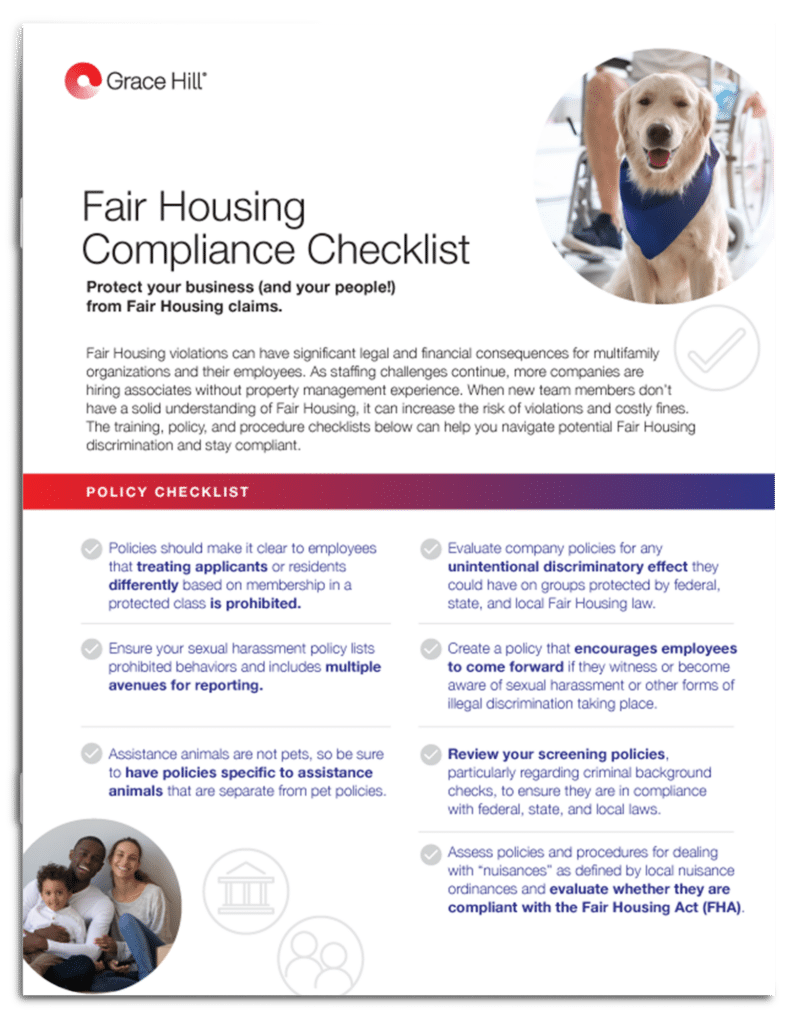
Want to strengthen your fair housing compliance?
Explore Grace Hill’s Fair Housing training courses and protect your team with expert-led education.
More Industry Tools and Insights

Fair Housing Tool Kit (2026 Update)

Onboarding Pathways in PerformanceHQ Preview