
 Customer Support


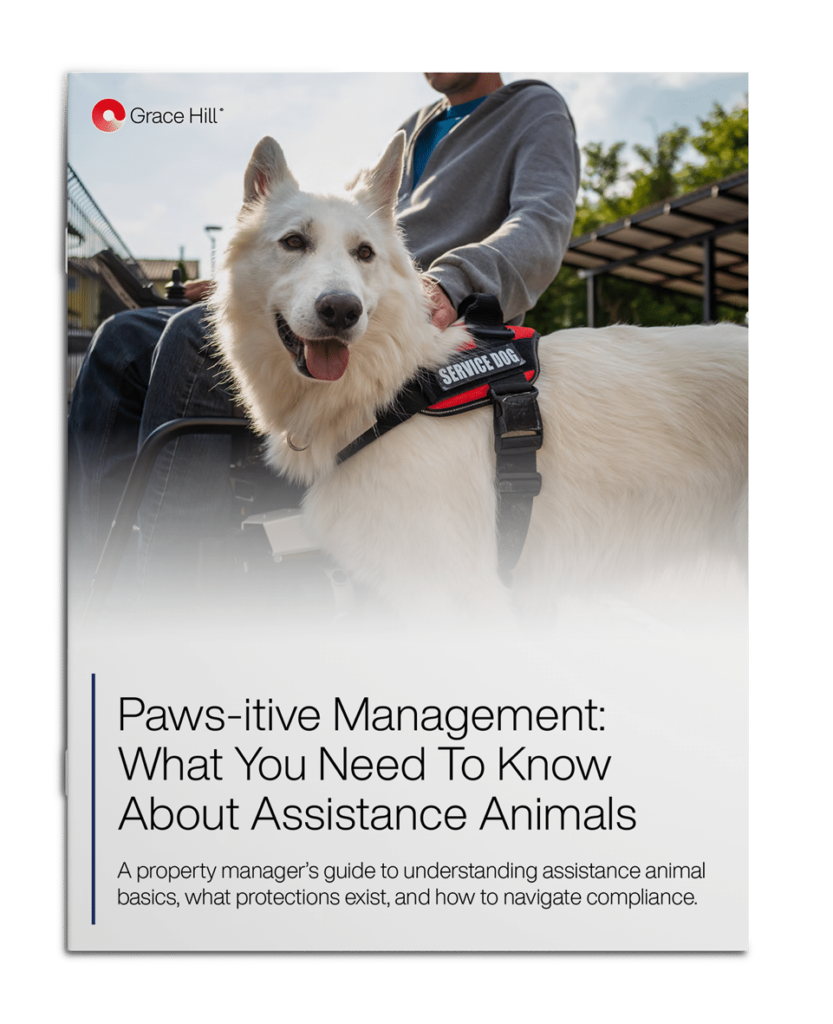
Service animals, emotional support animals — whatever you call them, just don’t call them pets! Navigating Fair Housing laws related to assistance animals can be tricky, and as public awareness grows, management teams must be prepared to handle requests appropriately.
This session focuses on service and assistance animals as reasonable accommodations under Fair Housing laws. Participants will gain a clear understanding of legal definitions, HUD guidance, and best practices for service and emotional support animal accommodation requests.
Learning Objectives
- The legal definition of service and assistance animals under the Fair Housing Act.
- The difference between the Fair Housing Act (FHA) and the Americans with Disabilities Act (ADA) regarding assistance animals.
- Best practices for handling requests, using appropriate language, and ensuring compliance.
Hello. Hello, everyone. It's so good to have you here today. We already have close to two hundred people online. This is so exciting. I think we had over five hundred people register, so this is gonna be a big webinar with lots of great information from our speaker today. It's a full event. So exciting. Look. We're up to, look at that. Getting past the two fifty mark. So super excited. Thank you so much for joining us today to talk about this important and often misunderstood topic of service animals. My name is Krisann Gaiko, and I am with Grace Hill. That's me with my doggies, Minnie and Roxy. My two labs, they are crazy. They love to swim in the pool, and they are spoiled rotten. So let's go ahead and get started today. I wanna do a little bit of housekeeping for the next slide. Here's our agenda. During the presentation, we want you to ask questions. So we'll have q and a at the end if there is time, but as we go along, feel free to pop your questions and do me a favor. It's easier for me to keep track of those questions if you put them in the q and a section and save the chat for chatting about other things that that helps us get to those questions a little easier. We will have our team monitoring, and we'll do our best to get all of your questions answered. So moving along, most of you are probably familiar with Grace Hill already. And you can go to the next slide, Katie. Thank you. You may associate us with industry training, which is what a lot of people associate us with training and policies, but we are so much more than that. Over the past few years, we have increased our technology offerings for the industry, including a very recent acquisition of Reelink video and virtual leasing tools that was this past September. And we have a lot of solutions that improve the performance of your teams, your property, your company. In addition to training and policies, we have mystery shopping, employee and resident surveys, tenant surveys for commercial. And now with Reelink, we also have a full suite of solutions for marketers, including resident surveys, reputation management, and unit level video tours, live tours, and three sixty tours, all with approval workflow. So if you haven't checked out, the Realync features, do that. It's a it's a awesome way to market your property, and increase your, resident retention and shorten your, lease, lead to lease times. Last year, we added Gracie, our AI chatbot, and we've had phenomenal response on that from our customers. Gracie answers policy questions from your team so they don't have to search. So you can just open it up, pop in your question, and Gracie will populate a quick answer for you, which is great when you're working on-site and things get super busy. These solutions all come together in our new PerformanceHQ platform with real time analytics. And coming soon, we're going to expand that to include our new Performance Intelligence Plus product that automatically delivers actionable insights and recommendations. So you can highlight these things to your on-site teams so they can improve and drive elevated performance. So let's go ahead and get started today. I wanna tell you a little bit about our speaker. I have with me today Katie Rigsby. She is a consultant and a multifamily maven. She's got over twenty five years of experience in residential property management. She is a certified apartment portfolio supervisor, certified apartment manager, certified apartment leasing professional, and a licensed Louisiana realtor. She is also the president and CEO of Katie Rigsby Inspires LLC and an NAAEI advanced facilitator. We are so thrilled to have her with us today. I will turn it over to you now, Katie. Thank you so much, Krisann, and thank you to the Grace Hill team for allowing me this opportunity today. I'm so excited to see how many people from all over the country are here today. I saw Texas. I saw New York. I saw Virginia, Washington, California, Tennessee, Illinois. I'm from Louisiana. I'm in New Orleans. Who shout out to all those hudettes, but I'm excited to see all the different people that are here in today's session. Not only is today, an important day because we're talking about one of the biggest topics that we have in fair housing, but it's National Fair Housing Month, and so we're celebrating today. A little bit of what you can expect from today. First and foremost, I'm not an attorney, so I can't give you legal advice. But what I can give you is my experience, the case law that I've studied, and the, my opinion based on what I've learned in the industry and all of the research that I've done. We're gonna learn today the legal definition of what a service animal and an assistant animal is defined as under the Fair Housing Act. We're also going to define the difference between the Americans with Disabilities Act and the Fair Housing Act. A lot of times, those get confused and sometimes the waters get a little muddy, and so we wanna make sure you have some clarity there. And then we're gonna give you some best practices for handling your request for accommodations, making sure that not only you're using the right language, but you're in compliance with the law. We're going to differentiate some today between what is law and what is guidance. I think it's really important to set you up for that right now that there are specific things that we have to do because it's law. And then there's other things that HUD, says, hey. We suggest this. And if you do this, it's likely to keep you in the best position, but it's not necessarily law. So I do wanna be clear about that and share that with you. So why is this topic important? Of all the fair housing topics to talk about today, why did we choose this one? Well, I have some important statistics to share with you. But before I do that, let's take an audience poll. I wanna know what percentage of fair housing complaints do you think were made on the basis of disability discrimination? You can scroll down on the poll. It's launched on your screen. Your options are thirty two point sixty eight percent, forty seven point twelve percent, fifty two point sixty one percent, or none of the above. Hurry. Hurry and get your vote in. You wanna be included here. I see a lot of people putting their numbers in the chat. Okay. You can also click on the on the dot there beside the, multiple choice answers. I'm seeing a lot of fifty two percent in the chat. Why don't we go ahead and close out that poll and see what our responses were? 59% of you said 52.61%. Krisann, this room is full of geniuses because they are right. And those of you who said, 47.12, you came close. I tricked some of you with my none of the above, because some of you are from the school of thought that if they give you none of the above, that must be the answer. So I didn't mean to trick you, but, it is 52.61%. Now I do wanna be clear about the statistics I'm sharing with you today. This is the number of reported complaints from 2023. So the the report that comes out in 2024 is on 2023, and the report about 2024 won't come out until about July of this year. So this is the most updated statistics that we have. In 2023, there were over 34,000 fair housing complaints made to the various HUD agencies. And of those 34,000 complaints, over half of those complaints were on the basis of disability discrimination. Now why is that an important stat for us today? Well, because if we want to reduce the likelihood of a complaint, this is one of the best areas to do that with because we can see that most of those complaints are coming from disability. So I wanna focus on making sure myself and my team is educated in that area. And in fact, of those 52% of those complaints that were based on disability, 47.1 of those were on the basis of someone being denied a reasonable accommodation. And so we're gonna drill that home for you today, make sure everybody's up to par and they're well versed on this topic by the end of this session. There's just a few key terms that I wanna share with you because as we go through today's session, you're gonna want to make sure that you are aware of what these mean, but also specifically the definition of disability, as it's defined under the Fair Housing Act. It's vital that you know this definition because as we start, verifying someone's disability and making sure that our documents are in compliance with the law, this is the definition that they utilize. And so we wanna make sure we have that definition. So a physical or mental impairment that substantially limits one or more, of a person's major life activities. And so then we have to know what is a physical or mental impairment. The way it's defined is there's an array of things that could be a physical or mental impairment. But, essentially, it's anything that would substantially limit one or more major life activities. So a substantial limit to those major life activities. And then you gotta know, well, what's a major life activity? So, again, that's a whole slew of things that could be listed there. But, essentially, if it affects somebody caring for themselves, taking care of themselves, working, walking, talking, those are all things that are covered under the Fair Housing Act definition of disability. And then the last definition that's key for you guys to know, the last key term today is reasonable accommodation. That's what we're talking about today. And I wanna make sure that you guys understand that when it comes to a disability and someone needing some sort of exception to a policy or procedure, that's an accommodation. We also have reasonable modifications. That's when we're actually making physical changes to the property. But today, when we're talking about animals and essentially assistance animals, what this applies to is a reasonable accommodation. That's a change, exception, or an adjustment to a policy. So for instance, your property is a no pet community. You don't allow pets, but someone needs an assistance animal, you would be making an exception or an accommodation to that policy by allowing that animal. So now that we kind of have those basic things under our belt, let's talk about the difference between ADA and FHA. So the ADA is the Americans with Disabilities Act. And while it is not a a housing law, it is a law that applies in general to public places. So the types of housing that are covered under ADA are public entities like state, and governments and also university campuses. But title three of ADA affects public areas and common use areas, and that's where our general housing falls into play. So while the ADA is not a fair housing law, Fair Housing recognizes ADA and says, okay. We're gonna abide by the ADA guidelines, and we're gonna step it up a notch, and we're gonna add some additional guidelines ourselves. And so it's really important to know that the Americans with Disabilities Act is a separate law from the Fair Housing Act. The Fair Housing Act says, hey. If you're a housing provider, you're gonna have to abide by the Fair Housing Act and recognize ADA. So you'll see a little bit of overflow between the two. So the Fair Housing Act essentially applies to all housing, and it pertains to not only common areas, but the interior of the apartments themselves. And, essentially, what it says is that if someone has a disability and needs some sort of accommodation to allow them equal enjoyment or opportunity at your community, then by law, you would have to allow that accommodation provided it's not gonna create a financial or administrative burden. So now that we have a little bit of an understanding of the difference between the Fair Housing Act and the Americans with Disabilities Act, let's dive into ADA a little bit. Let's make sure we have a good understanding about it because the definition of service animal is what's pulled from ADA and used in the Fair Housing Act. So we need to understand what a service animal is. Under the Americans with Disabilities Act, a service animal is a dog that performs a task or is trained to work for a person with a disability. So under the FHA I mean, I'm sorry. Under the ADA, a service animal has to perform a task or do work for an individual. Now service animals are working animals. They are not pets. We can't call them a pet. We can't consider them a pet. And they are required to work or do a task that they've been trained to do. Now the training doesn't have to be done by a professional. Their handler could have trained them, but it's something that they specifically do to assist this person with a disability. Under the Americans with Disabilities Act, it specifically says that a dog whose sole function is to provide comfort or emotional support is not a service animal. Now before you all run away and say, oh, Katie says we don't have to allow an animal if it's not a service animal. That's not what Katie's saying. What Katie's saying is under the Americans with Disabilities Act, emotional support or comfort animals are not service animals. Under FHA, they are assistance animals. So it's really important to know the difference because the way we verify is different. So we wanna make sure we have good clarification there. Now interestingly enough, under the ADA, there is one caveat to that dog rule. There are some special circumstances where a miniature horse may be allowed as a service animal. There's some criteria that have to be met there. Today is not about miniature horses, but I just want you to know that service animals are dogs or in rare circumstances could be a miniature horse. So people with disabilities have the right to train the animals themselves. They're not required to have a a certification. Also, you may be surprised to know that a service animal is not required to wear a vest or have an ID tag that says service animal, and it's not required to have a specific harness. However, the individual who is handling them or utilizing them as their service animal must have them under their control at all times. And, this animal is not exempt from public health requirements or local animal control guidelines. One thing to point out is that some states and municipalities do have registration lists for service animals. Here's the thing about that. By law, if every dog in the area is required to be licensed and have a registration, then that would be the same for a service animal. But you cannot, by law, just make service animals be licensed and registered. So very important to know that difference. And, again, the animal must always be under the owner's control. If it's not harnessed or leashed or tethered because of the person's disability, they have to have, voice control, signal control, or otherwise have some sort of effective control over the animal. So it's really important to understand that the Americans with Disabilities Act has clear definitions of what a service animal is, and that brings us to the Fair Housing Act and what it says about ADA. So I'm gonna share with you a guidance that came out in January of twenty twenty. Some people missed this because something else was going on in January of twenty twenty, if you don't remember. A little thing called COVID. Some kind of deterred or detracted from this. But in twenty twenty, HUD released guidance on how to handle requests for accommodations specifically with assistance animals. And so, I've given you access to this document on my resource page that's on your handout, but, also, you can access this document via the HUD website. But in general, here's what the document says. It's it explains your obligations as housing providers. It provides the guidelines for the two different types of assistance animals recognized under the Fair Housing Act, and it talks about the fact that persons with disabilities do have the right to request a reasonable accommodation. And then it gives you some guidance for assessing those requests. If you have not read this document, I highly recommend you download this document today and you begin to review it. It's great bathroom material, guys, next time you're in there for a while. The other thing I would encourage you to do is the National Apartment Association has a ESA toolkit that you can purchase. It's inexpensive, but it provides really great resources. There's some sample documents and things in there. And, of course, Grace Hill offers some compliance training and things of that nature. So you have a lot of resources out there available to you that you want to do your own research and make sure you're aware of the laws. So under the Fair Housing Act, there are two types of assistance animals. So the Fair Housing Act uses the the term assistance animals as an umbrella term, and that umbrella term includes service animals as defined by the ADA and then all the other animals that are accepted that either perform work, or provide assistance such as comfort or emotional support to a person with disabilities. So under the Fair Housing Act, those are all covered, and we call them assistance animals. So you'll see me or hear me use that term as an umbrella term today. So doggone it. Do I have to approve a service or assistant animal at a no pet community? Well, the short answer is yes. However, the the person has to qualify for that animal. Right? So, yes, if you have a no pet policy and this person is disabled and has a disability related need for the animal, you would need to make an accommodation or an exception to that policy. So let's dive into this document a little bit and talk about some of the things that are required for verification of a service animal. Now remember, ADA defines a service animal as a dog. And so for this guidance on approving or reviewing a service animal, that's what we're talking about. So the first step to determining if the animal is a service animal is is it a dog? You know, if it happens to be a miniature horse, you need to call your attorney and go through the special processes of of verifying that that's a legitimate, request. But in general, is it a dog? If the animal is a dog, then we go on to our next step of verifying the next phase of a service animal. If the animal is not a dog, that does not mean that you deny the request for an accommodation. What it means is it's not a service animal, and so it's going to possibly be one of the other types of assistance animals, but we can't call it a service animal. The second step is if it is a dog, then we ask ourselves, is it readily apparent that the dog is trained to do work or perform a task for the benefit of a person with disability? So can I see or have I witnessed or am I aware that this animal performs a task or works for the individual? Now here's the thing about a service animal. You're limited on the verification process, which is why it's really important to determine if this is a service animal because service animal has limited verification. All the other types of assistance animals, you have more opportunity for verification. So here's what the guidance says from HUD. Now remember, this guidance from twenty twenty is not law, but it is guidance to tell you, hey. If you're doing these things, you should be well within the law. Right? So we wanna pay attention to that guidance. So it describes in this document what it means for an animal to perform a task or to do work. It gives you some examples. And then it goes on to tell you what it means that they are actually working. So if there's at least one action that the dog is trained to take to help them as a person with a disability, it is considered a service animal. However, under ADA, if they haven't if they're not trained to perform a task or work and they're only there for emotional support or comfort, it's not a service animal, but it could be one of these other animals. Okay? So we just wanna make sure we're very clear on that. So if we've determined that, the person says that it's a service animal and it is a dog, there's a couple of questions that we can ask. Really, it's just two two questions that we can ask if they're telling us it's a service animal. The first question is, is the animal required because of a disability? And number two, what work or task has the animal been trained to perform to assist you with that disability? And here's the thing. If the answer to either one of these questions is yes, it has been trained and it's for a disability, we need to grant the request for the accommodation for a service animal, and the guidance says that no further inquiries should be made. And the reason it says that is because under the ADA, those are the guidelines. And so the Fair Housing Act is trying to honor that, and HUD is saying, look. That's gonna keep you out of the most trouble. Again, this is guidance, but I just wanna be clear. Under the ADA, the ADA says these are the two questions you can ask. And so the Fair Housing Act and HUD are saying or HUD is saying that that's we should honor that. So if they answer yes, you should grant the request no further documentation. If the answer to either one of these questions is no, then you do not have to allow it as a service animal, but it doesn't deny them. It just says, okay. Now we're gonna look at it as a possible assistance animal where you are able to get more verification. Okay? So service animal provides limited verification under the Americans with Disabilities Act. Fair Housing Act recognizes the Americans with Disabilities Act, and you're encouraged to follow that guideline. And then in general, the ADA does not have specific penalties for service animal fraud. However, there are some states, and, of course, I can't list them all. Right? But there are some states that have penalties for someone maybe lying about a service animal or maybe somebody putting an animal in a vest or or putting false tags on them. So there are states that have these things in place where it could be a misdemeanor. They could have fines. Some of them even have jail time, if someone is found violating or lying about a service animal. So you need to know the laws in your specific state so that way you can know maybe what kind of defense you have and really how do you even bring that up or prove that. Right? So that might be something to to to talk about it too with an attorney. You don't just wanna start accusing people of lying about their service animals because that can get you into trouble as well. But you definitely wanna know the laws in your area. So I wanna ask you guys. Y'all have been active in the chat. I can see it already, and I know that they are banking those questions for later. But I wanna ask you guys, can you charge an additional deposit, pet rent, or pet fee for a service or assistance animal? Put it in the chat. Oh, Krisann. Oh my gosh. Like I said, they're all geniuses. These are well trained guys. Look at that. Somebody said apparently now. They are well convinced at this point. Very good, guys. So here's the thing. Remember that once an animal is deemed a service or an assistance animal, it is no longer considered a pet. Right? And so if we don't have a pet, we don't charge pet rent. We don't charge pet fees. So we gotta keep in mind that once we've deemed that this animal is necessary for someone's disability, it's no longer a pet, which is why we encourage everyone to have animal addendums and not pet addendums. Because while we can't charge pet rent, pet fees, and things like that, we can require that they clean up after their animal, that their animal is not aggressive or a nuisance. Those are all things that that that can be required. But if I have a service or an assistance animal and and you have a pet addendum, I that doesn't apply to me. I don't have a pet. So we wanna make sure we have animal addendums so that the guidelines that we want for all animals are applied to all animals, not just pets. Very good, guys. So now that we know what the Americans with Disabilities Act defines as a service animal, let's look at Fair Housing Act and what it defines as an assistance animal. So remember, this is an umbrella term, and so it includes service animals that work and perform tasks, but it also includes any other animal that assists or provides therapeutic emotional support for individuals with disabilities. So this is where you get those additional animals. So for instance, people may call them service animals. They may call them emotional support animals. They may call them a guide dog, a companion animal, a therapy animal, a comfort animal, a psychiatric service animal, whatever they call it, you better not call it a pet. Because once it's been deemed that this animal is necessary for someone's disability and there's a disability related need connected to that animal, it is no longer a pet. So very important to remember that. Reasonable accommodations, do you have to be made, to land and zoning laws, homeowner association rules, coop rules, condominium rules. So if someone knee is in need of assistance animal and housing, the fair housing law does state that accommodations may have to be made to those guidelines. Additionally, assistance animals are not required to have any kind of formal training or certifications. Again, just like the Americans with Disabilities Act, they can be trained by their handlers or, again, emotional support comfort animals, they're not trained. Look. Guys, I can't train my boyfriend to be emotionally supportive. How are we gonna train an animal to be emotionally supportive? It just doesn't happen. So it's not required by law. A person with a disability is responsible for caring for the animal, providing veterinary care, feeding them, and also having them under their control. Now if the person with disability is unable to feed, maintain, care for the animal, they could have someone else do it for them. But this the animal still has to be cared for and maintained. So let's talk about the HUD guidance from twenty twenty regarding, further assessing assistance animals. So we've identified whether this was a service animal or not. So now let's talk about what happens when it's not a service animal, but we're not quite sure what we should do next. So we deem that this animal is not a service animal. So now we're gonna ask ourselves, does the person have an observable disability, or do you have working knowledge of a disability? So maybe you can't see the disability, but you're aware of it because of you've witnessed it or because, you have knowledge of it because somebody else has told you. They maybe they have a, a person, like, a caregiver or somebody who is with them often. That would be working knowledge. If someone's disability is observable or we're aware of it, we have working knowledge of it, the law states that that is verification enough. So there's no need for me to verify that someone in a wheelchair is is disabled. I can see that. Right? So we wanna make sure that we understand that if the if the disability is observable, no verification on the disability should be done. Now I might be able to to see their disability but not see the connection between their disability and this animal. I can verify the need for the animal. But if I can see the disability or I'm aware of the disability, that's verification enough. We should never be documenting the nature of someone's disability, though. We wanna refrain from asking people what their disability is and just sticking to that definition of disability under the Fair Housing Act and asking them if they meet that definition. So let's say that, they do not have an observable disability. The question then becomes, well, have they asked for this accommodation? Remember that just because someone has a disability doesn't mean that we have to make an accommodation if they don't ask for it. Right? So we wanna make sure and they may not use the word accommodation, but they may be saying, I have a forty pound dog. You only allow twenty, and I have a disability. They don't have to use the word accommodation, in order for you to start that process. So if they haven't requested to for you to make an exception or to allow this animal, then you move on. But if they have requested it, then you can't and you can't observe their disability. Now you can get verification for their disability. And there's a couple of different things that HUD says would be acceptable as verification. Now remember, we're looking at their guidance now. So, of course, if someone's determined disabled by a federal or state agency, if they have a letter stating that they're disabled then from from a state agency, then that's proof enough. If they're getting disability benefits, that's proof. However, just because they're not getting disability, doesn't mean they're not disabled. So another way you can verify it is confirming the disability with a health care professional, like a physician, optometrist, psychiatrist, psychologist, a nurse practitioner. These are all people who can provide that verification. Now let me be very clear. What happens more often than not is that people attend these sessions, and then they start doing what they think they should be doing, which is great. But the problem is not everybody with their company is doing the same thing, and their company doesn't necessarily know they're doing it. So here's what needs to happen. Every company needs to have a written policy on how do we handle request for accommodations and modifications, and when do we verify and what do we verify so that Krisann isn't being, you know, empathetic Emily going, oh, I'm so I feel so bad for you and just giving them whatever they want, And Jennifer's being, you know, a stickler and saying, oh, no. I have to have verification here, here, here, and here. And, you know, being a a researcher trying to determine if it's legitimate or not. So your company has every right to do a verification process, but they better have that verification process in writing in both their employees and the person's requesting the accommodation or modification better know what that process is. So we wanna make that very, very clear. If you work for a company who says, look. If somebody says that they're disabled, just just document it in the file and move on, then that's perfectly legal. If you work for a company that says, listen. If it's not observable, I want verification and I wanna verify that health care provider. That's perfectly legal as well. And then you have owners in between. But the problem is you need to know which one you work for and it needs to be in writing. Very, very important. So if the recurse if the person requesting the accommodation is, seeking the I'm sorry. If the person has has not made the the request, then there's nothing to do. But if they did make the request and you can't see that their disability is observable, you can verify that it's deserve observable, and you can ask them to go through the verification process. But you need to know what that verification process is. You must have a process in place. So did they provide you with something that that verifies that this animal is necessary for their disability? If they haven't provided that, then you have every right to ask for something. So the guidance goes into okay. Well, what would be reasonable information for me to obtain? Supporting information from a licensed health care professional, someone who, who is aware and has worked with them, but also prove, verification that not only do they meet the definition of disabled, but there's a connection between their disability and what and the animal they're requesting. So if that's not clear visually, then you have every right to to document that and verify that. Now some of you are gonna say, well, what about the letters from the Internet? Well, here's the thing. What the guidance from HUD says is that if a person brings you in a certificate or registration or document from the Internet from a site that you know is just one of those pay to play kind of sites, What the guidance says is that you should not deny the request solely on that document, but that you have every right to go further with your verification. So it shouldn't be an automatic denial. It should be, well, wait a second. We need more information about this. So what are some of the things that you can ask for, or or to verify this information? Number one, if they give you something on letterhead, confirm the letterhead because we can all I can make it twelve different letterheads in about ten minutes. Right? So confirm the letterhead. Make sure that the information for the health care provider is on the document, their contact information, their signature, and even their licensing number. And you could even look up their license at at with the local registry, the health mental health board, or the medical board in your area to determine that that license is legitimate if that's your company policy. What you don't want is somebody just in your office taking the letter as proof and another person going three steps further and can and verifying licenses, and then you're having a problem because you're not being consistent. So we wanna make sure that our companies know what we're doing and that that that's the process they want us to use. So the housing provider should assist the person in completing the paperwork and doing the process for, getting an accommodation. If someone comes to you and says, hey. I have this animal, and I wanna have it in my home, and you say, okay. Well, that's gonna be a pet fee, and we gotta start a pet lease. And they say, oh, well, it's it's my emotional support animal, then you go, okay. Well, we have a process for that, and your it's your job to help guide them through that process. And that's when you're gonna share with them, hey. These are the things that we're gonna look for, and this is what's acceptable. So you always want to have that guidance so that way they know what's coming and there's understanding on both sides. Make sure that you guys have something in writing for both your on-site teams and the persons requesting a accommodation. Alright. Here's another question for you, smarty pants. So can you deny a request because it was not submitted in writing or because they did not use your specific forms? I love this. Y'all are so smart. Answers. Yep. Y'all are so smart. You're right. You're right. Here's the thing. A request can be in writing or orally. And, also, the request, while you might have your verification process and you might have standard template and forms, which I highly recommend for consistency within your company. You cannot deny someone's request because they did not complete your form. Now you can ask they still have to go through a verification process, but if they bring a letter from the doctor and has all the information on it and you're able to verify it through your process, then because they didn't fill out your form is not a reason to deny their request. Anyone in your office can fill out the form on their behalf, make a note that you filled it out, and here's the information that they provided. So you definitely wanna have a policy in place. It is recommended that you have standard forms. But, again, I can't deny someone's request because they didn't fill out my form. And any request can be verbal or written. And it doesn't have to be a verbal request to your manager or office personnel. If you have a maintenance technician who's working in an apartment and a resident mentions that they need some sort of accommodation, they've started that process, and your technician needs to report it to the office immediately. So it's recommended that people who are seeking reasonable accommodations for support animals, provide information from a health care provider, provided your company policy is that you require this, if the disability is not observable or the disability related need is not seen. You don't see a connection there for what they're asking. So what types of information should you ask for in this verification? Number one, you should have the Fair Housing Act's definition of disability on that documentation, and you should ask them, does this person meet this definition? The other thing is is, you can ask them whether the patient's impairment substantially limits at least one or more major life activities. Again, I can't ask them the nature of the disability, but I can ask them if they have a physical or mental impairment and if it limits them substantially. And then you can ask whether the patient needs an animal because it provides work, because it's emotional support. You can ask them what the relationship is between what the, the disability and the animal that they're requesting. And then, of course, you can ask for the health care provider's signature, the date of the document, the contact information, and any professional licensing information. Let me say this. Years and years and years ago, we used to have a question on this form saying, would you testify in court? You should not have that on your verification forms any longer. That has been proven to get people in trouble. If you do have that on your form, the fact if a doctor or health care provider says that they wouldn't testify in court is not a reason to deny a request. Let me just be very clear for that because I know that there's still some out there. So if the person requests something that's not the typical animal that would be kept in the home, like a dog if it's not a dog, a cat, a bird, rabbit, hamster, gerbil, then you could go further with your verification and ask when was the last time that this this physician or health care provider consulted with the patient? What are the unique circumstances that require this unique animal? And does the health care professional have reliable information about this specific animal or that they specifically recommend this type of animal because of this person's disability? This is good, Katie. Thank you. There were lots of questions about that. I was like, she's probably gonna get to it. Yes. Yes. Okay. Good. Because here we go. Doggone it. Do I have to allow assistance animal that's not a cat or dog? Okay. Here we go. The guidance actually talks about this. Now a lot of companies, they have policies where they charge a pet fee for, like, cat and dog, but they don't allow birds or they don't allow reptiles. Or maybe they allow cat, dog, bird, but then they don't allow, you know, rodents and things of that nature. So let's talk about the guidance. Now remember, guidance, but I think we should pay close attention to it. It specifically addresses this. It says, look, if an animal is typically kept in a household, if it's typically domesticated, then you should allow it. So that would be anything from small birds, dogs, cats, to gerbils, rats, fish, turtles, any other small domesticated animal traditionally kept in the home. However, if someone's asking for the way they they they stated is a unique animal. If someone's asking for a unique animal, you shouldn't just automatically deny it. So if they want their pig or their chicken or whatever, you shouldn't just automatically deny it. What you should do is learn more about why they need that particular animal because sometimes people do have specific allergies that don't allow them to have a traditional animal in their home. Sometimes, for instance, that's why ADA recognizes miniature horses in some cases because some people are allergic to dogs. Horses live longer than dogs, and miniature horses can can be trained very easily just like a dog can. So there's some certain circumstances. Capuchin monkeys are a lot of times used for persons who are paraplegic because they'll help, in getting things and doing tasks. And so there are times when these unique animals are necessary. And so just extended verification is needed. And, again, I would have good legal counsel that I am referring back to so that way we never deny the request immediately. We always see is there something else that can be done? Is there another way that we can work with them? And that's kind of this big final, you know, point for this section is before you deny a reasonable accommodation request, you should always engage in what they call an interactive process. And so the way that the law states it is they use that term interactive process. It just means conversation. We're back and forth that we're engaging with them, that we're not just saying, no. We don't do that. No. You can't have a pet. No. We don't allow that type of breed. That you are actually saying, okay. Tell me more about your situation. Why is it that you need this specific animal? And let's talk about it. And sometimes we there's other things that we can offer, and sometimes we do have to make exceptions. I love this meme. The point of this is that because we have people from all over the nation, right, there are some areas of the country that are more landlord friendly. There are some areas of the country that are more tenant friendly. And so while there's guidance, the the legal counsel in your area should know how the judges and juries typically adjudicate over cases. And so getting a good attorney in your area guys, Facebook is not the place to go for legal advice. Okay? Don't go there because the people in your area may not know what's going on in this other area. So we wanna make sure that we're going to the right sources when it comes to things like this because it can get us into a lot of trouble. Alright. So is it possible for someone to have a pet and an assistance animal? What do you guys think? Absolutely. Right? Because if a person is deemed disabled and they have a disability relate related need for that animal, it's no longer a pet. It's an assistance animal or service animal. And a pet is something I keep for my entertainment and, for my own enjoyment. Right? And so it is definitely possible for the you to have both an assistance animal and a pet. Now I'm go I see Ricardo says, but we can charge for the pet. Right? Yes, Ricardo. You can charge for the pet. So you can't charge for the assistance or service animal, but you can charge for the pet. Absolutely. And you're not gonna like what I'm about to what I'm about to say, but the law does not limit the number of assistance animals someone might have. So some of the best practices for that so let's say that someone has three cats and they say that they're all their, assistance animals. What the guidance says is I can't deny them because you can't have more than one. That's not what the law says. The law says that you can get verification for each. And so, again, your company needs to have a written policy, but my in my opinion, what you do is you have if you got three cats, you got three documents. And this this document says, you know, missus Smith in apartment two zero one has requested this assistance animal. Can you tell me, does she meet the definition of disabled? Does she have a disability related need for this animal? And you go through that process. And so okay. Muffy is approved. But then we send over another form. We say, okay. Miss Smith has Muffy, and now she's asking for Duffy. What is it that that Duffy does that Muffy doesn't do? And then, okay, we're gonna send it over for Fluffy. What is it that Fluffy does that Muffy and Duffy don't do? So there is a verification process, but your company has to have that policy. So if someone needs a reasonable accommodation, to give them equal enjoyment and access, you cannot deny it unless you can prove in a court of law that it's gonna create an administrative or financial burden, an extreme administrative or And I did see earlier somebody said, how do you signify that? There's no number. There's no number. So the answer is you better have significant proof that if you did this, it would put you in great jeopardy. You know, if you're a, one of the questions that sometimes comes up is about insurance. Well, my insurance provider says I can't have this kind of breed of animal. Well, the law states that we have to comply with these federal guidelines. And so, number one, this day and age, you can usually talk to your insurer and you can, have it notated on your policy that this is an assistance animal and you provide that information to your insurance provider. But, also, if you can prove that your company the insurance company was gonna drop you and making a change to another company would be a significant difference, then you might have a leg to stand on. But I would I would be careful denying for an administrative or financial burden before I speak to local legal counsel. It's it's just really hard to prove that you couldn't do something else to accommodate them. So you do have to consider a request for more than one animal. Also, the person does not have to make the request before they get the animal. They could always make it after they have the animal and even after they move in. Even, let's say, you did an inspection on an apartment and you found an unauthorized animal. You send them that letter and they ignore it. You send them another letter, they ignore it. You end up placing them under eviction for lease violation. And now during the eviction process, they say, wait a second. This is an assistance animal. You have to stop the eviction process and begin the interactive process of determining, is this an assistance animal that we need to make an accommodation for? And, again, it can be written or orally. The other thing, is that the request does not have to be made by the person who needs the animal. They could have a caregiver or someone who is living with them or somebody who is their legal guardian or authorized representation representative that can make a request on their behalf. You cannot charge a fee for processing a reasonable accommodation request. And, again, you can't charge pet fees, deposits, pet rent for these animals. Essentially, you can't make it more expensive for someone with a disability to have access to your property than the, typical average resident. Housing providers can't limit the breed or size of the animal, and you might have breed restrictions on your property, but that's where an accommodation comes in. Now if you have proof that this particular animal, not this breed, but this particular animal has been a problem in the past, then you need to see if you can work out how we can prevent that from happening, or you may have, the ability to deny the animal. But you'd have to have proof that that particular animal caused a problem, and there wasn't something else that could be done to help prevent that problem. Alright. And we're gonna wrap it up with your owner's rights. We've talked a lot about the things that you can't do, so let's talk about the things that you can do. So you can have a verification process for accommodations and modifications, but it should be in writing and everybody needs to know about it. You can require the animal owner have control over the animal at all times. You can hold them financially responsible for damages caused by the animal. You can evict the animal owner based on a nuisance or rule violation. But, again, you better make sure that you've done everything you can to work out some other options, before doing that. And you can deny the request if they do not meet the definition of disabled or have a disability related need or, again, if you have extreme proof that it's gonna create an undue financial or administrative burden. So, as we wrap up today, I did wanna share with you guys this is all about animals, but if you want some additional tips from me, I can provide you with five tips for social media marketing if you text the word motivate to the number five five four four four. I'm gonna turn it back over to Krisann because I know we have some questions. And so, Krisann, it's all you. Yeah. You know, I I think you ended up I've I have been scanning through both the chat and the q and a. It looks like you've handled the majority of the questions at some point throughout the you picked up a lot in that last part about dog you know, a dog that's not on the leash, not picking up, making you know, all the violations that handled a lot of those questions. One of the things that I've seen a couple of questions come in around the if it's someone else's emotional support. So I have a friend that's coming over. This is their emotional support or service animal. Also, someone said if they wanted, an animal to be able to come into the department, they've got an ESA, but it's for their daughter who's not on the lease. How would we address something like that? Sure. So there's kinda two questions jumbled up in there. So number one, if someone's bringing a service animal onto the property, remember, there's only two questions we can ask. Is this, is this animal necessary for disability and what work or task does it perform for you? If it's deemed a service animal, game over. There's no more. If it is not a service animal, but they're saying it's an assistance animal, emotional support animal, something of that nature, then the next thing would, to remember is that the law does say that, people have to have what's called visit-ability, meaning that I have to be able to allow my friends and family to visit my residence and so or their friends and family to visit the residence. And so if someone if you have someone who's bringing an animal into the apartment and you're like, hey. We don't allow animals unless you've signed a pet lease, and they're like, oh, well, this is the assistance animal. You have every right to go through that verification process, but you would need to allow them to have the animal because if they're if they're necessary for someone's disability. You know, Krisann, I like to say it like this. An assistance animal considered it like an extension of someone's body. Right? And so if I, had lost my leg and I had a, prosthetic leg, you wouldn't charge me extra for it. You wouldn't tell me I couldn't take my leg certain places with me. Right? So once you deem that this person has a disability and they have a disability related need for this animal, then you allow it. You allow it. Right. That's a good point to remember. And then one more thing. I've seen a few questions come in about if they've if they've have brought this animal in and now they're coming back. So let's say they've lived there for a while. They paid their pet deposit. Now they're coming back saying, this is an emotional support animal. Do you have to refund the fee right then? The fees that you've charged. Yeah. That's up for debate. That's up for debate. I in my opinion, best practice would be to refund a deposit if they've paid that. If it was a nonrefundable fee, then in my opinion, it would be that they they pay that knowingly and willingly. And so that would be a no, but I would always check with my local legal counsel. Here's the thing. Owners have what's called a threshold of liability. Is it worth me keeping this three hundred, five hundred dollars to to just be like, no. It wasn't a pet. It was a pet when you moved in and now it's something different. Or do I wanna risk denying that and being sued for Right. Hundreds of thousands, if not millions of dollars. So that's that's an ownership decision and get legal counsel. Yeah. And as a supervisor in the past, I would have said, well, go walk the unit first. Yeah. And I I can help you make that decision real easy because the unit looks nice. I'm gonna go fine. Just do the refund. It's not a big deal. If it's trash, then I'm probably gonna call the attorney and go, okay. We might have a problem. Yeah. Yeah. Anyway, we are this has been great. I did put something in the chat. We're gonna put together, some frequently asked questions at to to be distributed after this. So, frequently asked questions at to to be distributed after this, so stay tuned for more. If you have not registered, we have our performance summit coming up in October. It's gonna be so much fun in Fort Worth. We're gonna do all the fun Fort Worth cowboy things. So, you've got till May thirty first to get your early bird registration, so do that. It's gonna be great. We're gonna have keynote speakers, fun entertainment events, lots of education and networking, so we would love to have you there. And the next slide I'm gonna tell you about, we are giving away, you because you joined today, you're entered to win a customized coaching consulting session with Sue Geier, foundation of Thrive for Success Consulting. She's an executive coach, communications consultant, and has a ton of experience. Sue actually coaches me, and she has helped me a lot with my communication and working through various things. So this is one winner will meet with her. Examples to consider include executive coaching for six months, for one person, a leadership team that you can work with. She works with our team too. The value is ten thousand dollars. So thank you so much. And then don't forget, we have our next customer, webinar that we do where we come in come on and tell you about all the things that are coming, July twenty ninth. And please, please, if you're at these upcoming events, come and stop by and see us. We would love to see you and, just visit with you about all things related to property management. Thank you so much for attending, everyone. Thank you, everyone. Thank you, Katie. It was great. Yikes. Thank you. Bye. Bye bye.
Our Speaker

Katie Rigsby
President & CEO | Katie Rigsby Inspires, LLC
Katie Rigsby, CAPS, CAM, CALP, is a multifamily maven with 25 years of experience in residential property management. She has held roles ranging from leasing professional and property manager to multisite supervisor and senior executive, overseeing a multimillion-dollar budget, a team of 200, and an extensive real estate portfolio. As a Certified Apartment Portfolio Supervisor, Certified Apartment Manager, Certified Apartment Leasing Professional, and licensed Louisiana Realtor, Katie is dedicated to advancing industry education. She contributes to the industry as an NAAEI Advanced Facilitator and by serving on local and national association committees.
As the President and CEO of Katie Rigsby Inspires, LLC, she provides consulting and training to help property management professionals excel in customer service, sales, marketing, leadership, and Fair Housing compliance. Known for her engaging and humorous approach, she delivers impactful learning experiences designed to educate and inspire.
Stay Compliant & Informed – Explore Our Fair Housing Protection Solutions Now!
More Industry Tools and Insights
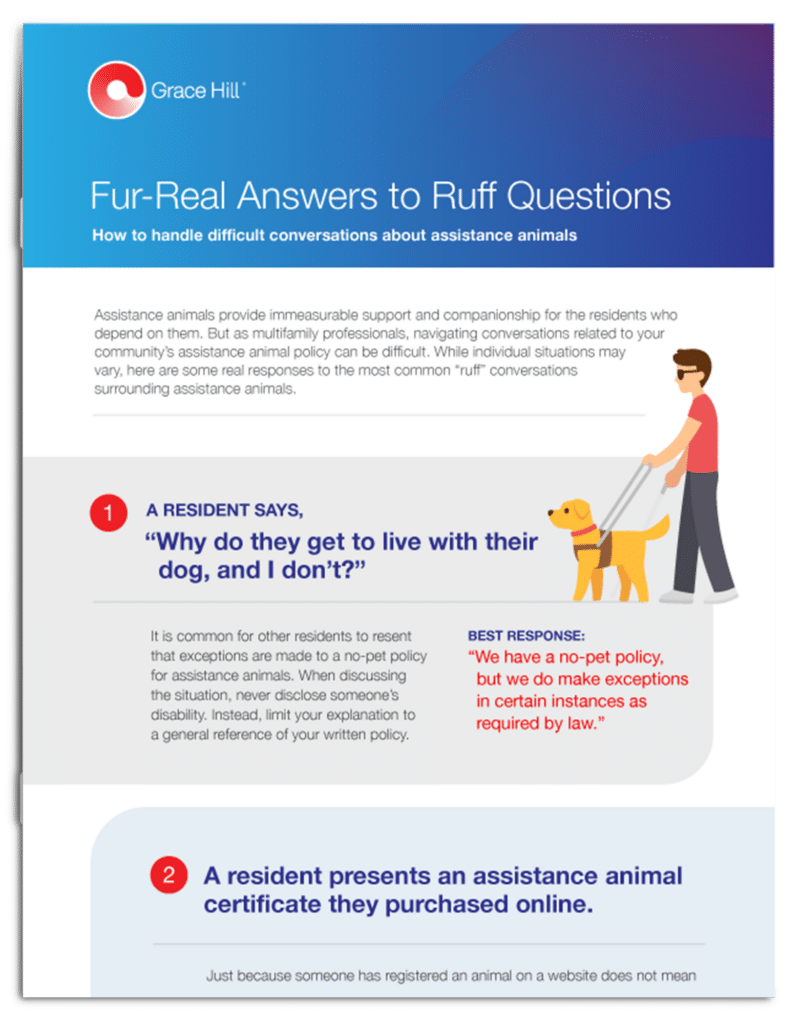
Fur-Real Answers to Ruff Questions