
 Customer Support


Join us for an engaging and candid conversation with Kelly Agent, Senior Vice President of Property Management at Griffin Partners. During her fascinating career journey, which has taken her from the Department of Defense to leading property management and engineering across multiple states, Kelly will share her experiences, lessons learned, and innovative approaches to tenant satisfaction and team building.
Learning Objectives:
- Understand effective leadership strategies in commercial real estate management and learn how to apply them to enhance team performance and engagement.
- Gain insights into innovative tenant engagement practices and discover methods to improve tenant satisfaction and retention.
- Explore practical approaches to overcoming challenges in property management from hearing about Kelly Agent's diverse career experiences.
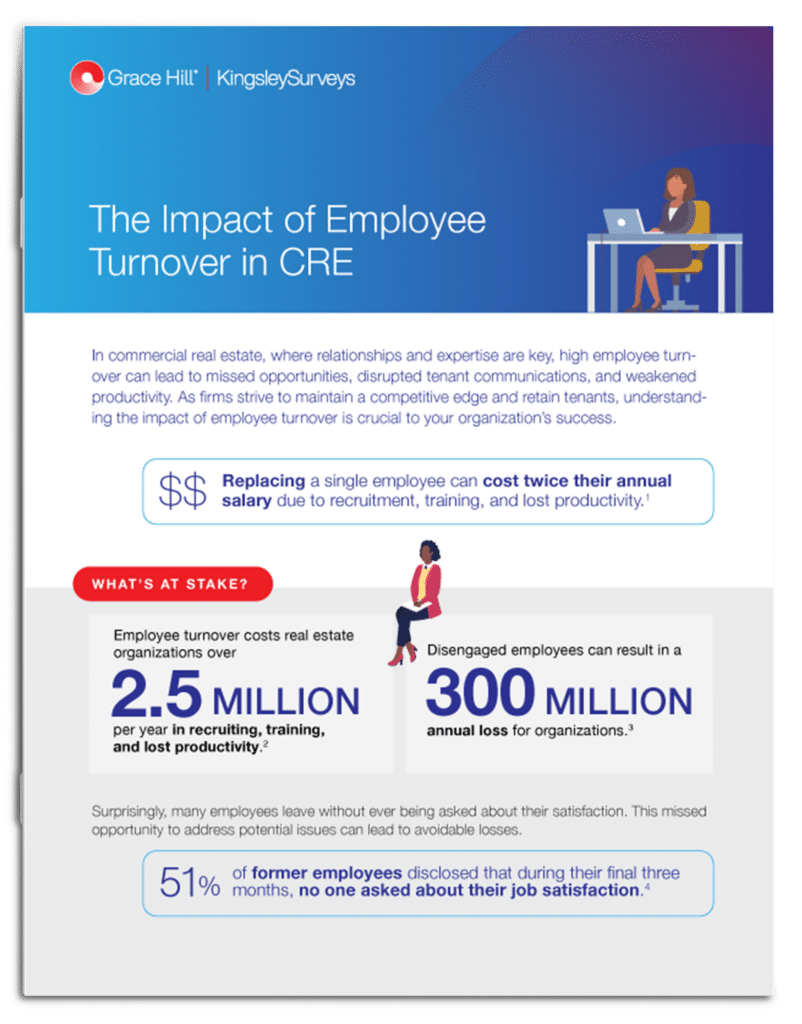
Hi, everyone. Alright. I can see that participant chat is filling up, so I'm gonna get everyone a second to get logged in. Thank you for your patience while we're getting started today. Alright. Hi, and welcome everyone to innovative leadership and tenant engagement strategies with Kelly Agent. My name is Jen Tindall, and I am the VP of strategic insights here at Grace Hill. So that's me. KingsleySurveys is one of our products and one of my personal favorite products that we have. So we're gonna talk a little bit more about that later today. But first, we have so much to cover. So what all are we gonna talk about? Well, first and foremost, we have the most incredible guest today, Kelly Agent. And we're going to spend pretty much all of our time today talking about leadership and tenant engagement based off of her deep experience in commercial real estate property management. I am so excited for you all to hear some of her best practices and tips from just the years of leadership that she has, truly a wealth of knowledge. Then we will briefly talk about what we do here with KingsleySurveys at Grace Hill. And if at any point during today's webinar you want to learn more about Grace Hill or Kingsley surveys, just type the word engagement in the chat. So the word is engagement. Type it in if you wanna learn more. We will save time at the end today for q and a, but please feel free to interrupt us with questions. It's way more fun, trust me, as a presenter to have folks interrupting with questions. So go ahead do that. You can post them in the chat. There's also a q and a function as part of Zoom, so you can use that feature as well. We will happily interrupt ourselves, answer those questions. Last but not least, we do have a few Grace Hill announcements, including the chance to win a prize valued at over ten thousand dollars. Ten thousand dollars, you guys. So I am really excited to share that with you later on. Definitely stick around to learn more. Alright. So for those of you who don't know her, Kelly Agent is the senior vice president of property management for Griffin Partners. She oversees the company's property management and engineering operations throughout Texas, North Carolina, Colorado, and Tennessee. So she has a lot of the US covered. And prior to joining Griffin in twenty twenty two, Kelly worked in several commercial real estate roles for over fifteen years y'all. So like I said, a wealth of leadership experience. She led operations and teams across the country in Washington, DC, Chicago, and Indianapolis. Kelly has both her bachelor's of business administration and her MBA from Mississippi State University. Alright. With that, we are working to get Kelly on. She had just a couple of technical difficulties as these things tend to happen. That is just how it goes. So give me one second to see if we have got her online yet. And if not, we will call her in. So give me one minute with that intro. I know you guys are all probably sitting on pins and needles. Excited to hear from her. I know I am. Alright. Alright. Give me one moment. I'm gonna get Kelly on the phone here. Alright, everyone. I have Kelly agent here on the phone with me. So we're gonna keep her image up on the screen so that you know it's her talking here. And I already gave your intro, Kelly, your background, so everyone is is just very excited. Like I said, sitting on pins and needles. Can't wait to hear from you. So I've got the first question that I wanted to ask you is because your career path is just so interesting. It's fascinating to me. From the Department of Defense to Griffin Partners now, you had stops in Chicago, Houston, and even I remember when we were talking, you spent some time in Alaska too. So for our listeners who may not know you, can you tell us what brought you to your current role as SVP of property management? Absolutely. So hi, everybody. It's so nice to talk to you guys. I'm so sorry. I was having some technical difficulties. So I, I I went to grad school. And after I went through grad school, I married an army officer. And we were stationed in Alaska, and I my whole plan in my career was I was gonna do marketing. So I started off in marketing for the army and did that for about two and a half years. And my father-in-law ended up getting sick, and so we moved back to Mississippi, which is where I am from originally and could not find a job in marketing, ended up taking a position in real estate kind of by accident. I started as an asset manager for an industrial REIT there in Jackson, Mississippi and did that for about two and a half years. I I loved being involved with the financials and really doing analysis for the company, but part of my role there was also just to kind of oversee a small portfolio of warehouses. And that's really where I developed my love for, for property management and really decided from that point on, I was more interested in property management than I was being buried in numbers all day. So, so yeah. So I I ended up doing that, and, and that's really where I got my start from there. With my husband's job, we've moved a lot. So our assignment was to move to Indianapolis, and so I I ended up, as property manager for a class a, high rise there in downtown Indy and got started there and had a wonderful mentor and really from that point on knew that eventually I wanted to lead a property management team. And, that's really kind of kind of how I, got started and and ended up with Griffin Partners through a a multitude of moves and and kind of career changes. But, yeah, it's it's been a wonderful, a wonderful, very portable career, I would have to say. I love that. I love that term portable too. That's a fun one. I mean, it's it's a nonlinear journey, which I feel like most people who end up in this path, it's because of some unexpected twists and turns. So I did wanna ask just given that you did have this nonlinear career path, at least at first, thinking you were gonna end up in marketing and then moving around quite a bit. What was the most unexpected part of your your journey, your career so far? So, I would say so just from a personal perspective, not long after we moved to Houston, which now was about, seven years ago, almost eight years ago, I ended up getting diagnosed with cancer. And, talk about throwing your whole life into a tailspin. I ended up having to take disability for about a year and a half, and I was out just due to treatments and surgeries. And, of course, like, during that time, I'm like, what does this mean, like, for my job, for my work life? And I, at that point in time, worked for a fantastic company who, even after the year and a half, they they gave me a wonderful assignment and a new development. And I ended up working for them for about three more years and really thought that I was gonna be with them for the rest of my career, hope that I was anyway. And I think we we've probably all kind of been at that point and realized, well, gosh. You know? I I want to grow here, but if there's no opportunities for me to grow here, what am I going to do? And then that meant that I was gonna have to take a leap. And then I would say kind of really what kind of parlayed out of that, which unexpected part, what I thought was going to be a disadvantage to me, which was really all of the moving around that we had done throughout my career, actually turned out to be a huge advantage in me getting this position. Mhmm. Because I had been exposed to so many types of real estate to such a variety of companies and policies and procedures and experiences. I've really kind of seen more, you know, at at forty five than what most people had seen in their entire career. Right. I believe it. And, man, I feel like the health scares the health issues. It impacts so much of us, and I appreciate you being vulnerable and sharing that because I know for me, it's it's always impactful to see someone in a leadership position who has gone through something like that come out the other side and just been stronger and more powerful as a result. So appreciate you you sharing that. And you mentioned that traveling around has actually helped you, and I would imagine that's also been helpful since you are leading teams, property management and engineering across those four different states. So that that's a lot, Kelly. I mean, I can imagine. So what does can you just walk me through what a typical week looks like for you? Oh, and, yay, we have her here now too. Okay. Amazing. I'm Kelly, I'm gonna hang up with you here so we can okay. Great. Perfect. Alright. So we have Kelly not just in picture form, but also in virtual. Amazing. Alright. I'm gonna stop sharing. But, yes, Kelly, I would love it if you could just share what a typical week looks like for you given the breadth of your role. Absolutely. So first of all, I'm so glad if do not just never give up. I'm like, I was trying to talk and, like, just keep never give up. So so happy I finally was able to to get the log on working. So, you know, every week is is kind of its own it takes on its a life of its own. So, I have a fantastic team that really supports me. I know you guys are familiar with the saying, like, no day is ever the same, which is, like, the blessing and the curse of property management, and it doesn't stop also when you get to the executive level. So I I start with know thyself. Like, I have so much more energy in the mornings, so I build my days kind of around, like, how I know my energy level is. So I tackle all of the really, like you know, the the items that really require a lot of concentration in the mornings. I typically in my afternoons with meetings. So any given week can be a one on one with one of my direct reports. It can be meetings with our CFO, kind of figuring out, like, from an accounting perspective, what do we need to do better, setting direction, two months out with, my managers, our senior managers, and also our director of community relations. So it's just it there there's a lot. It's a balancing act, which I know all of you guys are intimately familiar with. Yes. Absolutely. And it's no easy task to know yourself either, I will say, because some people feel as though, oh, I have to fit into this schedule because that's what I saw on LinkedIn that all these people do, and it works really well for them because they've made it to positions of leadership. But what I'm hearing you say is that you actually just discovered what worked best for you, and that's how you structure your day. And I think everyone needs to hear that. It is. And sometimes I'm like, I know I get twice as much work done in the morning as I do late afternoons. And sometimes with worth the mercy of other people's schedules too, so not every day is just completely however I want to spend it. But as much as I can and within those certain parameters, I try to do that. Perfect. That's great advice too. And I also remember in our conversations preparing for this, that you had mentioned when you joined Griffin, you stepped into a role that someone had held before you for sixteen years, And that's a very, very big shoes to fill, I can imagine. I joined Grace Hill just under a year ago, and I am still learning by trial and error how to find my way on the leadership team. So what recommendations do you have for everyone here today whenever they are starting a new leadership role? First of all, I think it's natural to be intimidated. I think so many people think that, okay. I should have all this I should feel put together. I should know everything that I'm doing. And, look, we all have cases of imposter syndrome. I mean, I think if you don't, then you probably need to work a little bit on some humility. Like, it's it's just it comes natural, and that's that's okay. So the first three months that I came in, I really just sat back and observed. I didn't make any changes. I really continued everything almost exactly how it was. I tried to figure out what was working and what wasn't, and maybe the most important part of that was sitting down and having individual meetings with every single member of the property management team and almost all of our engineers and asking them questions like, what do you enjoy? What what doesn't make sense in your workload? Are you doing things that that you don't know why you're doing them? And so then taking all of that information and then around the five month mark, we did a restructure because some of the feedback that I had received was we just don't have enough support at the bottom, and we really were too top heavy. And so made that restructure, tried to figure out from, that like, who's the ideal team player? Who are ideal team players? Figure out how to to promote those people and for the people that weren't trying to figure out how we could gently let them out of the organization and because sometimes there are people who maybe they're causing more harm than good. So we did all that, and it really has has worked out very well for us. Got it. Yeah. I mean, for me, what jumps out there is that you spent five months learning how everything works before you made some big changes, and you did decide to make some big changes. But I think that for me, and and I imagine for a lot of folks on the call, when you take a new job, your instinct is, oh, I have to, like, go do. I have to immediately show that I'm creating value. But instead, I think just being a sponge and learning and and figuring out how everything works is the method, the recipe for success based off of what I'm hearing from you. Yeah. And, I mean, I think every some things work differently for some people, but, yeah, I I think for me, and I think it it made my transition easier. I didn't wanna come in with a hammer. You know? I wanted to come in with a very precise, like, little tool. So but, yeah, it it it definitely helped me in my transition. Perfect. Well, I do wanna switch gears and talk about team building a little bit because you do oversee a huge team of property managers and engineers. We were catching up. I remember you saying that part of your restructuring that you mentioned was based off of this book called the ideal team player, and there's a framework within within this book that you recommended. So can you tell us more just about how this book changed the way that you thought about building and structuring teams? Absolutely. So I read this book about I guess, it was about seven years ago. And for those of you who have never read it, I highly encourage you go on Amazon. I think it's something like thirteen or fourteen dollars. Patrick Lencioni or or Lynn Lyncioni. I I I can't remember how you pronounce his name. But it's based off of the ideal that, basically, when you're trying to figure out who you work well with, why do you work well with them, why do you enjoy working with some people, and, really, it's hard to work with others. And it comes down to three important skills. It's humble, hungry, smart. So is the person humble? Like, do they have a humility about them? Are they willing to learn? Are they willing to receive feedback? Are they hungry? Are they driven to do more, to do better, to take on more responsibility? And then are they smart? And I think we all think, oh, are they are they intelligent? And it's not that at all. It's are they people smart? What is their emotional intelligence? Can they read a room? Do they know how what they're saying is affecting others? And so this book is such a beautiful diagram of how you diagnose that. And so I've used that for hiring people. I've used it for figuring out how do people find their other callings in life. I've used it for and some people might be stronger in areas than others. And and the book actually tells you how to grow those different qualities in people. So it's been extremely helpful to me. I love that. Oh, and someone, Amanda, thank you for sharing that book in in the link in the chat as well. I appreciate that. Yes. I can see how incredibly valuable that would be. And something that that I've heard often is that sometimes when you do have to gently move people around, it's not because they're not talented or smart or capable. It's just because they weren't in the right position for them to really accentuate their strengths, which it sounds like that's what this book is is getting at to a degree. It's just getting the right people in the right spots. Yes. Yes. Amazing. So another another thing that I learned from Kelly and her team is that you have changed from calling tenants tenants, use air quotes here for anyone that's just listening in, to community members. And that seems to really shift the conversation from being what I would argue is transactional just based off of the historical relationship of of a tenant and a landlord to more of a collaboration. But at the end of the day, we are always still focused on the bottom line. That is part of our jobs. So can you talk about how treating tenants as community members leads to increased renewals? I mean, that's that's the bottom line that we're headed for. Right? So can you talk a little bit more about that? Absolutely. So I think I'll kinda start with a little bit of a bigger picture that led to kinda how we arrived here. So when I started with Griffin about two and a half years ago, I one of the first things I wanted to do was benchmark. Because how do we know if what I was going to do is gonna make things better or worse? So I'm like, well, we need to know where we're starting. And so that started, of course, with Kingsley, and then I started saying, well, we need to figure out, like, what is our tenant retention now? And so we we started doing the tenant surveys. And so I knew that we couldn't just take, as you said, like, a typical approach. We just had to really shift our our way of thinking because we spend so much time with the people in our office buildings, like, in our waking hours, we're at our like, we're all working from the office and instead of work from home, we're spending more time in the office than we are there. So really trying to figure out how can we make it feel more inclusive. And so we did start calling them community members, and then, yeah, that led to okay. Well, what should our plan be for how do we transform these relationships, and how do we then use that engagement to transform into retention? So we we started with with Kingsley, and then we set a schedule. So we started having one on one meetings because I can guarantee you because I know I've been there, I mean, decades now in this industry, is we think we know what our tenants think. We we look at our work orders and, like, well, I'm not getting complaints because so we must be doing a good job. They that I guess janitorial is good. Their their heating and cooling is good. And what we came to find out is when you sit down one on one with these people, these are prescheduled meetings, not just pop ins, like, you know, hey. How was everything today? Oh, good. Great. Well, good to hear. I'll talk to you later. It's sitting down thirty minute invitations and saying, how are things going? And we we literally, like when we first started doing this, I had to come up with kind of a talking points for my team because just to kinda get them in the discipline of doing it. It's prepping before the meeting, researching the company, what do they do, setting up Google alerts on your computer for when maybe they had an expansion, and it's just easy to reach out to the decision maker and say, congrats on your new office in Phoenix. It looks like you guys are growing. Then meeting with them and figuring out say, okay. What are figure out who they are as a person. Do you have to commute far from from your home? Like, do you have a long commute or a short commute? Noticing things in their office. And this sounds so simple, guys, but where did they go to school? Like, for example, like, you're looking at my diplomas in the background. What what's their alumni? Do you notice things in their office? Are they Chicago Bears fan? Different things, pictures, asking them about personal details, and you will be shocked at how they will open up to you. And then after you leave that meeting, writing down those personal details and referring to them later. We use those what we here at Griffin for what we call Griffin gratitude gifts and different things like where you show up unexpectedly with, like, a a Chicago Bears little stuffed stuffed toy or something like that for their dog. And it's just simple things like that, but it's really transformed our relationship. So when they're when you're with them, they feel open to say, oh, well, by the way, actually, you know, we've been having problems with this one office. Like, our our CFO is freezing in here. Like, well, I'm so sorry. I didn't know. Or, yeah, janitorial is not, like, cleaning our offices at all. I'm so sorry. I didn't know. But the conversation then always ends with what can we do better? And it kinda forces them. It's like, okay. Well, I feel comfortable now telling you really what's going on with me. And doing that in Kingsley is great because in the Kingsley survey, every contact can say, this is how often I want to be contacted, so we put it on on our schedules. And it really has facilitated conversations that otherwise would have never come about. So it really our community members now, they feel like community members. We have collaborator meetings twice a year where we invite them all in to get feedback. And so it's really transformed our relationship with them with which, I mean, I'd love to talk about our KingsleySurveys and tell you more about that and kind of the transformation that we have seen that's come as a result of that. But, yeah, it's been great. Yeah. No. I would love that. I feel like that was one of the questions I wanted to ask you is what the impact that KingsleySurveys has had on your company. It's been it's been phenomenal. So we started the the first Kingsley survey in twenty three. We've only done two years. We're getting ready to do our third and year over year results. We went we were doing good to start with, we or I should say not bad. We were our first year at, say, four point three, and it's like, okay. And our our, response rate in twenty twenty four, so this past year, we got a ninety six response rate. Ninety six percent, which is unfa like, I was blown away, but that's the engagement level that's really increased because people are vested in what's going on in our properties. And our four point threes went to four point six and four point sevens across for property management, all of property management scores for engineering scores. It's just completely blown us out of the water. And maybe most importantly, for twenty twenty four, we had a fifteen percent increase in engagement in our decision makers. So we got fifteen percent more decision makers within the company to respond versus twenty twenty three. And one of the things I wanted to benchmark, which is tenant retention, is we and I was telling you we got our results just a couple of weeks ago. But over the last two years, just those changes has translated to an increase in our tenant renewals by fourteen percent. And I know fourteen percent doesn't sound a lot, but when you look at each individual lease, let's just say a five thousand square foot lease is one lease, and you look at the number that you need to keep, and we kept all out of all of our our churn for twenty twenty four, we kept fifty four of our tenants in place. And if you're looking at five thousand square feet and what that translates to between, like, your average TI, your average commission, and then lost rents, which our average for lost rent for any space that turns is that space will sit vacant for a year. That's about two hundred and fifty thousand dollars in cost for one term like, for one lease that doesn't bring in. So for us, for fifty four leases that we were able to keep, that's four that's almost fourteen million dollars that it translated to just to be able to keep those because that's really our purpose is in property management is customer service and tenant engagement, but also keeping our tenants happy. We don't want them to leave, and that translate like, translates to, like, meaningful dollars for the company. That was so incredible, Kelly. I just I feel like in case you guys maybe zoned out for one second, I'm gonna repeat that. So she has a ninety six percent response rate at Griffin Partners. I feel like y'all gotta ask her what her secret is there. She also has, seen an increase in renewals fourteen percent year over year, which translates to fourteen million dollars. I mean, that is that is just incredible. And I know from talking with one of my colleagues. So one of my colleagues is Patrick Keltner who runs innovation at Griffin, and he's the one who introduced the two of us. So I wanted to have Kelly on because I had heard a little from Patrick about the incredible work that that Kelly's team has done and that one of the ways that she has accomplished this is through some very interesting competitions that that you have created. For example, I know that you have categories like the team that performs the the best, that has the best. Kingsley survey scores, also the best financial scores. It's not just survey. It's it's other metrics as well as well as most improved. So I would love it if you could just share with everyone a bit more about how you create that competition, why you created that competition because it really seems to be working. Absolutely. So when I came in, I was like, okay. This is an initiative that I want to start. And, you know, when I introduced it, I mean, not everything is perfect. We had some team members, like, were looking at me like I had horns growing out of my head. Like, what are we doing? What is this about? And so, so I'm like, oh, how can we make people excited about this? And so I started thinking it happened to we've got to get our our property management team on board, and not just the managers. Like, we need the property administrators. We needed our engineers excited about it. So I developed what we now have, our our annual our Kingsley Awards. And so the Kingsley Awards, we give first, second, and third place prizes. It's a cash award, first place each team member. It's not just the manager. Every team member on that team for the award gets fifteen hundred dollars. Then they get additional days off of work. They get a special team lunch. So it's things like that really, engage them. And so they are all like that very vested in this. We have a naturally competitive team here to start with. So it really feeds into that. And so then on a in addition to that, it's a crystal award. So we hand this out. We invite the whole property management engineering team. And so everybody's observing this, and so it's just it's really parlayed into what's really it's something people look forward to every year. Like, I'm already excited about it for twenty twenty five. It's the best day of the year for me because it's like Oprah's favorite thing. So we're all we're giving out, like, all this stuff. But it's it's just been a really a good way to get people motivated because they want to get out and they want to get responses. And not only that, but the tenants are now more engaged, so the tenants want to be able to to to do that too. So it's been it's been really motivational. I love that. I mean, who doesn't love a cash prize, extra time off, free lunch? I mean, speaking my, like, work love language here. So that's amazing. Well, I know another tactic beyond just competitions that you also use at Griffin is you hired a director of community relations to specifically focus on events and tenant relationships. That's not something we see too often in our industry. So could you tell us more about her role and the impact that she specifically has had on your community members? Absolutely. So I know some companies and not very many. Like, they might have a position called, like like, director of engagement or something like this, but it's been pivotal in kind of taking us to the next step. So, and I I love talking about this. But during one of my actually, it was my very first visit to our Charlotte office. I was sitting down with each team member and met with this this person who was serving kind of in a property administrator role. But she came to us, from a building that we had acquired from a previous team. And she was telling me what she used to do, which her entire job with this last company was really kind of tenant engagement and and, community member driven. And so she sat down and she had this book about her marketing plan and the events that they had done, and she had saved all of this different feedback that that they had received or she had received based off of the relationships that had been built. I mean, there was, like, she would get emotional talking about, you know, like, she was able to like, there was this person who lost their pet, and so she was able to to spend time with them and gave them, like, a little gift or a memento of their pet with their pet's name. And it was just those touches that really took back to the next level. And so I moved her from that position into a portfolio wide position where now she sets meetings with all of our property management teams, and it's she determines with them what events are gonna work best with your community members and how can we solve this problem. And, yeah, the the the tenants may have asked for this, and we don't have that budget, but maybe we can do this. And so it's it's really just transformed the thinking, of the whole team. And when you ever you find a person with that passion, it's like, how best can you utilize them to use that passion that they have that and really to instill it in everyone else. So it's been it's been pivotal. I love that. I think that makes a ton of sense. There is a psychological principle called, the liking principle, where, basically, if you wanna influence someone, getting them to realize, oh, we are similar. We have these these similar traits, or I can empathize with you. Right? Like, oh, you lost a pet. I have a pet. Something like that. And being able to really influence your tenants in a way that's positive for you both from a personal relationship and from, like, oh, we we hope you're happy, and we want you to keep staying at our building. I mean, that is such an impactful skill to your point. And I know one of the stories when we were talking about her in this particular role, we had also talked about this this event that had happened in Raleigh, where where you had a tenant who had responded on their survey, their Kingsley surveys that they were unhappy with the janitorial service. But, when you set up a meeting with them, like you said, you like to set up these very structured meetings to learn more. They told you that they were actually so unhappy. They had been bringing in their own personal vacuum to clean, which is just wild to me that someone would do that. So can you give an example of just best practices on how to handle situations and also just how to surface those types of situations? Absolutely. So it actually was even a little bit worse than that. So we we had not done the survey. Actually, no. We had done a survey one year, and she had gone and she had reviewed the survey. And they didn't give great janitorial marks, but there were no comments in there necessarily. And so then she went and she reviewed work where she did all of her diligence before she set up this meeting. There were no com there really was not no work order history to speak of. They really didn't have complaints. And so she sat down. Our GM in Raleigh sat down with this this community member and did our the dialogue and really was getting to know them. And near the end of the meeting, the the the lady said, well, you should yeah. We've not been happy with janitorial, but it's been so bad. I've been bringing in my vacuum cleaner from home for over a year. And this my GM was mortified. She's like like, I didn't know. Like, we I'm so sorry. We wanna fix this. And, it just shows you it goes back to my original point, which is we don't know what we don't know. We think we know. And so having these conversations and then one of the reasons I love Kinsley is because when you do both of these, you're always gonna find out information that you did not know. I promise. Like, invite all of you guys. Challenge me on this. Like, do Kingsley. Tell me you didn't find out something you didn't know. Go sit down one on one with each tenant and ask them these sort of questions that I feel like there's always something that's gonna come out of this. So it took that relationship and was a very unengaged tenant to, this last like, this oh, actually, over the holidays, we did on an Angel Tree. They are now one of our more engaged tenants. They they showed up with this basket of gifts. Like, they were supposed to bring one. The whole company pitched in, brought this basket of gifts for our angel tree. Like, my GM had a meeting with her that morning. Like, she's practically in tears because she cannot believe that, like, how much they've got so that they've they've brought for this event. So it's just, you know, it's just so many stories like that. They're like, I cannot believe. I can't believe it. But, yeah, it's it's it's been interesting. Yeah. I love that. What a wonderful turnaround story too from taking something that could have gone very poorly or continued to go poorly and actually turning it around to where they're so engaged and and helping with the community too for the angel tree. So I do want to make sure we have time for these last couple of questions that I have for you, Kelly. And this is one of my favorite questions that I ask pretty much anyone that I meet for the first time because it's always interesting to hear what they have to say. So if you could wave a magic wand and fix one thing with, in your case, property management and how it's run today, what would you do? How would you wave your magic wand, and what would you change? I would say I'll just speak across the board like it's in industry. I wish that property managers and people in property management got the respect that we deserve. And I've I've I and I say that not from a bitter place, but I just don't think that the rest of the commercial real estate industry truly understands what we encounter on a daily basis. And I like to use the mushroom example. So it's a little bit crass, but I'm gonna use it anyway. So, so property management is treated like mushrooms. Like, this is a saying I heard once. We're this portrait so property management is treated like mushrooms. We are kept in the dark and covered in crap. And it's not eloquent, but it's pretty darn accurate to sometimes how we're treated. And I think we are the CEOs of our properties. Right? Like, we touch on so many things. Like, we're expected to be experts in accounting. We're expected to be experts in operations and sales and marketing. Like, all these different things. And not many positions do that where we have the balancing act. Like, the things that happen on a daily basis are shocking to most people. And and for that reason, our December meeting, our company meeting, where it's kind of an all hands meeting, I decided to end the property management presentation with, a a segment that I referred to, you can't make this stuff up. And I have pictures of different things that had happened throughout our portfolio just just from the last six months, and it started with a picture of where a car had driven into the side of our building. Another example was on Halloween, a a a community member brought in a smoke machine. You know? Why not? Brought in a smoke machine, set off the the fire alarm. We had evacuations coming out of the building. All these people were dressed in costumes. It was just pandemonium, and it's, you know, sprinklers going off and just crazy things that happened. And the the rest of the company was literally like, they were just like, I I cannot believe this. Like, I I didn't know. And I think that's part of it is a lot of people, they just don't know. So I think that was a long answer to say, I wish we could just dispel that because the value that we bring to companies and to the industry as a whole, I think, is really darn phenomenal. It is. Absolutely. And if nothing else, I mean, point them to that fourteen million dollar stat that you showed earlier. That's so impressive. And on top of dealing with cars running into buildings and evacuations and everything, I I couldn't agree more with you. Property management absolutely should be getting the respect that they deserve. Okay. One last question for you, Kelly. If you could please share one piece of advice for improving tenant satisfaction and retention, what would that be? Oh, there's so much, and I I feel like I've hit on a a bunch of different things. I would say the most important thing that you can do is develop real relationships with your tenants, with your community members, whatever you call them, and sched prescheduling sit downs and one on one meetings. Set it for thirty minutes. Go in their office. Do the research beforehand. Talk to them and get to know them as people, talk about their business. Like, you can find it here. You're a plastics manufacturer, but what does that mean? Like, what industry is it used in? You can find out just from that one conversation, are they in an expanding business, or are they in one that's going to be downsizing? So real relationships, one on one meetings, be authentic. People know when you're being sincere and when you're not, and just listen and and do what you can. Like, our budgets are not endless. Right? Like, we can't be we can't wave our crisp like, our magical wand and say, yes. We're gonna put together a a class, double a fitness facility because we've got all this money. It's just taking taking that information and doing what you can. Got it. I love that. I think that's huge. Alright. We had a couple questions pop up that I wanna make sure we address. So from Lisa, she said, will you share the checklist to prepare for tenant community member meetings? Is that something you could do, Kelly? Just some best practices you could share? I would love to. Yeah. Do you need, like, a physical doctor? I'll just kinda walk you through the checklist briefly. Yeah. If you have if you have just, like, a verbal, you could walk through. And then I would say, Lisa, if you wanna share your email in the chat, you can send it directly to the host. So if you don't wanna send it to everyone here, there should be a little drop down where you can just send your email to us directly. Then we can if Kelly, if you'd be willing to share just, like, best practices from there specifically. Perfect. Okay. Lisa. Amazing. Oh, we got a couple folks sending their emails that want this checklist. Okay. Well, Steph from our team or, or someone else, I'm assuming, please please grab those. That would be great. Amazing. It's basically four categories. It's prepping before the meeting, the questions like researching the company. The when you meet with the person, it's the personal information, noticing the things in the office, asking them about themselves, then the business. Oh, tell me more. I've had research before, so it looks like you guys manufacture plastics. It looks like you guys, are are in consulting. Tell me more about that. Like and then finishing with the the building services. How's your how's your heating? Is it too cool in here? Is it too hot? And then following up, what can we do better? And ask us sincerely. Like, how can we make this how can we make this better? Tell me one thing I can improve upon. Because it really when when they know that you want that information, then they're much more conducive to giving you. I believe it. I think that makes so much sense in really developing that relationship too. Okay. Wow. Everyone everyone wants this. We have so many emails in the chat of folks that would would like this. And, actually, one of them also said, very sweetly, thank you so much for offering to share your treasures of knowledge and leadership. So, just so you're aware. Amazing. Okay. We did have one other question. I'm gonna scroll back up. Is there a boundary oh, this is a great question. Is there a boundary of developing a real relationship and remaining professional? Oh, that is a great question. Yes. Absolutely. Yes. Absolutely. So I think knowing when I say you get to know the person, like, in a on a personal basis, like, you get to know their interests. We aren't we aren't asking people who they're dating. We aren't asking people, like, oh, well, tell me more about your your, mother in law's health. Like so there there is a fine line, and there's a balance between it. Always remain professional. Always, you know, you know, just figuring out what to ask, what's appropriate, what's not appropriate. But the thing that I encourage with my team in kind of setting up these these personal checklists, it can be a kickoff question about your commute, and then that can lead to, oh, gosh. Well yeah, I used to live in that neighborhood. We lived around the corner at such and such. Oh, I see that you graduated from North Carolina State. I had a cousin that went there and just drawing parallels trying to develop some sort of connection with them. It's not getting into their businesses, not telling them about your doctor's appointment that you've got at two o'clock. It's it's just about developing that connection, a personal connection. Perfect. I love that. I think that's wonderful advice. Alright. We do have a little more time for q and a shortly, but I keeping in mind that we have nine minutes left till the end of the hour, and I know you all have busy days, and we have a couple more things that we need to get through. So I'm gonna share my screen again, get through them very quickly, I promise, and then we'll get through to q and a in case you have more questions for Kelly. Alright. Sharing my screen again. And I just wanted to give you guys a very brief overview of Kingsley surveys in case you aren't familiar with us. We provide, as the slide says, data driven insights that help you improve your performance. And you may not be aware that we offer more than just tenant surveys. So tenant surveys are what Kelly was referencing, but we also offer resident surveys, employee engagement surveys, and client and investor surveys. So pretty much any of your survey needs as it relates to real estate, we probably have you covered. Just reach out. Happy to happy to share more. And, again, that the word engagement, you can drop it in the chat if you would like to learn more about Kingsley surveys. And one of the reasons why folks partner with us for their survey needs is because we provide the Kingsley index, and that is this benchmark that allows you to see where you stack up against your competition, and it can help as Kelly was talking about with those rankings and ratings of seeing which properties are outperforming versus more middle of the road relative to your competition. And we do offer surveys for a variety of property types, office, industrial, retail, medical office. We now also have this benchmark, the KingsleySurveys for life sciences as well, so we'll have to update the slide for the next one. And as far as the types of questions that we ask, Kelly mentioned several of them already. Janitorial, we ask about communication and how often you wanna be communicated with from the property management team. We also ask just generally about areas of improvement, and that just free form text feedback I know is very valuable. Another question that we ask is about space needs. So as Kelly mentioned, whenever you're having these renewal conversations, sometimes folks need more space, sometimes they need less space. And if you have that indicated on the survey, it can help inform how to drive those those renewal conversations that you do set up. Alright. It's a very quick overview of Kingsley surveys. I wanna make sure in case we have any other questions in the chat that I've got them covered. Okay. Good. Alright. Lots of thank yous, by the way, Kelly. So everyone is just thanking you for sharing all of your wonderful information. You're so welcome. So much fun. Yes. Okay. Good. Amazing. Oh, and someone asked for recording. You should, after this, get an email with the recording. So you should be able to access it, send it around to your teams. If for some reason you don't see that email come through, please just email us at Grace Hill. You can also find us on LinkedIn, DM us, but you should receive that via email. Okay. We've got a couple more things to get through that are really, really valuable and important, so I wanna make sure we cover them. And the first is our Grace Hill performance summit is back. So this was something that Grace Hill did prior to the pandemic. It's a way for all of our customers to get together, share some of these best practices with each other, and we'll also have training sessions on our different products as well as keynote speakers, people talking about leadership and things things like we talked about today. So I am very excited to attend. It will be this October the thirteenth through the sixteenth. Registration opens tomorrow. So get those phones out. You can scan the QR code, and you can be read ready to register first thing tomorrow morning. The fee is five hundred forty nine dollars, and you do need to be registered before May thirty first. Oh, we did have another question pop in the chat. Is Kelly on LinkedIn? I can't find her and would love to connect. She is. And let me just find her real quick, and I will send you the link. And then FYI, Kelly, that you should be getting getting some requests here shortly, so give me two seconds. Alright. Let me send it to everyone. Alright, Samantha. That should direct you to Kelly's profile. So let me know if if for some reason that link doesn't work for you. Alright. So this is our performance summit. And then last but definitely definitely not least, I wanted to share with you all that by attending today's webinar, you have been entered to win a ten thousand dollar customized coaching and consulting session with the incredible Sue Geier. And I say the incredible because I I have the pleasure of getting to work with Sue through Grace Hill. She is actually our leadership coach, which is why we're so excited to be able to offer her services to you all too. So keep attending the Grace Hill webinars. You can find more info about them from our LinkedIn or our website. We'll, of course, email you as they come up. But the more webinars you attend, the more entries you get to win this incredible offer. And you can do a variety of things with Sue, including executive coaching. You do a leadership or a team development training program or just communications consulting, which I will say I use her before almost every public speaking event that I go to, and she's fantastic. So that is Sue. And, again, you have all been entered to win. Yes. I agree, Becky. Sue is fantastic. Alright. So we have just a few minutes left. If anyone has any last minute questions, feel free to drop them in the chat. We have we also have our emails up here. So, Kelly, your your email is there too. If anyone has any questions for her or for me after this call, please just feel free. I'm gonna leave this up here for just a minute longer for you in case you wanna jot those emails down. But, again, you'll get this recording afterwards. Kelly, thank you again a million times over for sharing your insights today. I can say they were incredibly valuable. And from all the feedback that we've received, all the thank yous in the chat, I I know everyone's echoing that. Well, thank you for the invitation. So nice talking to everyone. And, again, my apologies for being late to the video. So thank you. Not at all. We're so glad to have you here. Thank you. Thank you, everyone, for joining today, and we look forward to seeing you again soon. Bye bye now.
Our Speakers

Kelly Agent
Senior Vice President of Property Management | Griffin Partners
Kelly Agent is the Senior Vice President of Property Management for Griffin Partners. She oversees the company’s property management and engineering operations in Texas, North Carolina, Colorado, and Tennessee. Prior to joining the Griffin team in 2022, Kelly worked in numerous roles in commercial real estate for over 15 years, leading operations and teams in Washington, D.C., Chicago, IL, and Indianapolis, IN. She obtained both her Bachelor of Business Administration and Master of Business Administration degrees from Mississippi State University.

Jen Tindle
Vice President of Strategic Insights | Grace Hill
Jen Tindle is the Vice President of Strategic Insights for Grace Hill. She plays a pivotal role in driving customer-focused insights across all Grace Hill products and leads commercial strategy.
Before joining Grace Hill, she founded All About CRE to close the knowledge gap between CRE and tech professionals. As part of her educational efforts, she writes a popular weekly Substack. Jen was also the founder and CEO of CREx Software, a solutions provider of commercial real estate data integration software for managers and owners.
Jen launched her career in CRE at Pennybacker Capital, a private equity real estate firm, where she held a variety of roles, including the creation and leadership of the Data and Analytics team. She started her career at PwC, winning a national award for her CPA scores.
More Commercial Industry Tools and Insights

What Renters Want: Resident and Tenant Amenities Report
Live-Work-Play: Building Smarter Mixed-Use Environments Through Surveys