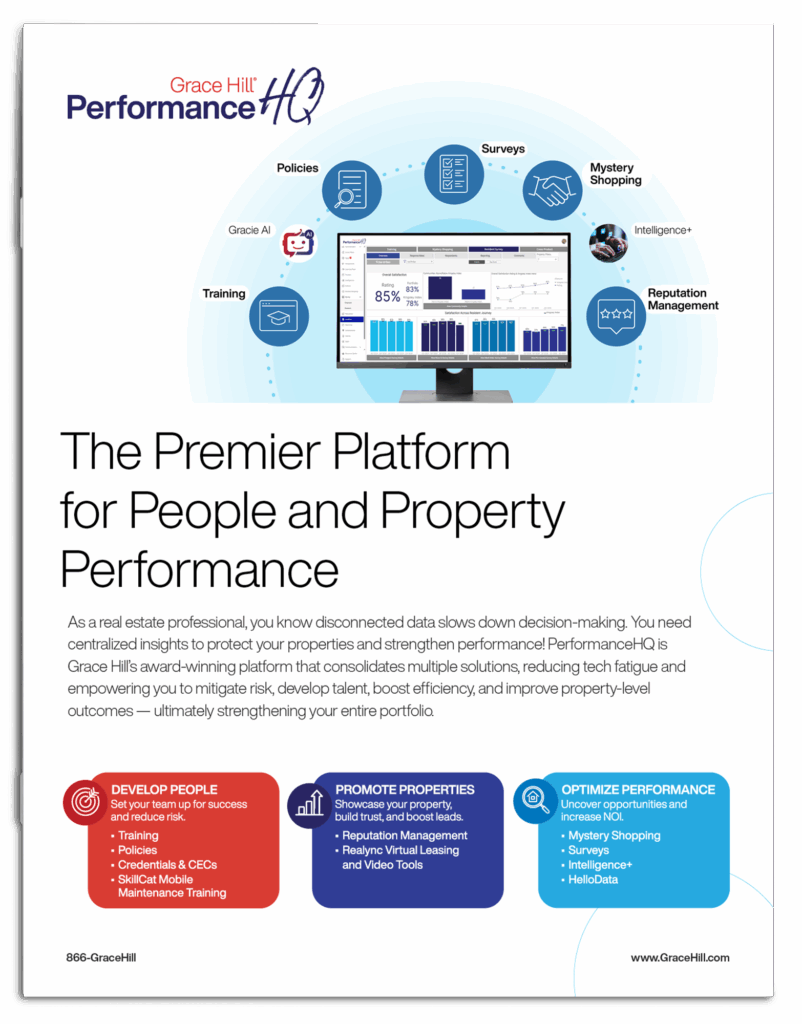
Hi, everyone. Welcome to today's webinar, top three multifamily must haves. The topic is reputation management. And I have to say, I even have on my circus earrings today to work through the chaos as we talk about reputation management. My name is Stephanie Anderson, Senior Director of Communications and Social Media right here at Grace Hill. I have actually been serving the apartment industry for the past eighteen years, and I have a really cool and unique perspective, a 360 perspective, in fact, that shows my views from all angles of the industry. I have served on both your side as an operator, a nonprofit association manager, and now for the past three and a half years as a supplier partner working for Grace Hill. But why am I here to talk about reputation management? I actually handle all of our social media accounts and all of our online reputation for our brand. So I am gonna couple my experience today with Jay's intense knowledge along with what we know about our amazing product to deliver it to you on a silver platter with how great of a product this is. So it is actually my honor to introduce my copilot for today's wild ride, Jay Thompson, senior sales engineer. Jay, having served on both a regional property manager position for national brand and an account manager for Grace Hill strategic accounts, Jay knows what it takes to elevate property performance and reduce operating risk in multifamily. He now leads a team of multifamily sales engineers that focus on delivering the impact of Grace Hill's suite of solutions. Jay, welcome to the show. Thank you so much. I'm excited to be here. Excited to talk about the topic. It's an all-important one. Me too. Alright. So as we dive in, you know, Stephanie, I think there's some great facts there on the screen. Right? That 79% of prospects make their leasing decision based on ratings and reviews. And I don't think that comes as a shock to any of us. In today's world, we are certainly a review driven community. Right? I think about that last Amazon purchase that I made. I read the reviews a hundred percent. You know? And then when you look at that other stat, the forty seven percent of renters expect management to respond not just to the good, not just to the bad, but to all online reviews. You know, as we were preparing for this, Stephanie, I was thinking of actually kind of a personal story that's going on right now. I'm going to a wedding next month, and so I'm looking at some vacation rentals. And so I've been on the website. I've been looking at different properties and and really looking at the reviews. Right? So 100% review-driven. Let's see what it looks like. I mean, let's be honest. It's hard to rationalize staying at a one-star property. But I will tell you, even more meaningful is within that review set, I've really honed into the ones where the owner or the management has responded to somebody who maybe had a less than, you know, when it came to their expectation. Because let's be honest, we're all human. Things do happen. So not only did I want it to be a property that obviously there was some pride in, but also what was gonna be the response if and when something didn't really go the same way, or the way that I thought that it should. So, you know, although that is obviously the vacation rental, you know, sector, it's not a far jump into rental housing as well from there. You know? And that's why we believe that it is crucial that multifamily maintain a positive brand reputation and really stay on top of your views. I love that story. In fact, you mentioned about being human. And I have to point this out here we are all human, and we cannot do it all. So the best practice is that we should be responding to every review. But on-site teams, all their tasks they have going on, they truly don't have time for all of that. It is impossible to respond to every single thing, plus do your day day job, plus enhance the customer experience that we all know is expected nowadays. So how are we doing all of this and we don't have a proactive reputation management strategy, we're then leaving money on the table. Leases aren't getting done. And how do we do it all, Jay? Hey, man. It kind of reminds me of those earrings. It is a little bit of a circus on-site. Right? So how do we give the tools to help really kind of tame that circus? I love that, and I think we should dive right into talking about these three must haves for reputation management. You know, you really need to maintain an active and consistent online presence by replying on all relevant platforms. So having that active online presence is truly like keeping the doors of your business open, but in a digital world. It's about being where your residents and prospects are on social media, but also on review sites and rental listing websites. That can be overwhelming in and of itself. So as someone who has been in the property management industry for a long time, I can attest to knowing how important social media is in shaping that public perception, but also influencing brand reputation, which is so critical nowadays. When you're regularly posting on social media, you're engaging with comments and responding to reviews. You're truly showing that you're attentive and approachable to your audience. It is going to build that trust and credibility that you must have within our industry. Amen. Could not agree more. So I'd love if we could for a moment then, Stephanie, kind of pivot into our reputation management solution. And let's talk a little bit about that. Right? Because, you know, again, you brought up a really I had some flashbacks, when you talked about the chaos that is sometimes property management. We've both been on that side of the ball game. I remember those days coming up as a leasing agent, the phone ringing off the hook, and the work order in front of you, and the prospect that just walked in through the door. So it is. So how do we give you efficiency to respond to those without necessarily increasing your headcount, which, let's be honest, in today's market may not be a reality right now. So how can we give you efficiency to really run with the tools and the talent that you have today? So when we first get in here, we're really talking about, you know, that classic online reputation management tool. This is a centralized repository where all of your reviews come in. Right? So and you'll notice we're gonna pull from major, review sites. We're also looking at some secondary and tertiary that you're also gonna see in there. But we do know Google and Facebook continue to be major drivers when it's reviewed. So, obviously, we're aggregating ratings and reviews across Google, Yelp, Facebook, apartment guide, apartment ratings, even community rewards rent dot com as well. There is filtering throughout. That filtering is really meant to make your job easier. So let's say I'm a community manager, and I know I need to respond to reviews. Right? All reviews as you pointed out. But maybe I've only got fifteen minutes today. So today, I really just am gonna focus on Google, and I'm gonna focus on, excuse me here, on my four and five star reviews because, you know, again, those are the ones that usually sometimes don't take as much, you know, of that meaningful thought behind it. You know? How are we gonna respond? So today, I'm really gonna look at four and five. You'll notice I can come in here. We have templates. You can have an unlimited number of templates in here. They do have embed codes. So the ability, you know, again, to really personalize that response. We've also maybe got writer's block. We've also got this AI generator. You can come in here. Maybe I'm not too thrilled, with this one, so I'll hit that again. I'll get a different response. I can also come in here and add additional context. But, again, in busy, you know, in busy times, since this is our four and five star reviews, maybe we just respond with our bulk responder here. So, again, I would really recommend I think you would agree with me that you you really use bulk responding for four and five star reviews. Your threes and belows really kind of need some individual attention in terms of that. But for four and five, come in here, select the ones you want. You can even select, you know, as many templates as you want, and then I can come in here and publish. And the good news is we're gonna carousel through those templates. Right? So the last thing that anybody wants to see is the same canned response to every review. So let's make sure that we're also cycling through those different responses as well. One more thing that I'll show to you here because it's just kind of near and dear to my heart, and I'm jumping ahead just a little bit. But when we talk about the ROI on this, I do love the fact that we feature a filter here that is with revisions, and that allows you to see the meaningful impact that your reputation management strategy is having on your clientele, on your online presence. So for example here, let me find one. This one you'll notice has an increase. So I'm able to see this move from a one to a three star. We'll talk a little bit later about just how one star increase can translate to your revenue. But for me, that's a meaningful story to go back and sing not only to your on-site teams, to your leadership, about the work that online reputation management does for your bottom line. And then finally, I wanna go over to social. And, again, I know this is a near and dear area of your heart, Stephanie, but when we'd be remiss if we didn't talk, right, about the fact, that social media is a huge part of your online presence. So you do have the ability to create posts to social, to Google. So let's say, for example, that I want to, you know, post to Instagram and Facebook. I can select my properties, quickly get in here, add my own messages and images, even use an AI generator again to help me get those creative juices flowing. And I would tell you what I love about this, Stephanie, and something you and I have talked about in the past is really just about that authentic, meaningful type of content. Because you want, as we're gonna talk about later, you want interaction. Right? So you wanna make sure that really the message that you're sending is tailored. I remember I had a community in a downtown location. It was absolutely imperative that our content really spoke to the community that we were in. It was such a force to live locally in that community that our social media really had to be geared to that. So, obviously, we love that feature as well. There's a lot more features in here for social media, like the ability to see all of your repost and even respond to those as well. So, you know, features like that, Stephanie, really address the pain of having to spend an enormous amount of time going to different websites, responding to potentially hundreds of reviews, you know, even getting down to aggregation and, you know, managing social media across multiple platforms. So really excited, and I'd be remiss if one thing else I don't talk about is we do have alerts and workflows for all of this. So, again, when you said those teams are busy, they absolutely are. Sometimes they can't live in this platform every day. So let's deliver them a notification that, hey. You have a new review, or, hey. You have a new task. So they can do their day to day ops, but then they know when they need to create time to go in and do the rest of this. Okay. Wow. There is so much to unpack here, and I get more and more excited every time we talk about this platform because of the ability of what it can do. And I'll tell you, while we're limited on time today, I would love to really explore in the future different opportunities for us to relook at ways to engage your team to get them more excited. You know, immediately when you're talking about the change in reviews and filtering that and how you've increased star ratings, how incredible to be able to talk to your teams about when they're doing that, how we could focus more on that for a bonus program versus, oh, if you get, you know, forty five star reviews, we want authentic reviews, and nothing, Jay, is more authentic than what you just showed. Amen. I love that. Incredible. So, you know, people wanna be heard and seen, and what better way than to respond to all the reviews using a sophisticated system like like our reputation management program. And that takes us to must have number two. You need a way to stay ahead of trends and be proactive in your strategy. I will tell you, what we know today is probably different than yesterday, and it's certainly gonna be irrelevant in the future. So we have to stay ahead of things. And you already touched on AI. That is the buzzword everybody wants to talk about. So, of course, we have to make sure that what we are providing to our customers is a way to really get ahead. So imagine trying to learn about your customers by reading every single one of their reviews. You can. I mean, you could look at Google, Yelp, social media, all the things. It would take you forever. And the most or hardest part about that is how do you even get a big picture from that? Mhmm. It would pretty much be impossible. So AI can actually analyze the sentiment of those reviews in seconds, Jay. I mean, if we talk about efficiency, there's the big one there. Yeah. Let's jump back into the platform here and talk a little bit more just about what you were, alluding to. So, again, you know, as you said, there's no more guessing. And I will tell you, I don't know about you, but I've been in this business long enough that I have had to go to the individual review sites and try to, you know, correlate data and make meaningful, you know, decisions based of it. And the fact is sometimes it was guessing because you couldn't get to all of it. Right? Guessing what, you know, residents loved and didn't love about your property. So, really, we wanna help those property managers proactively stay informed about conversations, trends, the sentiments. So a couple of the things that I would say when we're talking about proactive strategy, I am gonna go back into the reputation tab because for me, this is a clear differentiator for us. We are pulling in five competitors for every one of your location. Here's the good news. You have full control over that comp set. So if we pull in one just because it's geographically closed, but maybe it doesn't match your asset type, you can swap that out. But the fact that you're able to come in and see how you're doing against that competitor set, but I can actually even drill down to individual competitors looking for competitive advantages, you know, across my assets. So I'd be remiss if I didn't talk about that. But as you kind of stated early on, AI is the buzzword, and it has definitely been a game changer. So let's talk about just what some of those signals and AI means for us. Immediately on our snapshot, we tell you big picture about your company. What are your customer likes? What are their dislikes? Right? Here's where I truly believe, Stephanie. Reputation management becomes a total asset management strategy. My likes, I'm probably gonna funnel to you as marketing and go, can we herald these? Right? Can we really push it out? My dislikes, I may be getting with an asset manager going, let's talk about CapEx spend, or what does a value add project look like? Or maybe I'm getting with l and d and going, hey. Here's a gap that we're seeing across our organization. Maybe it's customer service, that type of deal. How do we fill in those gaps with our other solutions? And then let's look specifically at our Pulse AI. Right? So first, I'm gonna look at sentiment, then we'll come back to signals here and things like that in a minute. So with Pulte AI, let me get a little bit more data in here. We are scanning every one of your reviews for a positive, negative, or neutral sentiment. As a result, we can really pull out some major themes. So for example and I'm at a company level here. I can always come down into an individual level, but we're noticed that, you know, management is a negative topic for me. Now one of the ways that I love to click in even more is let's look at what we call our Pulse Explore. So, again, let's talk about I'm gonna take a different avenue. Right now, property is neutral. So it's got some good and some bad. I wanna know what comprises that. If I come in here and start interacting with this wheel, I begin to peel back the layers of what, you know, really talks about that property experience. So some of the things I'm seeing is the office, the facility, the community are real all positives. But what about this unit? I know we don't use the word unit, to your residence, but what is it exactly about that? Now I can get in here and really begin to see what is comprising that. And, again, what I love is I'm a former teacher. Differentiated instruction is a thing. So you're gonna be able to look at your company, but I can also look by asset by region. Because I guarantee you one size doesn't always fit all. There's meaningful changes that have to occur at each different level. And then, of course, let's talk a little bit about signals. So I will tell you, I went ahead and prepopulated this in. But I asked, what do customers say about my leasing staff? And because we're scanning all of this, our AI tool is able to come in and say, hey. There's some mixed reviews. Now maybe Alyssa here on my team, she's about to get a shout out. Right? She's really making some positive, inroads in our communities. But also then, I'm able to see maybe what the not so positives are. We will call out also each one of those locations that it comes into. So this is a great way, Stephanie. When you mentioned KPI, this to me was one of the first things I thought of. Maybe we're going, what do people say about maintenance? What do they say about customer service? What do they say about our resident events? Maybe these are all different components of that resident experience that you're really beginning to monitor. So, again, now you've got ways to make fast and meaningful decisions. And to your point, without having to sift through hundreds or thousands of reviews to begin to pull out those details as well. Wow. That is so important. You know, I just wanna dig deeper and deeper into this every time you mention more about it because our our ability to really stay ahead of these market trends, but also understanding the resident preferences, continuously improving the service quality, and resident satisfaction are absolutely key here. So let's transition into our third must have. You need a way to measure and improve your reputation and not just monitor it because a lot of people look at reputation management as a set and forget. This is not a George Foreman grill. We have got to pay attention. So without a realistic picture of your competitor's performance, how can you truly know where your property stands? Great point. I will tell you for me, Stephanie, I mean, let's be honest. Reputation management encompasses a lot of things. But at the end of the day, it's meant to move your bottom line. It's meant to make you better. Right? So, again, as we dive back into the platform, let's talk about some of those things as well. You know? So here at Grace Hill, we believe that we should bring this information and data together. So we're gonna provide you insights, recommended actions to help you understand the health of your reputation of your company, even help you establish action plans, again, around that resident satisfaction, retention, lease conversions. So couple things. Let's go back to social. Again, I know this one's near and dear to yours. So as we look at social, you can begin again, because of this listening tool, you've been can begin to see things like your brand mentioned as well. You can also dig into performance metrics. You can see what the engagement rates are. When I'm back here at a high level, even if we get to provide our breakdown, I can quickly see how my page is growing, what that engagement, what does the impression look like, even my top performing post. Right? Even all the way down to hashtag metrics. I know, Stephanie, you're the queen of hashtags, and I will tell you I'm not. Right? But there's a definitive science around hashtags. What makes a good hashtag? What drives? And here, you're able to kind of look at those reports, make really meaningful decisions. Again, this spans the scope of your company. In addition, let's talk quickly about our reports. So we do have a myriad of reports. Again, we talked about some that I can deliver to your teams real time. I can also, you know, give you weekly, monthly, etcetera. This is probably my favorite, though. You talked about those all important KPIs. Come in here, create a report of your own full of grass. This is great for investors. If you're a third party manager and you need to report back to ownership, but you can come in here. You can develop it. You can even schedule this out for distribution on your own, and you can begin to see all the different metrics that you really wanna look at here. But one thing I do wanna end with here, there's a lot. And, you know, Stephanie, to your point, I do get excited, and I wish we had more time because I literally think we're just beginning to scratch the surface, right, of what a full reputation management, looks like. But let's talk about LBV. So LBV stands for local brand visibility for us. For us, this is the benchmark to hold your other assets accountable to and also just to see how you're doing. If I'm being really honest, Stephanie, there are a lot of scores out there. Multifamily loves its scores. Right? We give score to a lot of things. I truly believe that if you don't know how to affect the score or what makes up that score, you simply have a number. You have to know how I can move the needle. Right? If I got a score, but I'm like, I don't know if I pull this lever or this lever to make it better, I'm just spinning my wheels. Our local brand visibility, we tell you exactly how to do that. It's comprised of of reviews. How many do you have? How many are you responding to? Social. Are you engaging? Is it meaningful engagement? How accurate are your listings? We're not even talking about that really in this, you know, webinar, but how accurate is that? Is your Google My Business page interacting with? Are there errors there? And, again, that competitor set, how are you comparing against them? So if this was my organization and I'm trying to get that LBV score to go up, whether I'm at a company level or at an individual level, Right now, social is gonna come front and center. Right? I'm gonna go find me a Stephanie Anderson or somebody who's already on my team and go, I gotta drive it. Because right now, social's beginning to bring down our local brand visibility and how that's overall impacting our reputation. Wow. To be able to drill down to that level, to really find that pain point specifically to overcome it and create or update your strategy in place, that is gonna do tremendous, tremendous things for your communities and your overall company's branding together. So, wow, this has been so, so great. So let's let's think about these again. Let's reiterate these these three must haves that are so so important. We talked about you need to maintain an active and consistent online presence. That really included replying to all the reviews, regardless of the platforms as long as they're relevant. You need a way to stay ahead of trends and be proactive in your strategy. This is one that oftentimes is missed. And then three, you need a way to measure and improve your reputation, not just monitor it. Absolutely. So, you know, I'm a data guy, and we both been on that side. There has to be an ROI to this. And I think we've talked about the compelling reasons. But let's talk just about a couple other meaningful ones that we have noticed as well. So using our tool, we've seen a fifty percent increase in page one appearances, And that's on your Google. Right? Again, we didn't really go into depth of kind of that metric, but I'll be honest. When Stephanie Anderson is in Tampa, Florida where I'm located and puts apartments near me, I want your assets to show up at the top of that list. And this tool helps with that. You know, the sixteen percent increase in total reviews and then a twenty four percent increase in five star reviews. I read a really meaningful stat. You know, when we looked at that one that went from a one star to a three star, I read a stat that for every one star rating increase, there's a four to five percent conversion rate increase. That conversion rate in multifamily directly translates into revenue. So some really meaningful stats around that. So, again, we know how important reputation management is. Negative reviews can pile up without a response. Those ultimately, you know, can hurt your reputation and drive prospects away. So staying on top of reviews, monitoring, and management is crucial, not only for maintaining that positive reputation, but for fostering resident loyalty as well. So with that said, Stephanie, thank you so much for allowing me to join you with this. It's been a great discussion. We really believe that we have the tool to help you manage it all. So I would encourage anyone here that's listening, we'd love to have a further conversation about this. You can visit our website or contact Grace Hill for more information. Thanks so much, Jay. Thanks for watching, everyone. Thank you, all.



 Customer Support