

 Customer Support


As Artificial Intelligence (AI) becomes increasingly popular, its impact on Fair Housing practices is becoming a critical concern. From automated tenant screening to predictive analytics for property valuation and maintenance, AI tools promise efficiency and insights but also pose potential risks for bias and discrimination.
This on-webinar explores the implications of AI technology in Fair Housing and rental property management and is designed to explore the complex interplay between AI innovations and Fair Housing obligations. Learn about the potential benefits and challenges of using AI in leasing and property management processes, as well as best practices for ensuring compliance with Fair Housing laws.
Learning Objectives
1. Understand the impact of AI on Fair Housing practices, including potential benefits and challenges.
2. Identify best practices for using AI in leasing and property management processes while maintaining compliance with Fair Housing laws.
3. Explore strategies for monitoring and addressing potential bias in AI algorithms and data sets used in rental property management.
Hello, everyone. Welcome. Let's give it just a moment while everyone is joining us. I would love for you to use that chat box. Go ahead. Say hello to Megan and myself. Hi, Jessica. Hello, Amy. Oh, so many friends in the chat. Thank you Well, I want to give you a big hello and a big welcome to today's webinar, AI and equity, navigating the implications of AI on fair housing. Did you know it's fair housing month? Well, you might have known. I'm sure you've seen a thing or two around on social media. My name is Stephanie Anderson, and I am the Senior Director of Communications and Social mMHedia at Grace Hill. I've been proudly serving the apartment industry for the past eighteen years, And I think we could all agree that so much has changed in property management over the years, and today's topic really is a great result of those changes. So I have on my ice cream earrings today, if you can see those. So what's the scoop on AI and Fair housing? Well, you'll have to stay tuned to find out. In the meantime, before we get started, just a few housekeeping items for you. Today's webinar is being recorded and will be shared with all registered attendees later this week. Now as an attendee, you will be in listen only mode. This will help prevent any outside noise or disruption so that everyone can hear today's presentation. If you have questions, and I know you will because this is such a great topic, I want to encourage you to use that q and a box located right there on your screen. Of course, we want you to engage in the chat as well. So while the presentation is taking place today, I will actually be on the back end of today's webinar trying to engage with you, answer questions, and, also pointing out some great things that today's guest speaker will be saying. So I hope you'll join me there. Now for the good stuff. I am really excited to formally introduce today's speaker. She is someone that I have known for many, many years in the industry. I'm sure you have as well. Smart chick Megan is what you might have seen on social media, but I wanna introduce you to Megan Orser. She is a powerhouse with over twenty six years of experience in apartment management and a marketing and communications degree from the University of Michigan. Megan brings a unique generational perspective to her work. Many of you might know she grew up in the industry. In fact, her mom was in the industry and still is just a little bit more on the retired side. And so she has a fantastic perspective all through the years, not just from the independent rental owner side, but also being the head of operations for Smart Apartment Solutions and Smart Moves. So So she's been on multiple sides of the industry. She understands the concerns that we are all facing, especially in today's climate. So with all that being said, I am thrilled to welcome Megan to our virtual stage. Well, thank you, Stephanie. What an introduction. I feel like I could go and run another company now with all of that. You're so kind. Thank you. Well and welcome everybody, and thank you, Grace Hill, for putting together this topic and asking me to speak on it. Some two things actually that are very near and dear to my heart. I love our industry, and I I love fair housing, and I love, talking to people about fair housing beyond the surface and really figuring out how they can protect themselves and the operators that they work for in the industry. And I also really love technology. I am a I refer to myself as a, an elderly millennial, and so I'm just on the cusp of a Gen Xer millennial, and so I understand I grew up with a lot of paper and a lot of the older school style, but I am still very hungry for technology. And so, of course, AI has been something that has been something I've been following for quite some time. I started following, artificial intelligence when it started to hit the market and be developed more in this third generation, which we'll talk about back in two thousand eighteen. So we're gonna dive a little bit deeper into what the heck is artificial intelligence and AI. We'll talk a little bit also about what differences there are. There's some common misconceptions where people think maybe a chatbot and automation are the same thing as AI, we'll clear that up. We'll also talk about the rise of AI in rental property management and how we're seeing that more and more each day, and operators are considering, you know, maybe adding this tool to their to help their team members out. We'll also talk about some challenges and the the maybe the darker side of AI and what that's brought to our industry already. We'll dive into some case studies in regards to resident screening and how that has been impacted with fair housing and with AI. We'll also talk about some AI case studies that maybe don't necessarily impact our industry or they do impact our industry specifically, but don't necessarily come from rental property management, more just on a a more of a global scale. And then we'll also talk about some pending case studies and some some lawsuits that probably most of us have heard, what we can share, and what we know so that you can keep your eyes and ears open for that. So without further ado, let's go ahead and get started. Great. So what is AI? What is artificial intelligence? Well, artificial intelligence refers to the development of of a computer system and software that can perform traditionally tasks that we have done, you know, sending an email, generating an email, typically triggered responses, that humans have done. But with AI, it doesn't actually require a human to do this, and they can, in some ways, be trained or taught to become a little bit more intelligent to move things along. AI systems are designed to learn from data and recognize patterns and make decisions and predictions without being programmed necessarily to do so. And as they get a little bit smarter or they're trained, they can do some of these tasks independently. The key capabilities that we find in AI is that they include natural language processing, so they're actually able to listen to a human speak or even text and then be able to convert that and and more and more become more and more with intelligent responses. They're even able to look at images now, computer visions, even take analytics, predictive analytics, and, help you in even making autonomous decisions. So we've seen this grow really, really quickly. I shared at the beginning that we actually started seeing artificial intelligence hit the mains the main space of conversation back in two thousand eighteen. ChatGPT, I think, was probably the most popular one that started in two thousand eighteen, and then it was released to the regular market in February of twenty twenty three, and we pretty much saw that explode. We saw people in our industry using it to help them with social media and blogs and what have you. Anything that we could get our hands on, we just dove right in. So how does it work? Well, AI systems are built on machine learning or logarithms. That's an important word to remember, logarithms, that can identify patterns and relationships in really large data sets. So a large data set like property management software or the Internet. Anywhere where there's a lot of data that is stored or dumped, they can typically sort that fairly quickly and make educated or intelligent decisions. By continually feeding an AI system massive amounts of relevant data, even new data, the logarithm can learn and improve their performance over time without it actually being directly programmed for each specific task. So it doesn't have to be taught new things over time. It can learn that over time by you continually giving it the data. For different types of machine learning, including supervised learning, unsupervised learning, There's also reinforcement learning where it it produces something and then you give it feedback. And they all have their own strengths and weaknesses and difference in their applications and depending on how we're using them. Recent advances in the area like deep learning, which is the stage we're in right now, they actually have the capability to tackle, more in more complex problems. So they're they don't require, you know, very specific prompts. You can actually speak in more layman's term. They can understand different dialects. They can understand different languages. They can understand if you use multiple different foreign languages in one sentence, then they can sort that. So, they're getting smarter and smarter every single day. One thing I wanted to clarify is I hear this a lot. I actually heard it this morning when I was at an apartment association discussion was someone was referring to a chatbot and said that they had been using AI on their property. And there are some differences between chatbots, and I understand why why we might think, well, a chatbot is AI, but they're not. Key differences would be that chatbots actually rely on pattern matching, predetermined scripts. So, typically, like, a a common question and answer that you might have your q and a page on your website. And you actually train it by giving it the responses to these common questions. So a common one might be, does this community accept large dog? You would train the chatbot to to say yes or no, and then it would funnel down based on already predetermined questions and answers. So there has been some frustration in our industry with chatbots because some people believed you could just plug them in and they would train themselves and you'd get to go. But they require a lot of human training, especially in the beginning while they get going. Chatbots have limited contextual understanding, and they cannot engage in free form. So if someone asked them just an off-the-wall question or something they haven't been trained on, they're not able to respond to it. They would they would tell you I can't I can't decide on that, or I would need to get you to one of my human friends or whatever the the the nice marketing tech that they give, but they wouldn't be able to have that open-ended dialect like a human would. Chatbots lack the ability to learn from interactions and improve their own responses unless they are powered by AI. That is something that is starting to come now. And chatbots are designed for specific narrow tasks, while AI systems can tackle wide range and complex and unstructured problems. So I love chatbots. I don't wanna throw any shade at them, but they're definitely for, you know, for folks maybe if you have a a very busy leasing office and you have these very common questions that would just help funnel leasing calls or funnel email call email leads or anything like that, a great tool to help funnel down the masses to really get it get them to the the the human that they need to move along the process. Where AI, if it's powered by AI, then that chatbot chatbot could learn over time and then start to come up with questions based on what's being answered and so on and so forth. Another common misconception with AI is that automation is AI. And, again, there's a key difference there. And if it's not automation that's powered by AI, if it's just true automation, then, again, automation is actually really just focused on creating efficiencies and tasks that we do over and over and over again. So huge fan of automation. I think this is a place when people understand the difference between automation and AI. They start start to lean more into automation first because it doesn't necessarily have an a logarithm component. It is a little easier to add and introduce into your world. And it definitely we can all find as property management professionals mundane tasks that we do over and over and over that we probably could automate. So they typically, again, just like a chatbot would follow a preprogrammed rule or instruction. Automation systems are designed to perform specific repetitive tasks and cannot adapt and learn on their own. Automation lacks the ability to understand context. Again, reason, open ended questions, anything like that, automation wouldn't be able to handle. So with AI, if they identify that there was a broken link, maybe in their automation, they could fix that. If it's just traditional automation, it would rely on a human to fix that. Automation is often rule based and deterministic, while AI leverages machine learning, logarithms to identify patterns and make decisions in a more dynamic, flexible manner. Automation is primarily concerned with automating existing processes, while AI aims to create new capabilities that can tackle, again, complex or even unstructured problems. Maybe even problems we don't necessarily know what the solution will be to yet. Okay. So that was a quick history lesson. I will get off of my soapbox about the difference between AI, chatbots, and automation, and let's talk about our industry and where we're really seeing true artificial intelligence today. So where I've seen it is in our resident screening activities. We've seen some case studies or even some lawsuits that have come out of this, But there have been more operators that have been using resident screening to help with sorting or vetting applications, maybe to make sure that there is more compliance or that they, in in efforts to remove any unconscious bias on applications, that's been really a a back and forth. So I would say that the a a TBD to be continued on that conversation, but I think it's something that we should watch because it's it's growing, and that conversation is growing ever so quickly each day. We've definitely also seen AI in the rise in predictive analytics for property valuation. So as owners are looking to expand their portfolios across the country, they have been relying a lot on predictive analytics and AI the last twelve, eighteen months, or even longer if they've had access to it to do market research, to find data quicker, to sort data quicker, and to really see if there's any anomalies or trends that maybe a human eye has missed. And so I've read some very fascinating articles, in many of our industry publications that have talked about that and the rise of this being used in those firms. Still in the the beginning stages, though, I would say it it have a lot of human oversight on that as well. But it can save you some time if you're able to compile or even summarize the data in a matter of a couple of minutes as opposed to many days or many hours. We've even seen some operators that have used it for predictive maintenance indicators. So not that uncommon anymore, but we've seen even larger facilities that have had indicators to let them know if there's a leak or maybe if there is a carbon monoxide issue or even just a light bulb out. There are triggers that we can set up through AI to really have us be our eyes and ears on our communities even in areas that we maybe don't visit every day or we don't get to see at nighttime. AI has been able to to allow us to leverage that when we maybe don't have an employee to do so. We've even seen it alleviate some staffing challenges. So it definitely has not replaced any humans, and I wanna stand strong on that AI is intended to cut task, not people. It's just intended to give us more time so that we can spend more time with our customers. We, as an industry, understand that we have moved into a customer-centric marketplace, and we want to have more time to give to our customers. And AI is probably going t be one of the many tools that we will leverage to help us do less repetitive tasks, honestly tasks that maybe nobody wants to do, so that we can do more fun things like resident events and talk to our residents and not feel like, gosh, I have to go and send that email or do this repetitive task. We've seen it in revenue management, algorithms, which we'll talk about at closer at the end of the session today and where we've seen that caused some challenges, but also maybe some benefit. And then as I said, alleviate I think I skipped over that. Alleviate some staffing challenges, where Where we've seen that specifically, in automation. So we have used AI technology in our accounting department as well as our staffing and recruitment department to help us with sorting and vetting, not applications, but after someone has applied to make sure that they've done all of the onboarding things that they need to do or if there's any other tasks, even just helping us write some letters, automation for sending out certificates, all of the things that we were doing more manually, we've been able to introduce that into our our marketplace. And then probably one of my most favorite is we're actually seeing people use AI to help with potential, on fraud. So as we know in our industry, we're seeing a rise of fraudulent bank statements and pay stubs, and it's difficult as a as a human if you haven't been trained specifically to know if this PDF has been edited or even being able to track someone's activities or an applicant's activities to determine if this behavior is in in tune or in like of someone who is committing fraud or if this is, you know, an activity of of a true applicant. They're doing all of that. So I don't wanna speak on the prop tech community and everything that they're doing. But let this be my public service announcement to pay attention because they have some awesome tools coming out of PropTech community to help make our lives a lot easier on-site. Okay. So some tools that I love, this is a free one, and you can even scan this with the QR code. It's not that easy to get female engineers as opposed to male, and it had more weight on certain universities than others, and then that had some unconscious bias. And so very interesting study to read, but then that also let us know that there's still some some room to pay attention to in our industry if we're using this for our application even just reviewing a a very tedious application or lease, it could have some challenges. We've even seen a rise with just prior impact or even unprotected classes. So, again, because it's using data that's already out there or information that's out there, it's having to navigate, and it could make predictive, assumptions. And those assumptions could be biased. They could not necessarily follow fair housing guidelines. So and, really, until there's a a specific multifamily industry or RPM industry, AI ran compliance, company or oversight for that, it really is the wild wild west for our industry because it's for everybody. It's not specifically for real estate. And so the real challenges then have arisen because we thought, oh, well, gosh. AI is gonna save us all this time. It saved us time in other areas, but now we're having to use that time we saved for oversight to make sure that what we're putting in our generative AI or putting out to our public is correct. It is unbiased. It doesn't have any, fair housing or or other issues that might arise. So we still require human oversight. There still has to be someone that's reading what's being generated or being put out or the decisions that are being made and and needs to step in if there needs to be an override. Okay. So let's talk case study. How are we doing on chat? We're doing yes. I will share some of the study links as well for sure. So here is a case study on a logarithmic logarithmic bias in resident screening. I will tell you we removed a lot of the specific names of the properties, especially if there were already if there are still pending cases, we didn't wanna we just we really just use the information as a learning opportunity, but didn't name their specifics. But you can find them, and I can share them with you if you wanted to get more into the case specifically. And some of the ones that I can share, I will give you the case numbers in here. But this case study, with a certain demographic or groups, what we found in this this this resident screening was that certain demographics and groups, particularly racial minorities and low income applicants, were being disproportionately denied or subjected to higher security deposits. They found that the property management company conducted an internal audit and discovered that significant logarithmic biases in the tenant and screening and resident tools, And the AI algorithm was heavily weighted towards factors like credit score, which tend to lower be lower among historically disadvantaged populations due to systemic inequality. So understanding okay. You still have to know your market. Right? I can't just go, well, I'm gonna go turn on AI screening, and it's gonna be cookie cutter across my whole portfolio. We know that in different parts of our market, maybe require different screening levels, right, based on the municipality, just based on the demographic for the youth socioeconomic. So having that understanding and, again, having that human oversight. So, fortunately, this company, they did an internal audit, and they found that they had these issues going on and that the AI was heavily waiting specific algorithms based on these. Maybe they didn't determine that, but, you know, that was the data that it was being fed. The disproportionate denial and disparate treatment of protected classes, undermine the property management company and obligation to uphold uphold fair housing principles. They actually found that they were rejecting applications, that they shouldn't have been, and those applicants filed fair housing complaints, which then led to an investigation and fines and reputation damage for the management company. So they found out while they were doing an internal audit, but then while they were doing the internal audit, they then started to get, fair housing complaints based on the the rejected applications. The property management company immediately suspended the use of the AI screening tool and launched a bigger comprehensive review. So they wanted to see, okay, how far did this go? Was this just maybe one property, that was implicated, or was it our whole portfolio? So these are coming up more and more as we're seeing these tools being implemented. And I don't wanna scare anybody and say you can't use it. I'm just saying we need to maybe not turn the whole fire hose on right away. Let's maybe test it, have a lot of oversight, a lot of feedback, and then take take small baby steps is what I'm telling you. Okay. So then they then partnered with some fair housing experts and data scientists to audit the algorithm, identified the sources of the bias, where they were finding the weighted algorithm scores, seeing what they could train that, remove that, rewrite that code with the fair housing and the the data scientist. And then that included in adjusting the algorithm waiting, diversifying, training the data, and then that which is an ongoing process, and then ongoing monitoring that and then providing continual feedback loops. And so a feedback loop typically would just be feedback, but you're really you're doing it every day, every transaction. So every every resident that you would screen, you would then go and scrutinize this. And then you might do a test study and screen them with an without a logarithms and then seeing, you know, where are there any inconsistencies. And so it is a longer process, but really making sure that we're vetting it completely with with the right folks. So what they found is relying solely on automated AI tools for the tenant and resident screening can introduce significant fair housing risk without proper oversight and validation. And so perhaps they use the screening tool now still, but when it denies an application, they don't just take that and go, okay. It's denied. I'll send them the adverse action letter. It goes to a review committee. That review committee then will look at this application, look at the screening, and go, okay. Are any of these, you know, biased or anything that might be done that shouldn't be? And is there anything that we could override? Is there anything that we can work with? I think this is a pretty common practice that we've done with other things beyond AI. We've kind of looked at this as a whole as an industry when we're doing background screening and and having the conversations around criminal, criminal activity. So I think this is just, again, another practice that we're taking to a new frontier. Hey, Mary. I hate to interrupt, but we got a question from Britney, and I'm sure everyone wants to know. Are you able to share the study link? Yeah. So I will share that after after the one that to the specific study. Absolutely. Because there's a couple of them too. There's a few of them. Thank you so much. Yeah. Thanks. Good question, Britney. Absolutely. So the a logarithm can perpetuate and amplify existing societal biases if that's what the data is showing. So you've gotta make sure that, again, like a chatbot, you have to make sure you're working with it, you're training it, and you're monitoring it. Maintaining compliance and fair housing, make sure that you're paying attention to the laws. Any changes in fair housing, you're still monitoring and having oversight. Make sure that that you also thoroughly vet the AI powered tools for potential bias and despite impact before implementation. And if there are any tools that are specific to our industry, I give them a look because they tend to already be paying attention to fair housing, but that doesn't mean that you can go, I'm good. They're an RPM, you know, industry tool, so I don't have to pay attention to fair housing. No. You still are responsible for oversight. And this is still gonna be a longer process as we learn this as an industry. Okay. So establish robust governance, auditing, testing, procedures, AI, to align with your fair housing principles. Train your staff. That was the other part when I was reading the study. Is this was something that was more implemented at the top level? They didn't necessarily think that they had to to train their on-site teams on it as much. And so let everybody know. If there's a change going, then we need to train everybody on it it so that they can recognize it and they can be your eyes and ears to say, hey. You know, this is different. This is different. We're getting different results, so we're getting reports here. Maybe we should maintain and look at this. And then maintain transparency and accountability throughout the use of AI. It's important to let people know that you're using AI. If you're gonna be using an AI tool for screening or just even, you know, for for efficiencies, you should let people know. You should disclose that there is an AI technology or tool. If that's something that they're not comfortable with, if there's maybe a workaround, if you're able to not use it again, that's up to your company policy. Probably, you could, but we need to be disclosing it. We need to be making people aware and being more transparent, not just after the fact so that they can understand how these tools are being used for their their information as well. Okay. Alright. So let's talk about another case study of in which I will share the link of successful AI powered powered leasing with Fair Housing compliance. So I removed the name of the property again, because I want it for anonymity. But ABC Property Management was looking for a way to streamline their leasing processes and improve resident satisfaction while ensuring they remain compliant with their housing regulations. So to achieve these goals, they implemented an AI powered leasing solution that handled these inquiries that would help them schedule viewings and also help with the preliminary screening of the applicants. Not the final say, but maybe getting and collecting data that we've required. You know, I need x number of pay stubs or how many ever in your leasing process. You've trained it. You've built those funnels, and so it was able to help with getting information into those buckets. The AI powered leasing system was trained on regulations to ensure that the applicants were treated equally and that they were able to remove any potential bias. It helped the the leasing team process inquiries quickly and efficiently, and it was able to even provide, resident details and informations about the properties, give them, you know, follow-up emails, text messages, here's a link to the application, and really help with the customer service aspect, for the resident or the resident cycle process. During the applicant screening process, the AI system was able to analyze relevant data points such as the credit score. It could look at things Okay. So let's spend the rest of our time talking about AI in the news. What are we hearing? What's going on with artificial intelligence? And I'm gonna just check-in with Kat. Okay. Alright. We're good on the chat. Alright. AI in the news. So this one actually is in the about AI in the news. It didn't necessarily talk about the RPM career RPM industry specifically. I'm in RPM careers mode, week mode. But this actually but it really affects everybody and anybody who is screening for applications in general. This was a study done by the Impact Fund and, with Lindsay Nano, and she's the director of litigation and training. So she's an attorney that was talking a lot about AI. She actually wrote and and covered the study with Amazon and how they were introducing AI in their screening practices and then pulled it because there were just still a lot of unconscious bias or bias that were popping up. And so they still they not saying that they're not going to use it, but it needed more work. They weren't ready to roll it out specifically. One of the quotes that I pulled from what she wrote that I thought was interesting and I wanted to share with you all today is she said that the third generation of artificial intelligence, which is what we're currently in, you know, we've gone through generation one, generation two, generation three, which is where we can communicate and it can communicate back to us like a human. That's the the generation, the third generation that we're in. So which the the third generation that we're in, and we're see we're seeking to incorporate deep learning. So we're training the AI right now, deep learning, to to really understand complex conversations, dialect, being able to make more complex decisions, more higher executive decisions. So even in regard to Quad, which I showed you that generative AI where I wrote that, you know, security deposit letter being changed, Quad is actually developed to be responsive like a COO, like a chief operating officer, and that is supposed to be I'm not saying that his intellect, the AI's intellect is a COO by any means, but the response level. And that's just some insight to show you where this AI is going and how deep that learning is. That specific AI generative model is being trained right now to mimic that specific executive level team member. So there's there's so many capabilities and so many matrix levels that we could go with this conversation. This deep learning will permit programs to autonomously learn rules, and that will automatically judge new data to create outputs without human intervention. And so we're getting to that place now where the third generation AI is is developing and training itself so quickly that it's able to make these independent decisions without us maybe even knowing it. And so it requires even more human oversight. In this quest for compatibility, AI based product may screen out vulnerable groups, and that's what they found with the the Amazon study. So if you wanna read more about this, I thought it was a pretty interesting, study that was done by with impact with the impact fund on AI, specifically in screening of employment applications, but a little bit more into this third generation of AI technology. So you can scan the QR code. I'll also share the link with, Grace Hill, and they can share it with you guys after if you wanna read more about that. Alright. So then the next one that I'll share is something that's still going on. So I would say probably one of the bigger in the news conversations where we're seeing it has to do with, a logarithm. So there's many cases that have come out here. I actually listed the specific cases, that are pending so far, but there are more, happening right now. But if you've not heard, then where have you been? I'll tell you. We have a couple of our revenue management operators that help us with our rent that have been in the news, specifically about the rents and the because we know housing affordability has been such a challenge in our industry. We've known that as an industry for for quite some time, but the general population has really been upset. They know that rents have been high. They are going kinda going through this learning cycle of understanding why. And so now we've seen that our industry is starting to be targeted with some of our prop tech tools and their with our revenue management. And revenue management was used data that they have in their system based on the operators that work in their sys that, you know, commute that contribute with their units and their data into their system, they were able to actually give us some market data based on these algorithms with some AI and saying, you know, based on your market, based on the number of units you have vacant and all of the competitors in the market, we suggest, you know, rents at this rate. What we're seeing the this or the accusation, at least in the court is that because this data isn't public and it's private data and large operations are in this database, but they're essentially working together to come up with rents and and decide on rents. And so they've accused the industry and the software of antitrust and essentially saying that they colluded, allegedly colluded to come up and pick fictitious rent prices that may not necessarily be what the market is. So whether you believe that or not, take it or leave it, that is the current conversation that is going on. We're seeing there's two lawsuits that have come out of it already. We're seeing more that are starting to hit now. But we're starting to see the government is looking at our industry in this lens. And so they're looking at the tools that we're using and how we determine if we're going to rent to somebody, for what rent we're going to charge them, the lease terms that they get to live there, the likelihood of their renewal, and what they're gonna pay in that regard. There's so many impacts or implications that can happen. So pay attention. There really is no right right or wrong answer, and I'm certainly not an attorney, but it is something that I would say is going on right now. And as things have be been picking up in our industry and we're seeing us more in the news, it's really a good idea to educate yourself on what is going on so that we can educate others, but also understand how quickly it's changing and maybe if we need to make any adjustments, in our operations that are impacted by this. I have also found I don't wanna throw any shade at any of our revenue management systems. I have used them in my career. They have also been responding to this and adjusting very quickly too. So at the end of the day, maybe have a conversation with your supplier partner and say, hey. What's going on? Like, what changes are you making? What should I know? What do I need to know? Ask your supervisors if you've got more questions. But they're making the quick adjustment. They are definitely, you know, putting more mindful spins in and understanding where they need to look in on all the areas that maybe they didn't notice before. So I hope I said that correctly. I don't want again, trying to keep loose keep myself out of saying anything I'm not supposed to. Hopefully, I didn't. But check it out. Please pay attention because this stuff is still going on as we speak. The third one had to do with, background screenings, and this is one that actually went all the way to the Consumer Financial Protection Bureau. So more on specific cases, they do name some some already named, communities here, but the report revealed that people were being denied of rental housing because of negative information that maybe it had been reported for somebody else. So the specific person in this, case was confused with somebody else that had the same name. And they found out that by doing the snapshot in our industry that this was actually happening a lot in the screening processes because, again, the AI tool was utilizing a logarithm and data, and it might go and find, you know, a specific Tony Stevens in Texas. Tony Stevens may not be the same Tony Stevens from Texas that he is in California. And so there were just a lot of mixed up data, and people were denied, housing. And so what I found in here was that the consumer snapshot revealed that renters submitted more than sixteen thousand complaints about incorrect information on their reports, and another four thousand five hundred complaints about obstacles space trying to get the companies to fix their errors. One thing I also wanted to call attention to, and this is just really a compliant thing, is as our industry has started to move to more of a digital landscape, we're seeing more and more complaints in Fair Housing with the adverse action letter not being sent out. And so this is just something that the a public service announcement. We all know that a a an adverse action letter typically comes when we run someone's credit or criminal background screening. And we're supposed to be sending that to them in some way, shape, or form, whether that's your company policy requires it through email or through snail mail or what have you. But the largest complaint that we're seeing to start uptick, especially that was, in the study with the Consumer Financial Protection Bureau, is that people are not getting that letter at all. And so I had actually started to ask some operators about that, and it was determined that this is something that can sometimes just be, you know, unchecked in your screening system. Because we went to a paperless, you know, platform, it's just not automatically printing. So it just might even be, like, a quick housekeeping that you can, adjust and make sure that those adverse action letters are going out. Make sure that they're being saved to the resident file. So that if you do go through an audit or if you do have to produce it, you can show that it did go out. I did drop a QR code here as well. So if you wanted to read more, on these reports, there are several. There were more than more than just the one that I shared here today. So this was just more of a summary from that. Okay. Alright. And so, lastly, on this last one I wanted to share, this actually came from the National Fair Housing Alliance, and this is a report that they released in August of twenty twenty three. Again, you can scan this QR code and check that out. But the report examined how increasing use of a logarithmic decision making and tools in housing and how that perpetuated and amplified discrimination despite the, intent of being neutral or objective. So if you wanna find out more information, more of that data, just a bigger, deeper dive in how this is implicating our industry, specifically in fair housing, this was a really good study to check out as well. K. Well, then let's turn it over then to miss Stephanie for a quick update. Okay. That was incredible. So much information. Don't forget this is being recorded. So, of course, if your hands could not move fast enough to take notes, you're safe. Thank you so much, Megan. So before we head into a little bit of live q and a, I just wanna take a moment to touch on a couple of things. So I wanna invite you, if you are not already following Grace Hill on social media, this month, we are sharing five total training tips, one every Tuesday during the month of April, and they all tie back to fair housing month because, of course, it's hip to be fair. And speaking of training, did you know that we released a fair housing toolkit this month? It includes everything you need to advance your knowledge while also training your team members on all things fair housing. It does include some top trends surrounding important compliance, and it allows you to have fun while doing so because fun and fair housing is is important to do. So if you haven't received a copy of this toolkit, please reach out to your customer success manager. Again, this is just for customers, so please reach out. And if you're not a customer, we are doing things like this to enhance the customer experience. So all the more reason for you to partner with Grace Hill. Also, I want to let you all know that if your team is challenged with any of the topics discussed today, our team at Grace Hill can help. We truly understand the trials and tribulations of technology and compliance along with the excitement of things like AI. So we offer training and policies that will enhance your current offering, or we can help you get started. You might have seen us in the news earlier this week on Tuesday as we released reputation management. It's an enhanced reputation management program that we have, and we would love to talk to you more about that because, of course, it ties into fair housing and technology and AI and all the things we've talked about today. So if you are interested in talking more about any of these things I've mentioned, personalized demo, a consultation, or just to ask questions, our team is here to help you. So if you're a current client and you want a demo to learn more about our solutions, or if you are not a current client and want to learn about our entire offering, not just a specific product, please take a moment to put the word AI. So our artificial intelligence AI right there in the chat box, and a member of our team will connect back with you shortly. So we are getting close to time here, and I wanna make the most of our ask the expert time. So let's get back to this exciting content and take a look at what's happening in our q and a box. So Britney was the first to ask a question, Megan, and she says, what is on the horizon in twenty twenty four and twenty twenty five for the AI technology? So go ahead and pull out your crystal ball and let us Yeah. I don't have one in front of me, but I would I've definitely been paying attention to the property tech community. And I don't know if you guys haven't visited them lately, and we're coming up to apartmentalize with the trade show, and you can go and and talk to them, one on one. But we're going to see a a huge uptick is and I was actually reading this in, Dom Beverage's twenty for twenty is that we're definitely seeing in the application and the fraud sector that we're gonna see a lot more AI technology, altered PDF and it being able to spit this out to leasing and saying, this is fraud. You know, this doesn't add up. The math isn't adding up. You y'all I don't do math in public. And so when I see in the groups and people are like, the year to date is wrong. Like, I don't see that. I'm not one of those people. So that AI tool and being able to to have that as a a a tool for folks like me, to to catch these low hanging fruits and go, oh, you know, this is wrong. Or, again, the the being able to track someone's habits and going, they're using the copy and paste function a lot. We think that this specific IP address or this username is fraudulent, and they're committing fraud. And we might even be able to catch them in the act. Well said. And fraud continues to be a topic that is forefront for all of us in the industry. We actually got a question from Michael in our chat. Michael Munson says, Megan, you talked earlier about AI being used for predictive maintenance. Can you talk more about that or what programs people are using for that? Yes. So, Michael, I will look up because I actually was just putting these specifically together for a maintenance person. So I will share them, the resources that I found in the specific companies. There were several that are utilizing AI technology for predictive, and preventative maintenance. So, letting us know if there was an issue with an air conditioner to light bulb to a water link. I even was reading about, letting us know when mail had hit certain mailboxes, so that we could alert our residents and let them know. But, yeah, I will definitely share that link of all of those awesome tools available for you right now. We have gotten a lot of chatter, today of, accessing all of this information. So don't fear. We know that it was a lot of information given to you in a very short amount of time. So we're going to make sure that you have the recording, all the links, QR codes, everything you need to gain all the knowledge from this great session today. Well, Megan, we are right here at the end of our time together, and I I can't tell you how much I've learned alone. And I know our attendees have as well. We know your time is valuable, so thank you so much for being here with us today. And, of course the opportunity to talk with you. Yeah. Oh, we love it. And thank you to all the attendees who joined. We know that your time is very, very valuable, and so to be here and engage in conversation with us means the most to us. Megan's gonna put some contact information on the screen for you all. Should you have any additional questions not related to Grace Hill products and services, but you just wanna ask her to clarify something from today's presentation or to get any additional information about, what she shared today, you can certainly reach out to her right then and there. And so, again, I wanna thank everybody for your time today, and, I hope you have learned something incredible about AI because, I hear the bots are coming, Megan. They're already here. Wonderful. Well, thank you all, and have a wonderful day. Bye, everybody.
Speaker

Megan Orser
CEO and Residential Manager | Smart Apartment Solutions and Smart Moves
With 26+ years in apartment management and a Marketing and Communications degree from the University of Michigan, Megan brings a fresh generational perspective. She holds multiple accreditations, including HCCP and CALP, is pursuing her Michigan Broker's license, and is a CPM Candidate.
As head of operations for Smart Apartment Solutions and Smart Moves LLC, Megan provides occupancy solutions and property management services across the Midwest. She actively serves on industry committees like IREM, NAA, and NAAEI, holding key leadership roles, including 2024 Chair of NAA's Independent Rental Owner committee. Her expertise has earned her two NAA Excel Awards: CALP of the Year and Industry Educator of the Year.
Known as "Smart Chick Megan," she delivers engaging, experience-based educational sessions with personal insights. Get ready to learn and be inspired!
More Fair Housing Tools and Insights
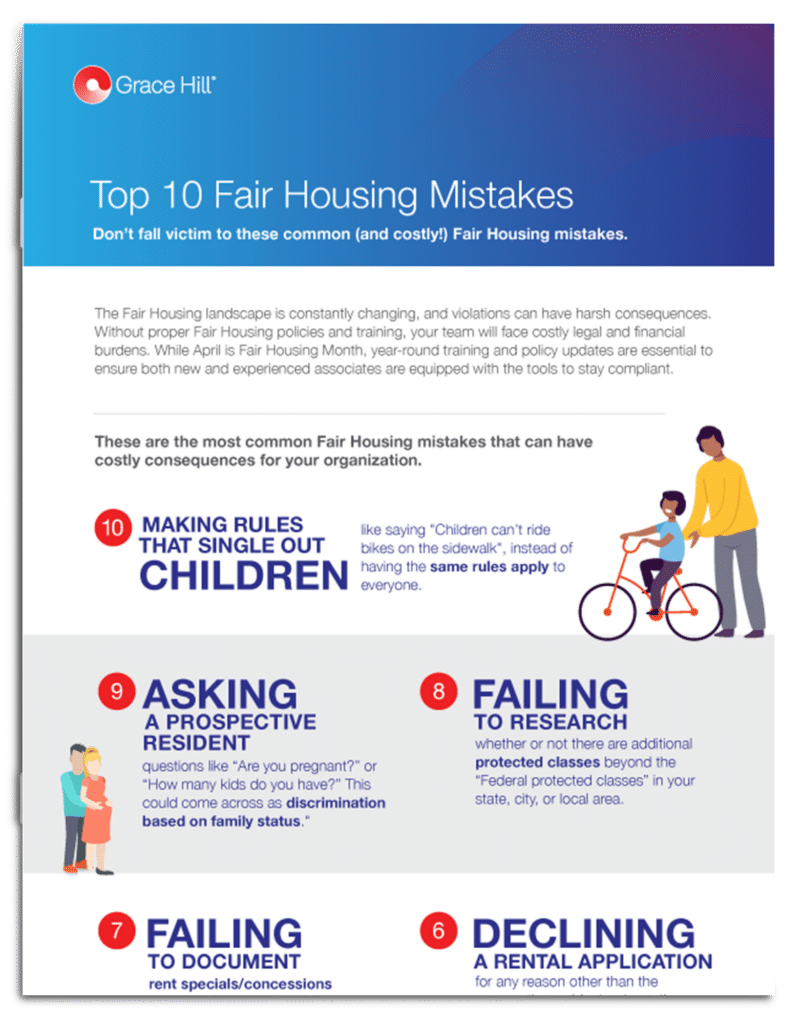
Top 10 Fair Housing Mistakes
HOTMA Horizons: Navigating the New Landscape of LIHTC Regulations