
 Customer Support


It's the dog days of leasing season. Move-ins are stacking up, next year’s budgets are taking shape, the mercury's climbing, and the data is not slowing down. Survey scores, mystery shop results, and training reports, and market data all hold valuable answers. The hard part is finding those answers quickly enough to act on them. If your evenings are going to spreadsheets instead of the pool, we'd like to make you an offer: let Intelligence+ do the sweating.
Watch as Jay Thompson, Senior Manager of Sales Engineering, and David Scarbrough, Associate Director of Product Management, for a live demonstration of Intelligence+ inside PerformanceHQ.
See how Intelligence+ brings data together, helps teams understand what needs attention, and recommends what to do next without hours of report-building or dashboard-hunting.
Here's what's on ice:
- Escape the Spreadsheet Heat Wave — See how Ask Gracie for Intelligence+ answers a plain-language question in seconds, sourced straight from your own property data. No report-building, no dashboard-hunting.
- Cool a Training Gap Before It Boils Over — Automated Training Recommendations and Assignments close the loop the moment a signal surfaces. One click, no backlog left to simmer until fall.
- See Past the Summer Glare — HelloData comps in Intelligence+ put resident sentiment and market position in the same conversation, so pricing and staffing calls — and the budget lines built on them — aren't made squinting at half the picture.
- One Platform, Cool and Covered — Training, Surveys, Mystery Shopping, and HelloData all feed the same system, so every signal your team captures this summer turns into clear next steps, including the ones that back up next year's numbers.
Whether you already use PerformanceHQ or are seeing the platform for the first time, you will leave knowing how Intelligence+ turns a season of data overload into clearer priorities and practical next steps.
Less time sweating the numbers. More time improving performance.
Hello, everyone, and welcome to today's session. We're glad you're here. It's the dog days of leasing season. Move ins are stacking up. Next year's budgets are taking shape. The mercury is climbing, and the data isn't slowing down either. Survey scores, mystery shop results, training reports, market comps, they all hold answers. The hard part is finding those answers fast enough to act on them. Today, we're gonna show you how Intelligence Plus inside PerformanceHQ does the sweating for you. Before we dive in, a few quick housekeeping items. First, we are recording this session and we will send the replay to your inbox tomorrow. Next, we want to hear from you. Drop your questions throughout the session in the Q and A box on the Zoom control panel at any time and our panelists will answer them toward the end. Lastly, and this is a good reason to stick around to the very end, we're giving one lucky attendee a countertop nugget ice maker. Yes, the good ice. The soft, chewable, good to the last cube kind you usually have to leave the office for. It comes with a syrup set and Grace Hill tumblers to share so you can mix up your own flavored drinks during a busy season. Consider it our way of helping you keep your cool while everyone else sweats the data. Remember, you must be present to win, so stick around. We'll draw the winner before we wrap. To get us started, I'll hand things over to our two Grace Hill experts. Today, we have Jay Thompson, senior manager of sales engineering. Jay has been both a regional property manager for a national brand and a success manager for Grace Hill strategic accounts. So he knows firsthand what it takes to elevate property performance and reduce operating risk. Also joining us today is David Scarborough, associate director of product management. David leads product strategy for Intelligence Plus and works closely with our customers to shape how AI driven insights and recommendations show up inside PerformanceHQ. He'll walk us through what's new, what's next, and how the platform connects the data across training, surveys, mystery shopping, and HelloData. Jay, David, welcome to you both. Awesome. Thanks so much, Kayla. We're so excited to be here with you. I'm a little jealous of the good ice. Everybody wants the good ice, so stick around. Hopefully, you're gonna win that. Before we get into any of this, though, for a moment, I just wanna have story time with Jay and David. So humor me for just a moment. But, David, I gotta know. It's August. Right? What does August look like in the Scarborough house right now? Oh, that's a great question. Honestly, I would say it's it's controlled chaos. I just got back from a vacation, and, you know, we all know how that goes. So it means playing catch up against a mountain of unread emails. Then on top of that, we are scrambling to get my son ready for, the new school year, and beyond since this year. He is graduating, so he's a senior this year. So college application processes. So going through that. And then, of course, naturally, right, our home AC decided that this was the the perfect week to quit on us. So, yeah, August is definitely keeping us on our toes, to say the least. Fair. August is Augustine. Right? So first of all, best of luck to your son. It is upcoming year as a Floridian. I'm sending you all the good vibes with the AC. That is not I appreciate it. So in all seriousness though, right, the reason why I wanted to start off with that is because August is usually that controlled chaos. It's when all of summer finally shows up. You take that last minute vacation out with the kids before school starts. Hopefully, you don't have AC issues that come around, but it's when even sometimes in particularly multifamily, you're in the heat of it all. Right? There's budgets. There's move ins. All of that. So story time with a purpose. Right? That we understand that control chaos. Like Kayla said, I was fortunate enough to serve on your side of the ballgame, and I'm gonna do my best to describe an August in your world. Do me a favor. In the chat, tell me how close I get to it. Right? But August, move ins are stacking up. You're coming out of that busy leasing season, so move ins are stacking up. If you are in student housing, you definitely are in the throes of that right now. Your teams continue to be short staffed, so maybe you're supporting in a variety of ways. I'm meeting a lot of corporate professionals right now that are even playing the roles of regionals because, unfortunately, there is a position vacancy. Probably got a mystery shop somewhere in an inbox that needs to be read at some point. You got some resident sentiment feedback that's coming in, but if you're being very honest, you've skimmed it at a high level. This is always the kicker. One of your properties is underperforming. Right? And your owners want a SWOT analysis, and they want a remediation plan by the end of today. Executive summaries, because you just wrapped up month in, not that long ago. So you're probably thinking about executive summaries, and you're thinking about marketing plans. And then here's the cherry on top. Budget's due. At least that first pass, right, is due. And those people just don't want guesses. They want justification. Right? So everything that's been building is coming to a head. Right? Robbie, I appreciate that. Well, I don't appreciate it. I wish it was not controlled chaos at its best right now in your office. But glad to hear that resonates a little bit, and hopefully, we're gonna help you find some of those answers. Right? But here's the thing, David. When you and I were talking earlier, the thing is all of those kind of questions, particularly when we're talking about that underperforming asset or your budget numbers, all of that data to help you make those good, justifiable answers and with efficiency, efficiency, they already exist somewhere. For a lot of people, it exist in a system or typically in multiple systems somewhere out there. Right? The problem is turning that into an answer takes somebody's Tuesday night. So somebody's working late tonight because they gotta go gather all that information. And if I'm kinda telling on myself when I was on your side of the ballgame with you all, sometimes some of that just didn't get done. And here's why. You got a phone call that one of your owners is making a surprise property visit on Thursday, so you've got a prep. Or you just got a brand new acquisition and you're taking over a whole portfolio. So sometimes that just the data doesn't get pulled, but you still make a decision around it. With that said, Kayla is gonna launch a poll for us, but I'd love to know how many hours a week does it take you or someone on your team to just pull and verify the data? Not analyzing it, just pulling and verifying. This is anonymous. Right? So feel free to be honest in here. And so we'll get that for just a minute. I wanna make sure we get a pretty good snapshot in here, but how honest? So alright. We're gonna wrap it up here in just a second. We got a pretty good quorum there. So, yeah, if we wanna go ahead and we will so look at those results. Pretty if you think about it, pretty well split. Right? Now if you think less than five hours, that's a little bit below what national research says. You're five to ten hours people. That almost tracks with what we're typically seeing. So think about that. A single day of work simply devoted to this. Right? To be an admin rather than doing some of the ops of your job. Ten to twenty hours, my heart goes out to you all because that right there is time consuming. That takes your attention away from other things that really move your NOI needle. And listen, I really have a heart for the people that said no idea, and that's part of the problem. Right? Because you don't know. So what I will tell you is research shows it's typically six to eight hours a week for most people. Right? And that again is just getting the data and verifying it. That's not analyzing. That's not getting to it. It's just pulling it together. So if we flip that a little bit more, that is literally two months of the year. Two months out of your year where you need to be driving operational excellence that is devoted to getting that data. If we look at it in terms of dollars and cents for some people, that's almost north of twenty thousand dollars a year in a payroll. Right? And that again is just spending to get you to the starting line, which is exactly why sometimes we just make decisions based on guts or feelings. So that's our whole webinar today, is we wanna show you three ways that Intelligence Plus gives you the answers without, hopefully, having to spend a weeknight or Saturday night doing this. So, David, I'm gonna kick it over to you for the next little bit. Yeah. Thanks, Jay. And look. So we are gonna show you three ways. I'm gonna be presenting one of those ways. So if you're gonna stick around, stick around for that one. That'll be the best one. No. I'm just I'm just teasing with you, Jay. So, yeah, I I too wanted to start with a question as well. So this is kinda I I think this is a question at the heart of everything that we're gonna be showing today, and and I do want answers from this one in the chat. So make sure you plug in answers in the chat. Alright. So question is, you've got an underperforming asset. Occupancy is soft. Renewals are down. So you know something is wrong. How do you figure out whether that's a people problem, a promotion problem, a pricing, or product problem? Don't don't don't make your answer aspirationally what you would do. They just type in the chat what you actually do. It's Monday morning. Drop it in the chat. Getting some answers. Market analysis. Mean it says Slicing lots of data. Yeah. Those track for sure. Into the data. Yep. I think the double click into the data is right where those systems pulling that data. Exactly. Exactly. I enjoy the humor there. Right? Put it on a dartboard. We just throw it, and there there you go. So Yeah. And I I've talked with a lot of customers. These are definitely tracking here. We often hear, you know, hey. I log in to a list of systems. Yep. Data. Data. Data. Data for sure. Some cases, people will say, I I walk the property, or I call the RM, you know, which may be the right instinct. But it's also why it could be very long because you're essentially rebuilding from memory, what your data already knows. Let's see. Tracking metrics, performance reports. Anybody here go with their gut? Because I've heard that before as well. I just go with my gut. Shops, training reports, operating KPI reports. Right. And so no. Phyllis is like, no. Nobody's going with their gut. But, look, based on your answers, I mean, it's clear to see that, that there's a lot of systems you guys are talking about. Data, data, data. We've already talked about how that's you know, can be a six to hours a week process just to just to aggregate that data. Data in six different spots, so we spend so much time aggregating that data, and then we have to analyze. By the time that's done, there's another issue. You know, I think I think Robbie just hit the nail on the head here in exactly what we're talking about. And so what we're gonna be showing you today is how you could easily take that data, and it translates to performance results and performance improvements. So some of you may be familiar with PerformanceHQ. You may also you may know it as, hey. That's the place where our training lives. Maybe your surveys and your shops are in there too. But here's what I want you to to ask yourself or reconsider. Those aren't just three products that you happen to buy from the same vendor. Those are actually three answers to the questions that I just asked, the people, product, pricing, promotion. How so? Well, a mystery shop tells you what happened on a tour. A survey tells you how the resident felt about it and what they think of the asset itself. Training records will tell you what the team member was actually prepared to do. And then HelloData tells you what the property down the street was charging, whether they're offering any concessions, and what amenities they advertise all at the same time. So you have your people, your promotion, your pricing, your product, and they do overlap. For instance, a shop tells you about your people and your promotion at the same time. That's the that's the whole point. Any one of them alone gives you a suspect, but together, they give you a root cause. Said another way, each one is technically a report separately. Somebody pulls it. Somebody reads it, and heaven forbid, it just goes into a folder, and then it is never looked at again. But together, they form a diagnosis, And that's what Intelligence Plus is. That's what we're gonna be showing you today. It's the layer that reads across all of these datasets and tells you what to act on first. And what we're gonna be starting with is is is our ask Gracie feature, which is how you could interact with it in a conversational way. Hey, David. Before we go further, first of I love about together their diagnosis. Right? And I think about when you go to the doctor, I don't want them literally just hearing one symptom and going, here it is. This is what's the matter. I need them to look holistically at the picture. Right? But I do get this question often when we're demoing, which is if I only have one of those products that you're talking about, does any of this work for me today? It does. But I think that the key takeaway here is not to its fullest potential. I'd rather say that just plainly out front, right off the bat. I mean, one signal, it answers one of those four questions. Four signals tells you what it actually is. That's that's the difference that we're talking about, and we're gonna take a look at that during the the demonstrations today. Awesome. Which is why we are done with depth by PowerPoint, and we're gonna drop directly into the system and start having, you know, show and tell, if you will. So before I get started, humor me. Many of you may already be in PerformanceHQ. And for those of you that are thank you for being partners. We hope that we can show you really how to elevate to the next level. But I would be remiss to think some of you may not be in PerformanceHQ today. So very quickly, PerformanceHQ, you will hear me affectionately call it PHQ. So forgive me if I go by the acronym. But PHQ or PerformanceHQ is the system in which all of our solutions live. It's a consolidated tech stack. Right? We already know operators today have upwards of, like, fifteen to twenty different logins. So anytime we can consolidate that, that's a win. Now if I'm being my gut reaction to that, if this system was just about reducing logins, I think that's a clap in a conference room and we move on. The power of PerformanceHQ is because we are collecting data from all these different areas, from your training records, from your comps, from your resident survey. They then can be bubbled up through a layer that we call Intelligence Plus, where we make actionable insights and recommendations for you to move forward. So let's drop right in. Right? And so gonna give it just a minute to catch up here. My Internet always lags a little when we're on Zoom. But I am gonna put again my hat on when I was a regional manager. It's the end of a Tuesday night. It's been a hard day, and I'm just gonna ask an honest, not a polished question, an honest question, simply a tired one. Right? So I'm gonna ask, I need a high level overview of my portfolio's performance. And I Gracie is now gonna parse through data in here, and she's gonna respond. Now she does, again, have a lot of data that she's gotta sift through, so she'll take just a little bit to respond to that. Through the power of television, though, we've already teed up these answers. So let's go ahead and kinda look at what she said. Right? So she said, hey. Here's where we're at. She gives me some strength for some of those assets. So where I'm doing well, and that's important. But tonight, because I'm tired and I just gotta know how to elevate, I really wanna know where my areas for improvement are. So the first thing she's caught out for me is I have some critical property triage that needs to be done because I've got some scores that are really threatening the integrity of my occupancy, my NOI. Right? She calls out the ones that I specifically and as I begin to read through, it's HVAC failures, mold issues, unreliable trash service, maintenance and repairs, communication and responsiveness. I immediately, back in your seat, get this thinking feeling about what is this talking about in terms of resident churn, where is my occupancy gonna be in September, October, November as I lead into twenty twenty seven. Right? So now she's gonna give me some more, but I'm a be real honest. I probably right here, opportunity number one, got a that gut sinking feeling of, oh, no. Where what are we gonna do about this? So I follow it up with a question and ask, so based on that, which of my properties have the highest likelihood of resident churn? Because I'm nervous about that. And I wanna know have any of the teams been trained around those gaps. Right? So again, Viridian Collective, remember that name because that was on the very first part, but it's also here as well, is that's one of my top ones. And here's what's even more concerning concerning. They're at a fourteen three fourteen point three percent compliance level. Right? So we're talking about to appear. And again, this is survey data, so some of this stuff I don't have. But we're also then gonna key up for you those key insights and your next steps. Right? What I love about this, when we talked about all those when you were saying data, data, data in the chat. Right? Or we gotta go analyze all this data to even get to the starting line. What I love is this question, it's been multiple things. It's been your resident feedback as well as your training. This also works for mystery shopping and policies. If I wanna go where their policy acknowledgments that I need to have my team, you know, maybe look at surrounding these gaps, what would those be? Gracie would make a recommendation on that. So this is obviously a powerful tool when you're tired and you need to go on. However, with that said, Intelligence Plus also sometimes flags those issues. I'm not gonna steal David's thunder. That's the part that he's got coming up. But, David, before we go on, I have a quick question for you. Sure. Where do these numbers come from? That's a great question. So the the the great thing here is these Gracie's not making anything up. Gracie isn't hallucinating. So every figure traces back to your specific data. It's not going out on the Internet and pulling anything from there. So it it traces back to the actual shop records, the actual completion logs, the survey results. This isn't a model that's producing a plausible sounding number. It's built on well structured, verifiable data. And that's one really key element there, well structured data. So everybody, I think, are using large language models right now. But it's it's it's the old adage is true. Garbage in is garbage out with an LLM. And so that's where this a tool like this really sets itself apart from just trying to use an LLM model with unstructured data. So we built it that way on purpose. And the reason is because the first time the large language model gives you a bad answer, that's that's the last time you're actually going to trust it. So we we we spend a great deal of time ensuring that you could be confident in the answers that you get from Gracie and that they're relevant and that they're accurate. I love that. Great answer. Alright. I'm gonna steal one more time bit here before we turn it over to David. And I wanna go, and again, through the power of television, you've noticed I just wanna come back and let you see that, again, Gracie did answer my question. But as we come back, I wanna go back and I wanna come back to that SWOT analysis. Because a lot of times, and again, I've been in your shoes. For me, when I had to do an old SWOT, yes, I would look at commsets, of course. I would look at what the development pipeline is, that type of deal. But I was also listening to my staff. Right? Well, what I've heard on tours, that type of deal. The what I've heard isn't always defendable. Right? So I asked Tracy if she could create for me a SWOT analysis around the Viridian Collective. Because, again, this was the one that started to give me some heartburn because I thought that we may have some renewal intentions. These are the things that will eat away in a Tuesday night and keep you from dinner with your loved ones or friends. Right? So I asked them again. Let's kinda look at quickly. She's gonna give me my strengths around it. We're doing some really great. Right? So if I if you're a marketing person on here, you got some things you can really start to, you know, tout on. Right? People love the serene environment, if you will. We do have some weaknesses. Again, that renewal intention management scores are literally at the flow level floor level. Excuse me. And then opportunities. What I love is that is that remediation piece that starts to come in play. And she's literally saying residents have identified clearly that the gate, valley traps, HVAC, water shutoff, parking are all fixable issues. That's a targeted remediation plan that you can enact. This is four hours of assembly that's literally gone. What's left is the part that you're really good at, and that is running your sites for operational excellence. So, David, I'm excited to kinda hear one of your favorite things about Intelligence Plus. Oh, gosh. There's there's so many favorite things about it. I mean, what Jay was just showing, what I what I really love about this is you don't have to be export an expert at reading a dashboard. It it it's so it's a really low barrier to entry in terms of, hey. I have a question. I need an answer, and it comes back with really, really good answers and insights. That's probably one of my favorite things about it. But I also do love how how it surfaces things that are critical and what you need to be focused on. And I'm gonna show that in a second. But And before I yeah. Let's say before that and I just pulled up our own analytics screen because I got a question for you. When you were developing this, we don't usually get product people on the line, so I'm a pick your brain while we're here. But when did make the data easier to get stop being really in gold for you all? Oops. Okay. That's that's a great question. So I I mean, I'll start from the very beginning. Right? How much time we got? No. I'm joking. So when I started on this journey and doing a lot of discovery, talking with a lot of customers, it was pretty clear that you guys were prioritizing implementing data driven strategies, and that was really to mitigate the risk of record high operational cost, high employee, and resident turnover. I think the last time I checked, resident turnover was hovering around forty four percent and costing roughly around four to five thousand dollars to replace a resident. So we knew, based off those conversations, how important it is for our customers to be as lean as and as efficient as possible, while at the same time ensuring that your teams are performing optimally. And in order to do that, you need data, data, data, right, what they what they were commenting in the chat. You need a holistic view and understanding of your people, your properties, your market performance, and all of that that's required to do that comprehensive analysis lives in disparate systems. And, actually, oftentimes, is owned by different functional groups within your organization just being another barrier to getting that data. So I I I actually spoke with customers who have entire teams of people whose sole purpose is to aggregate data on a regular basis for reporting purposes. And if you and and you gave, like, the monthly view, twenty thousand dollar view earlier previously, but if you roll all that FTE spend up to an industry level, we're talking millions and millions of dollars each year. So there was a significant economic motivation to to address that problem. Our first stab at this was creating a comprehensive analytics dashboard that combines training, mystery shop, survey results, and a single pane of glass view. However, like I mentioned earlier, not everybody's an expert at reading dashboards and graphs and visualizations, and nor do they really have the time to do that type of analysis. So it's it's stopped being the goal the moment that we realize that having data at your fingertips doesn't automatically lead to taking action. In Multifamily, knowing your resident satisfaction score dropped is kinda useless if you don't have the time or bandwidth to to diagnose the root cause and execute a fix. So the goal shifted from being data access to prescriptive action when we realized that operators are simply too busy to dedicate resources to extensive data digging. So instead of making users go to look for insights, Intelligence Plus summarizes the data, highlights critical areas needing attention, and then prescribes specific tailored recommendations that could be incorporated into an action plan. So, essentially, we took our analytics to the next level with this, and that is to say that, hey. We're gonna do the heavy lifting for you. And so so the elevated version of what we just looked at, the the dashboard, and also just the just, hey. I got a question. I need an answer. The elevated version is not even needing a question in the first place. So let's I I think that's a good segue to take a look at what's what we got next on the agenda. Alright. Perfect. Thank you, Jay. So here we are. We're back on the overview page where we started with the previous demo. And this page is broken down into a few sections, but where I want you to focus your attention is the critical insights area of the page. So we all dedicate time, resources to collecting resident feedback. We send out surveys. We read comments. We track scores. But I do want you to ask yourself, how often does that massive volume of feedback truly translate into to tangible, concrete improvements? And too often, it really doesn't. And the core problem is impactful insights like these that Jay's showing on the screen, they're often buried in thousands of data points and, even more, thousands of unstructured survey comments. So you're practically sitting on a gold mine of information, but it's hidden or out of reach. So it could literally be a Herculean effort to manually translate raw survey responses into meaningful, actionable insights. And without a clear data driven view, you're kinda simply guess which areas to prioritize for improvement. That wastes time. That wastes energy, and it also makes it difficult to get buy in needed to take action. So what we're looking at here is is this is our commitment to moving beyond just, like, reporting the news in that we're shining a flashing light on what's critical and what actions you could take to boost performance. So we call this here our critical insights carousel, and this displays a number of insight cards that are prioritized by criticality. That's really key. So you could scroll left or right with the most critical items being at the beginning of the carousel. So those may be insights regarding safety, security, management communication, renewal intentions. The point is to direct your attention to what matters most right when you open this page, without the need for running a report or asking a question. This is served up to you automatically, but it doesn't stop at what the problem is. It recommends how you could fix it. So as you could see, we have a location here that is experiencing significant concerns about safety and security, citing issues with lighting, crime break in stuff, emphasizing the need for improved security measures. It also gives you the context that this is based on, what, twenty seven respondent comments. So that's so now you know that is a statistically relevant theme. But, again, we don't just tell you what the problem is. We also provide these list of recommendations that could easily be incorporated into an action plan as tasks that can be assigned out and tracked. So we're really addressing that feedback to action gap to ensure that the results that you're getting are actually the rubber hits the road, and action is taken on those results. But we're gonna take a look at action plans in a second. But let's say you wanted to view insights for a specific location. You could also easily leverage filters here at the top of the page to do just that. Here we are. Yeah. We're gonna take a look at Ocean Club. So one thing you'll notice is the overview just updated to summarize just what is critical for Ocean Club. And one insight here that's really catching my attention is that service related issue at move in. You may ask, why did that catch my attention? Well, I'll tell you why. Yeah. Let's open that up. There you go. Did you know that forty one percent that that residents are forty one percent more likely to be satisfied compared to those who experience a maintenance issue within the first thirty days of move in? Moreover, most controllable churn decisions form within the first ninety days of a tenancy, making move in probably the most underutilized lever operators have. In fact, according to NAA, a standard two hundred and twenty five unit building at forty percent turnover rate cost the property over a hundred and sixty thousand dollars annually. And reduce reducing turnover by just one unit per month can save an operator more than twenty thousand dollars per year. So that's why insights like this are so critical and why it's equally important to implement mitigation strategies to ensure a better move in experience. It's essentially your second chance to make a good first impression, if you will. And in this case, Intelligence Plus, it provides a number of recommendations that can easily be incorporated into an action plan for implementation and tracking, and that's what we're gonna take a look at next. Awesome. Hey, David. Before we look at that, there is a lot of noise in this industry. Right? And I think somebody had put in the chat, like, we gonna pull it, then by the time we pull it, like, there's already something else. Right? There's just a lot of noise. Can you talk to us a little bit, like, when you were designing this, how do these things, like, the critical insights, not just become another noise within their day to day? I mean, that that that's certainly a fair concern, especially with multifamily industry. And, honestly, preventing the what I would call alert fatigue is was one of our top priorities when building this, and we and we do that really in three ways. One, signal based thresholds. Right? So an insight isn't triggered by random blips. Every card is driven by a distinct performance signal that's tied to a clear, verifiable piece of evidence or multiple pieces of evidence. Two, context and prioritization that so I just kinda mentioned this. But instead of burying you in raw notifications, the UI is is categorizing these insights by criticality, so you instantly know what needs immediate focus versus what's running smoothly. And then lastly, we have role based relevance. So users, when they come to this page, they only see insights for the specific properties properties or regions that they manage. So regional manager isn't coming in here and getting spammed with data outside of their scope. So the bottom line is when you look at a card, you instantly get the why. And if it ever feels like clutter, then we got it wrong. That's a bar that we set for ourselves. Awesome. Alright. David, can you again, I know you talked about how sometimes these things just go in a folder. Right? Can you talk about how we close that loop a little bit? Yeah. So I said earlier that, you know, a a a gets read. It goes in a folder, and, hopefully, that just doesn't, you know, never get looked at again. But what Intelligence Plus did when and and we're talking about that service related issue at move in card that we were just taking a look at, this triggered in June. And, you know, within the platform, you could assign training to address that the same day. But what was also done at the same time is this action plan was created around this issue, And the recommendations that we provided were promoted to being task that you could assign out to team members and employees within your organization, you know, the boots on the ground that could actually affect change. And now you, being the plan owner, you could track these tasks to fruition. And each one of these tasks tying back to resolving the underlying issue that Intelligence Plus identified in the first place. Yeah. David, I love that. And so little quick story time for those on the call to kinda put in a real life example of what we've heard from one of our clients, and this wasn't around a survey related issue. But they found out from their survey feedback, this operator did, that they really residents were really struggling with the product itself, that it needed some renovation. They were able to surface through Intelligence Plus that theme, if you will. As a result, they got a hundred thousand dollar renovation approved by the ownership, and it has already drastically changed the NOI for that customer. And that was in the budget. Right? Like, that's how they justified it in the budget. So as we kinda transition into that budget, that's what I would challenge you all to think about. Right? As you don't want a line item in the budget that says, well, we think this is gonna move the needle. The better answer is I have specific properties. I have specific findings. I have specific themes and recommendations to move the needle. Right? One of the things David and I talked about in the critical insight cards here, actually, some of them are gonna tie with training recommendations. And I remember I was like, hey, David. Why don't we do that for everything? And, David, I think you said to me, like, hey. If every recommendation was just a training recommendation, then we just built a better LMS. We didn't buy a holistic you know, build a holistic tool. So for me, that was really important. Last thing we wanna show you all here is we begin to kinda round the the base for home, if you will. I'm gonna drop back into Gracie. Everything that we've kinda talked about right now is things that happen within kinda your four walls of your organization. Right? But, again, let's go back to that underperforming asset. Here's literally what I heard from another client the other day, and they were an asset manager for about a mid tier company. And they said, hey. We had an underperforming asset that came to us wanting to talk about the power of Intelligence Plus. And they said, we began to see it, that we thought our shop scores were pretty mediocre. Standards were going down. So they thought, you know, we're not being held to a standard by leadership, so they made a manager change. Manager change are costly. Right? They're costly for your teams. They're costly for training. They obviously cost you money to go out there and advertise for that role. Little did they find out later on, a property two blocks over had dropped rents by eight percent in May. And they said nothing we were doing at a person level was going to change the fact that this was a pricing issue. Right? So while I am a revenue manager and I hate the conversations about reducing pricing, let's talk a little bit about how we take that look in Intelligence Plus outside the four walls. So I asked a question here. Is pricing an issue at the vineyard to Valley View? If not, what is driving potential resident churn? I do wanna say for this one, this involves our HelloData product. So if you have not heard from us lately, we were fortunate enough to bring HelloData into the Grace Hill family. HelloData is a market survey tool. I know there's a lot of chatter out there right now. It's been in the news and some litigation around it. This is all publicly scraped material. So it's going to website, ILSs, etcetera to generate this information. So hopefully, that takes a little bit of maybe the anxiety out of that. Right? But when we look at this today, we noticed okay. Vineyards of Valley View is not a pricing issue. And I do think particularly, and I love my on-site teams, but our on-site teams a lot of times go, we just need to reduce the rents. Right? This tells us that this one, it's not a pricing issue at all. What it is a potential issue, cleanliness of maintenance, leasing, and move in experience. Right? So HelloData was able to go out, grab the comp set. So we were able to look and go, again, let's hone in to a really good answers. So all this data, it lives in different places. Right? People have to go remember to get it. So make sure that you're not having a data problem, that you're not making decisions without the holistic view. Because pricing wouldn't be the answer to vineyards or valley view. Right? Alright. As we kinda wrap up here, what I really want you to think about again is your resident data, your team data, your market, all in one view as a clickable source. That's how you make justifiable recommendations. You move the needle. So as we close here, there were three demos that hopefully you'll take away from here. One, we looked at cross platform correlations. Quick, tired answer of how does training in my property performance go hand in hand. The second one, we were able to dive in. David showed us how resident excuse me. How we surfaced a theme based on that resident feedback. Right? And how you're able to fix and close that loop. And then finally, we looked at resident sentiment, but how it sits next to your comps, and we were able to watch it change a potential diagnosis from pricing, excuse me, pricing to a people or a product issue. Not one of those works if those four things live in four disparate systems. Right? That's the argument that these data points, they all belong in one platform. So every data or signal that your team captures this summer leads to a clear next step. With that said, it's August. I'm gonna wrap up. It's August. It's hot. We know your numbers are due. Let's let Intelligence Plus do the heavy sweating for you. And with that said, Kayla, I will turn it back to you. Thank you, Jay. Before we open it up for questions, do you know someone who goes above and beyond, not just at work, but for their community? Someone volunteering at a shelter, running a nonprofit, showing up for foster kids, giving back in ways that don't make headlines but change lives? Nominate them for Grace Hill's Impact Hero Awards, or nominate yourself if that's you. Scan the QR code for more details and to apply. Three finalists win a donation to the charity of their choice, thirty five hundred for the grand prize winner, two thousand for first runner-up, and one thousand for second, plus an all expenses paid trip to the awards ceremony in Dallas, Texas. All it takes is a few minutes and a photo. Hurry. Nominations close August twenty eighth. Let's get one of your people up on that stage. Okay, now it's time to open it up to our audience for questions. If you haven't done so already, please submit your questions for Jay and David using the Q and A box located on your Zoom webinar panel. We did have a few questions come in during the session that I can start with. Do you still have time to get those in? Do I need Grace Hill surveys or other Grace Hill products for Intelligence Plus to work? Yeah. I'll take this one, Kayla. So short answer is yeah. Intelligence Plus is it does run inside PerformanceHQ and works with your works from your resident survey data. So you will need PerformanceHQ with an active Grace Hill survey program to use it. Surveys are the only requirement to get started. Intelligence plus will turn those results into prioritized actions on its own. From there, the more performance data that you connect in, training survey sorry, training shop, HelloData, the the richer your insights become, because Intelligence Plus can link those signals across products to surface things that no single could tool could do. Very good. We have one. Can you please repeat the last of the three points? Last of the three points. Kayla, do we know which one they were? Well, we presented three today. Oh, I think it was about the HelloData comp set, if that's the one that you're talking about. So the last one was making sure that you're able to really look at a full you know, is this a people product pricing issue? So going outside your four walls, outside that resident survey, your training feedback into what's my concept doing so that you're able to really, you know, provide a diagnosis with a holistic view. Very good. I've got another one here. You are right that it is busy season. How fast could we actually be up and running if we started today? So I'll take that one. How fast do you wanna move is kinda the answer for us. I do have account executives that are obviously ready to reach out, have conversation, understand the needs of your organization, and really find the perfect solution fit for you. I will say, typically, if you're gonna need survey to go with that, it's about thirty to forty five days from the support with our implementation team. So the long story short is we can get you up and running and hopefully help you backfill the end of twenty twenty six and start twenty twenty seven out really strong. Awesome. Alright. We did have a few more come in. I've got time for one more. How does this handle data across a portfolio with different property types or in different regions? I I I could take that one, Jay. So Intelligence Plus, it analyzes your entire portfolio at once, but then it does let you filter and compare by region, property, if you're familiar with with PerformanceHQ setup groups. So we have, groups in PerformanceHQ. So you could see a portfolio wide view and then sort of drill into those different organizational structures, if you will. And it does aggregate data at those different levels as well. So that means a a trend at one property, it doesn't get buried in in the portfolio average, and a regional pattern doesn't get missed. You could spot where performance varies across markets, compare like for like, focus attention where it matters most, whether that's, you know, one struggling asset or a or a systemic issue across an entire region. So it's pretty it's pretty flexible in that in that regard. Awesome. Alright. Well, as we wrap up here, I am excited that, hopefully, some of you took some things away in order to elevate your really operational excellence to cut through some of that data noise. With that said, if you're ready to have your data work for you rather than working to get your data, If you'll drop stay cool into the chat, we'll just have somebody follow-up with you. Again, we just wanna hear where are you at as a company? What's your KPIs for the rest of twenty twenty six leading into twenty twenty seven? And let's see if we can help you. So again, drop stay cool for a no pressure chat, and we'll just talk with what's going on there. And with that said, if you are able to add surveys with Intelligence Plus by August thirty first, so we are able to to get that done by the end of the month. And again, I've got teams ready to have that conversation. We're able to offer you two months free on a twenty four month contract. So really help you hopefully get it in there, figure out that number for the remainder of twenty twenty six, and then have it to roll into twenty twenty seven with a lot of success. So alright. Kayla, back to you. Good moment. It's the moment you've all been waiting for. It's the time to give away the nugget icemaker gift pack. As a reminder, you had to be here live to win, so this is your payoff for sticking with us. Just a moment ago, I pulled the winner from the live attendee list using an online randomizer, and the winner is Claire h. Congratulations, Claire h. Your countertop nugget ice maker syrup set and cups included is officially on its way. Keep an eye on your inbox. We will email you shortly to confirm your shipping details. If you didn't win, don't sweat it, the bigger takeaway is still yours to keep. Intelligence Plus can do the heavy lifting on your data so your evenings go back to the pool instead of the spreadsheet. So we look forward to following up with everyone, those questions included that we didn't get to. And if you'd like to see Intelligence Plus wrangle your own portfolio performance data, we can set that up. If you think additional questions or would like to connect with our speakers, find them on LinkedIn using the QR codes on your screen, or drop them a note via email. Thank you so much for spending your time with us today. Everyone stay cool out there. Goodbye. Thank you.
Our Panelists

Jay Thompson
Senior Manager, Sales Engineering | Grace Hill
Having served as both a regional property manager for a national brand and an account manager for Grace Hill's strategic accounts, Jay knows what it takes to elevate property performance and reduce operating risk in multifamily. He leads a team focused on showing operators how Grace Hill's connected platform translates into real, measurable results.

David Scarbrough
Associate Director, Product Management | Grace Hill
David leads product strategy for Intelligence+, working closely with customers to shape how AI-driven insights and recommendations show up inside PerformanceHQ. He'll walk through what's new, what's next, and how the platform connects the dots across Training, Surveys, Mystery Shopping, and HelloData.
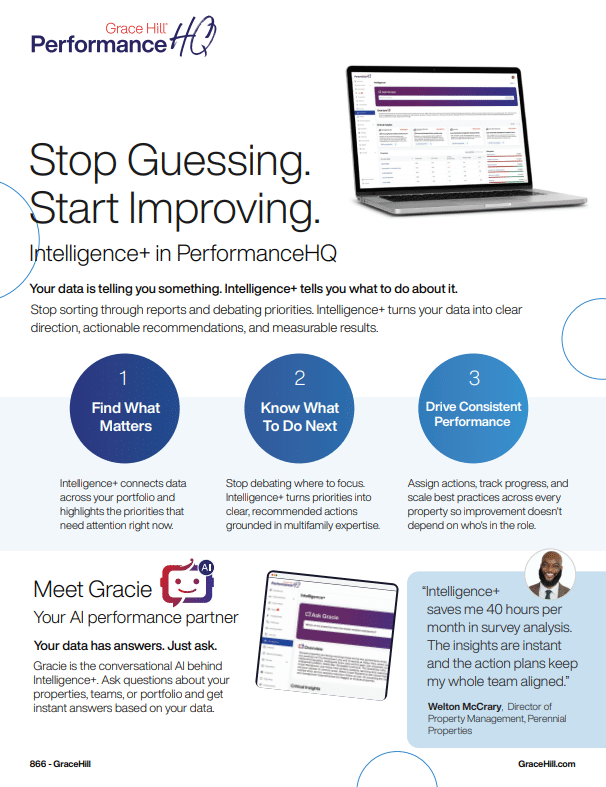
Turn performance data into prioritized action.
Intelligence+ connects training to real performance data so teams respond faster. When a gap surfaces, the right course surfaces with it.
More Intelligence+ Tools and Insights
Intelligence+ Enhancements Flyer

Intelligence+ Preview