


 Customer Support


ON-DEMAND WEBINAR
The Art of Onboarding:
Building Strong Foundations for Employee Success
Creating a positive first impression and fostering a welcoming culture is crucial to ensuring new hires start on the right foot. To achieve this, you must clearly articulate the organizational structure; introduce new employees to the company's mission, vision, and values; and provide the necessary tools and resources for success — all from the start.
By implementing these effective onboarding strategies, companies can transform their onboarding process and quickly turn new hires into high-performing and valuable employees!
Hello, everyone. We're going to get started in just a few moments. Thank you so much for joining us. We just want to wait to ensure everyone has opportunity to join. I love it. And it's Thursday. Lisa, I had to think about what day it was. It is Thursday. Right? Thankful Thursday. I see those numbers going up. I'm excited. You know, the anticipation has really been there for you, Lisa. Everyone was ready for you on two day. And we had that little technology glitch, and now we are here and ready to roll, and it's just gonna be a jam packed hour. I'm so excited. Oh, gosh. I'm so excited too. You know, we're gonna have some fun for sure. Kinda get people going, the excitement. Yes. Utilize that chat box. I'm all about chat Yes. Yes. If you're joining, go ahead and say hello in the chat box. Let us know you're here. I love it. I also love to see emojis. What's your favorite emojis, right? You? Where are we smiling? I hope to see a lot of smiles. That's what it's all about. My two favorite emojis are always the side. The side, like, crying, but you're laughing so hard that you're crying. Love that. Yes. Not the straight one, but the side one. The other one that, I really love is, like, with the smiley and, like, you can tell they're giggling and they have their hands in front. And I love that one too because it's sort of, like, I'm not gonna say anything, but it's funny. Oh my gosh. I love it. Hello. Hello. Oh, okay. I saw a lot of times. Do you have w Texas? Whoa. Sorry. I love everyone, but, you know, gotta raise your hands. We got some Florida in the house. Wow. This is exciting. Georgia, Ohio. Oh my goodness. I'm in Virginia. So we we're covering quite a bit of territory here. That is so exciting. Well, if you're ready, Lisa, I think we should just dive right into today's presentation tation. We have so much to cover within the time frame allotted. So I am excited to to just go right in Hello, everyone. Welcome to today's webinar, the art of onboarding, building strong foundations for employee assess, transform your new hires into rock star employees with these proven onboarding strategies. My name is Stephanie Anderson. I'm the senior director of communications and social media right here at Grace Hill. I've been proudly serving the apartment industry for the past seventeen years. And as many of you know, onboarding is very near and dear to my heart. It is a passion of mine since I started in multifamily, and it's actually where I gained my first corporate role as an onboarding specialist. Many people do not know that. So that is today's fun fact for you. That was back in twenty thirteen, which feels like a very long time ago. And, so, yes, I'm very excited about today's topic. All of this to say that today's webinar is extremely informative and very relevant to today's landscape. I wanna personally thank everyone for joining us. I wanna extend a special welcome to all of our Grace Hill Ellis and Edge to Learn customers. Today's webinar will discuss effective onboarding strategies that you can use And I guarantee, Lisa is going to leave you with some great takeaways for you to implement within your organization. But before we get started, just a few house keeping items. Today's webinar will be recorded for all attendees, and you will receive it later this week. As an attendee, you will be in listen only mode that's going to help to prevent any distractions, and so that everyone can hear clearly. And, you know, also keep in mind, we want you to engage. This is opportunity for you to interact with Lisa, not just for the Q and A at the end, but also throughout today's presentation. So I'm gonna invite you to use the chat box that many of you are already using. And you can also use the Q and A box when you have a specified question you'd like for us to call out either during the presentation or at the end. So now for the good stuff, we've gone through all of the prerequisites of today, and I am absolutely thrilled to formally introduce today's speaker. As a national speaker, Lisa Daniels has dedicated over sixteen years to the multifamily industry Lissi has excelled as a leader supporting teams and driving talent development with expertise and leadership development training and perform evaluation, she is committed to helping individuals thrive in their roles. Lissi's deep love for education and mentoring is evident in her volunteer work with the Apartment Association Grader Dallas and the Tarrant County where she contributes to the education committee and serves on the NAAI faculty. I will say from a personal perspective, I have shared the stage with Lissi. So she is one of the best in the business, and I've also experienced learning from her as a learner, when she is presenting. She also served as a Grace Hill customer for many, many years, and was most recently part of our advisory council here at Grace Hill. So very exciting stuff. I am absolutely thrilled to have her here. Please help me welcome to our virtual stage, Lissi Daniels. Oh my goodness. Thank you so much, Stephanie. Oh, I am so excited to be here. And like I call, it drops some nuggets, right, some insights on just how to have a strong foundation for employee success, right? The art of onboarding. And to be able to have this platform and speak on that is, truly exciting. So if you're excited that I'm excited, and I'm ready to get started. Stephanie, you're ready to get started? I'm ready. Alright. Let's go. Alright. So I always like to start this and say, in sales, first impressions are everything. Right? But then onboarding is no exception. As an employee's first date, we have to set that tone for their career within your company that you represent in that company culture. We wanna create that positive first impression. Companies, I truly believe, have to have an effective onboarding strategy which provides new employees with necessary tools and resources from guess what? From day one. And also, you should be able to introduce your new employees with your company's missions, your visions, your values, but also setting up that clear understanding of what your organization is, structure is and what it's all about. For your employees to have and become hyper forming, assets to your team and ultimately grow and be very successful. And that's why it's so important for me for this. And and throughout the years of learning, in the chat, I'm gonna go ahead and throw out a question for you guys, and Stephanie's gonna help me guide that. Okay? Have you ever started a new job and felt overwhelmed okay, or lost during your first week. I know I have. It can be very stressful experience. Right? And that's why I say onboarding is so essential. So if you have, put it in the drop, the chat box, and then we'll kinda go back to that. So why should we start now? Well, effective onboarding against sets the tone for the rest of your employees, experience within the company. I love this quote by Andrew Graham. You never get a second chance to make a first impression. First impressions count. With every new encounter, you are being evaluated. Right? Studies have shown that that person forms their first impression of another individual between seven seconds and two minutes. Remember how I went back and said, just how important is it is in cells Why would it be that just important when it comes to onboarding and taking our new employee through the steps to be very successful? They have already have that first impression of what your company is about. So let's continue to make it a very great one as that. It shows that you the company values your new hires. Right? It's invested in their success, and you can promote and create something very fun within that. I remember with one of my companies we did, interviews with our employees of what made our company so special. Or what was one thing about the company that was that experience that they enjoyed. And then we played that back, and then I did a training on that on top of that and what happens is it showed new employees the excitement of that company. It talked about the organization of that company on their structure. We talked about the creativity, but it really show that sense of community of what that company, has. Also, you can include your d n DeI if you have a DeI program. This also helps new hires better in their success, be able to see that you are welcoming and you have an inclusive workplace culture. So if you do have that program, incorporate that some way into your onboarding strategy so that you can make everyone feel welcome. And when you have this, it becomes a very smooth and effective onboarding, which leads to, we all want, right, higher retention rates, better productivity, and, of course, a positive company culture. And at the end of the day, you are then awarded or you're then known as that top company. Again, I always feel like when you have these effective tools, what you're doing is you are, as you see, it's displaying the value of that. It's promoting the engagement that you want your employees to have the excitement that they're coming to work every single day, but you are putting back the the information, the tools, the resources, everything with them that we're gonna talking about today. And then again, it promotes that positive culture. Right? That's every day this employee's coming to work that they're excited about their team, they're excited about their company, They're excited about the things that you're putting forward to them, but you're also showing that you value them that that's why they are a part of that. And it's not like you're just hiring them on board, providing them new hire paperwork and, like, alright, there's that empty seat Philip going on your ways. No. We're putting back into them at the same time. Stephanie, did we get any questions about any answers regarding the, how they felt overwhelmed during their first week or started or how that experience? Well, I will have to say that unanimously across the board, we were getting all yeses and quite a bit of them too. So I definitely think it's relatable. I did wanna point out, Marissa says you learn to try and be resourceful really fast in those types of situations, which I'm sure you'll agree. And the other thing I'll mention is Stephanie says, yes, would have been nice to have a buddy slash mentor. Yes. Yes. And I'm gonna get into that. You to hit it right on the nail because I think that's someone that can help you set yourself up as well, but you have that person that you can confide in and help you grow too. So I'm boarding by the numbers. I'm really big when it comes to just stats and letting you see when it comes without and with a successful onboarding program. Did you know I'm winning that really sticks out with me as twenty percent of employees turnover happens in the first six weeks. Wow. That's really quick. And as leaders in our organization we have to really step that up and say, are we providing our new employees with the success, the tools, the, open feedback, the adaptation alignment when it comes to them coming on board because, again, we're so excited to get hired on and be a part of your company But at the end of the day, now we're excited that we need you from day one until we transition to the place where we feel more comfortable than turn around and didn't have to be able to do that with someone else. Right? So think about that. Replacing loss executive costs business up to two thirteen percent. Whoa. That's with some high numbers. But with a successful onboarding program, look at this. Fifty eight percent of employees are more likely to stay for more than three years. Now that is good. Right? That's exciting. That's because you're providing the tools and doing that. And so as we sit there and continue to talk about how to create that positive first impression, right? It is about that warm welcome. I remember being on-site as a leasing professional. We're gonna talk about time frame because, you know, and at that time, I had a a leader assign me to appear just like it was mentioned earlier. Haven't appear to appear or a mentor. If you don't have a mentor program, that's okay. Set up and have a peer to peer it or someone that has experienced or been with the company a while to help that new hire through their first thirty six ninety days. But I remember I had a peer that, guided me through that onboarding process, right, helped me be there to where I didn't feel like I didn't I couldn't ask questions or they showed me. They sat there and they were they listened. They helped me through that. And if you have a mentorship program, that's even better. Right? That's something that it goes through the channels where that mentor is gonna be there with you for the first ninety six months if you're really lucky, they're gonna be there with you for the remaining of your career because that's how you set and build those relationships with that. But as I go back in that, that was one thing that stood with me when it came to me being, of that positive first impression and having that and I was a leasing agent over seventeen years ago. This is a long time. So again, things have changed and evolved so much since then. But you wanna make sure that also you provide that warm welcome and introduce with your team members. Right? It's not just them coming on board. It's been and having that welcome, video or welcome announcement or recognition of new employee and the excitement, but it's the team affair. Right? After you get through that, the onboarding paperwork that is very important. But at the same time, give them that office or let them feel like, oh, this is my new community. This is the place I'm gonna work with. These are my my peers that I'm gonna work with. I'm excited, but also making sure as a leader, we are giving them a clear, concise job to subscription when it comes to their expectations. Right? Their goals, their anything that's aligned. Have those conversations from day one because what you're doing is you're setting up that success continuously and it's not saying, okay, you're hired. Here's the keys. Good luck. Alright. I'll talk to you later, and they're sitting in that seat. That's setting them up for failure, and we definitely don't wanna do that. So you wanna offer that. Again, assign that mentor, give them the onboarding process checklist, however you have it set in place to be able to answer those questions and have that buddy to lean on to be able to walk through, all the new tech with the systems you have or everything. You've hired them for their skill set. You hired them on for a reason, now they gotta learn your culture and your company and all the tools that you utilize. But also you wanna make sure that you're emphasizing on that commitment, right, of that employees development. You wanna make sure the growth, the work life balance. Right? All of those are set up in that first week, first, second week, third week when it comes to your new employee, and letting them know that yeah, you've got hired on to this great company in this organization and everything that we provide. Now let me tell you more about us, right, and how is that? And and what we can do to even, you know, grow and build and develop you from where you're at. So if you have a leasing consultant and then they grow to the next position assistant, and a manager and so forth. So encourage that open communication because I think it's so important when you do that but you're allowing that time frame to where you are fostering that, open door, but that collaboration. And it really does start at number one. I'm at number one day one, but you're also building that team building. Right? You're you're welcoming all your new employees to be where they're like excited that the person is coming on board to help grow your business ultimately. And even if you're in leadership positions, that's the next leader up in the organization. I think it's so important to wrap your hand and provide that. And so that's why I I feel when you have that positive first impression, it's so mandatory because it can't make or break you just like we ourselves with sales. Again, it's still the same process. You're continuously trying to grow and keep your employees so your retention rates can be lower. And they want to stay with you for longevity at the same time, but you're creating them for their growth too. So with that, You want to provide them their resources. Right? And what does the resources look like? You know, that's all your different types of tools that you have I, you know, if you think about it, I remember being outside, like, learning new programs, right, or your new lead management system or property management systems, or just navigating how to go through your learning management system. Right? You need to be able to have someone be able to walk you through that provide clear instructions or, you know, detail. And that's where that peer to peer, that mentor comes into play with you that can help you give you the necessary tools to perform your job. You cannot set your employee up for success and be able to run something if we're not providing them with all the necessary, information tools that they have or they need, within your equipment. Right? We gotta make sure everything works. And that's just like, again, I I hate to always go back to how you utilize when new move ins come in. We gotta make sure everything's set up and ready for a new move in, but it's the same for our employees. We gotta make sure that we have them set up, right, and be ready to go on that first day. So, again, introduce your team to relevant again team members, and stakeholders and make sure that you're providing them with everything. You know, people like to see who the people are in their company, and that's our organization And what does that look like? Right? We had where I was used to the, Darja also where it had all of our organization and you can see who are top players or who are everyone was in our company, who you can go and meet, and who you can go, introduce yourself. But it gives you the clear vision of everyone from top to bottom and bottom to up. So, again, provide that information, and kinda talk through the company of that. I also feel that it's the who's who of your company too. And I like Jocelyn, because Jocelyn is a really good tool that we utilize when it came to our company organization. But it was also one of those tools that you I say it was like a Facebook for your company's Internet where you can be able to collaborate, meet, talk, and also, be involved with everyone in your organization at the same time. But then again, it goes into assuring that you have access this is all your resources. Right? So ensure you have access to your essential company's policies and and safety guidelines, making sure your team, your new team member is it has those resources and knows where to find them, knows where to locate them to where then there can be set up. And then you know that there's not gonna be any expectation or any situation where they're not gonna feel like I don't know where anything is at. Again, your ultimate goal is to provide that that's set up for them in that positive first impression as well. And what's very important is the feedback Right? So establish those regular check ins that I'm gonna talk about too down the line. And check ins is not six months. It's not within the year. Check ins is maybe after your first twenty four hours with them to come. How are you doing? Are you good? There anything I can help you with? Is there anything your peer is working with you on or your mentor is working with you on? It's not peer to peer. It's not it's the check ins with the leader and a new hire to where they feel value, but they feel like, oh my god, I'm excited. I still have an a great leader And we all remember our great leaders that it has been there with us and and shown us and peers or mentors that helps guide us through our, first day and on. Again, it's an exciting moment. So why would we not want to set that excitement up for our new hires to be the best that they can be. Right? Anything in the chat? Any questions before I can go on, Stephanie? I wanna just kinda make sure. There is a lot going on in the chat, but all good stuff. We've actually received a couple questions. Do you wanna dig in now? Yeah. We can I can answer, a couple, and it'll continue to go on? I just wanna make sure I'm still there too. Yeah. They are here. So Ali would like to know, can you share with us whether those numbers are all industries or just multifamily? And I believe that is referring to one of the first slides you went over with the data. Yes. So that is multifamily. Great question. Great. Now, Alicia would like to know how can you ensure that employees are utilizing the tools after they have been given access and guides? That's another great question. That's where I think the peer to peer and the mentor comes into place and making sure we do those check-in follow-up. Right, making sure our employees have and are comfortable with the tools that they don't have any questions and that they are open to come in talk to us about it without having to feel like, oh my gosh, I shouldn't say or ask those questions because I'm new to this. So I think open communication is very important. Awesome. Well, we're ready to keep going. Okay. Keep them coming. Employee engagement. Oh my god. Just this the part. You've you had that whole process of creating that positive first impression. You had that where you're providing the necessary tools and the resources and the things that is gonna be very important for it for your team members to say, but that's where you get the committed on the employee engagement. Right? This is according to a study by Glassdoor, companies with the Robost, and this is back in twenty twenty one. Onboarding process improved new hire retention by eighty two percent and predict productivity by over seventy percent. That's really good. So again, the the numbers are there. The facts are there. It's the fact that we have to continue to grow and build that for our employ our new hires as well. So engage your employees are most likely to be productive. They're most likely to be committed. And motivated to succeed if you have that foster of that engagement from day one of them coming on board and showing them that and having that clear understanding of what your company goals are, their values, and expectation. It's like sitting down at that day one and having that conversation. So it's like, okay. This is the expectations for the first thirty days. How are we gonna line that? I wanna make sure we have that open conversation. And you'd be surprised the productivity of what that employee is gonna come back and give you and have that when you have those open where you provide that open feedback for them. Right? New hires you feel supported. I always say value during that onboarding program. Right? That's where they're gonna feel like you are now invested in their success. It's not just hiring an employee for an empty seat. Right? It's now in hiring an employee because you value them, and now you wanna see their success, which leads to a higher retention which we're ultimately looking for, right, and lower turnover cost at the same time. So when you build those relationships from the day one and you are providing that positive, teamwork and that sense of community with your employees, you're gonna ultimately get back what you put in. They're gonna come to work excited. They're gonna come in and do the work. They're gonna come in and have a place where they feel that ultimate excitement of being a part of your company. And that's our number one goal is to have that, right, that positivity. Right? And so you wanna emphasize again on your company's commitment to your employee, right? Your the the commitment of what you're going to work with them through their process for their development, their growth, the work life balance in that as well. I mean, especially with everything that's going on, you wanna make sure that you are focused on that with your team member and the new hire. You know, they've done the research of why they're coming committed to you as a company. We have to also do our part too as an employer for them. But when you do that and have those processes and those expectations and you're aligning that and you're and you're letting your your employee know about that commitment. They're likely to feel that they're their professional goals align with you, right? Their company goals, the missions, the value, the visions, not the value of the vision, and leading to increase job satisfaction ultimately as your employee engagement that we are looking to see. But that also means that they feel heard. Okay? And they feel that they are part of you and your team, you and your organization, you and the and which gives them that motivation for engagement to come in and do the work, and they wanna stay long term. And I know in the chat, how many guys you just love overall the experience you have within your company that you ultimately come and you're like, you know what? I wanna go above and beyond. I wanna work and do this longer, and I wanna grow with That's all committed into that employee engagement starting. Guess what? From day one, and we have to continue to evolve and continue to grow that. Nothing's never like plateau. It's always forever changing. And ultimately, that's where we're, where you'll get that commitment at the same time. Okay, so now we're going to go beyond day one, right? So you, and when I mean beyond day one, I mean, like I've already set that tone for it and your expectations, it's about having that ninety day plan. And what does that look like with you and your employee? You know, when you have that scheduled training, right, the site you know, they have their compliance training. They have the things I gotta take care of. But now it's like, okay, you're you're past that ninety days. Right? You you've gotten to where you know a little bit about your job, your your your expectations, you're feeling a little bit more com comfortable. I'm excited. You're excited. Your peers with you. And now it's time for me to say, okay, let's do some of those check ins. Right? Don't wait until your yearly evaluation to check-in within your employee. Do those check ins. Yes. You may still have a peer or mentor helping, but do those thirty, sixty, ninety day check ins. You would be amazed at how that will make that individual feel when it comes to making sure that they're staying in line with your goals. The last thing you wanna be is at a yearly performance, and they're like, well, your goals don't align, or we have our expect expectation has not been set up in the right direction. So Again, make sure that you're aligning that. You're working with your team members and go a little bit be, beyond that. And so, and and and practical strategies for that in in creating their their career growth development plan, right? Cross training, or maybe it's you know, different departments, different roles. Again, this must be on that ninety day. This is going into that sixty month that six month This is going into that one year. This is where you're gonna start seeing, okay, what is it that you're aiming? What is it that you wanna grow and develop to? What is it that you wanna take more on electives? Or more on network or going into associations and going to different classes and certifications. This is all where you're going to start establish that come after that time frame of your ninety days and your six months. But it's also establishing your performance markers, right? Okay. So you're here. We're at six months. How are you feeling? What can we do? What is it that we both, you know, what that you need to work on or how I can help you? Or where I can take you to that next growth and what now I have your coach, and you're continuously having that feedback with that communication. I always say communication is so important. And it does. It's it's a constant evolving circle because that's what we're there for. We're there to help them grow, but we're also there for them to provide that that that fulfillment, that commitment that we want ultimately in your organization. And and that's what you're investing in. Right? That's where it's a little bit farther than just the higher on see. No. It's higher on. I value you. I'm gonna help you. We're gonna get you to that next level. I'm gonna grow we're gonna go to where, okay, where do you wanna be at now? You know, we're at we're at one year. What is your goals look like? How do you wanna align that? What is your expectation of me? What's my expectation of you now? And then where can we set that? And that's where you put those performance markers, and that's where it goes to. Okay. I wanna get my certification. Great. Boom. Let's let's look at how does that look like. Maybe it's additional training. Maybe it's shadowing or or cross training on that scent. Again, those are what happens when you are investing and you're providing that commitment as an organization with your new hire, but you're also making them feel like, wow, okay. I can see my longevity, but I can see my career growth. And it's the career triangle. It's that little up steps, right? And and most important, you wanna make sure that they feel like they can grow. And not just stuck in one little area, right, ultimately. And so that's why I say make sure you have those scheduled regular evaluations. It's so important when it comes with your your new employees and, your new team members. Okay. Any other questions? Anything else? I'm still moving on. I just wanna do a check-in. Okay. Thanks for the check-in, Lissi. We do. We have more questions, which is great. Normally, we get on webinars, and people can be a little bit shy or timid about asking, but this crowd is phenomenal today. Really, really, really. Bringing in the tough questions for you. Bring them at me. I love it. Hi. So question, how do we encourage direct leaders? To be consistent and accountable with these check-ins and one one-on-ones. Great question. Oh, wow. That is a really great question. I think the way you can hold I think we have to hold ourselves accountable, but at the same time as leaders, we need to have that open communication and feedback. And you have to make sure that you are doing the work too with them at the end of the day and making sure that you are, it's almost like showing that example for that, and you don't wanna lose that in the, at the end of the day, if that answers your questions. Great. Now we do have another question. Let's see. Do you recommend having managers use a formal check-in form that they must share with HR. That's a great question, Gail. Wow. That is. Can you repeat it one more time, Stephanie? Sure. Do you recommend having managers use a formal check-in form, so an actual paper or maybe even a digital and that they would share with HR each time. Yeah. I absolutely would recommend that. I think it would kinda keep things in the line. Alignment, but also setting up that expectation. So I do definitely would agree with that. I like that. And then lastly, Stephanie wanted to make note that something her HR department does is they schedule a check-in within two weeks to not just review benefits, but ask the important question. How's it going? Oh, that's the most important question. It's like, how are you doing? How's it going? And if there's anything I can do to help. And that's not just with HR. That should be with also within your team leads too. So I love that. That's a great point. And one final one final thing that came in right there at the end. Alicia, her company has that, but She also shares it with the training department for future check ins. Oh, I think you incorporate. I don't think it should always be about HR. I think it's a training process as well. If HRN training is working together, I think training should do those check ins at the thirty, the sixty because there's so many tools and systems and things that we have a new hire having to learn that, you're not gonna gravitate or be able to expand that all in just thirty days or sixty days or ninety days. Sometimes it's averages takes up to learning one's position of six months to a year, but then with all the new stuff that you have. So, yeah, I definitely do believe if you have the bandwidth and the team members to do that in the training department. Have that. I think it's very helpful for a new hire as well because you're you're ultimately there to help them up for success. Absolutely. I couldn't agree more. Alright. You guys are coming at it. I love it. This is, you know, it's it's important at the end of the day, you know, your onboard if you don't have an onboarding program, It's not to where you can't develop something small and make it big and grow. But if you do, always having to make sure that you are evolving with different changes and making sure you are incorporating everything when it comes to your organization because ultimately it you want everyone to see the vision. The vision of what your organization is and what they're aiming to on top of that, but every day that they're coming in and putting in the work, so they feel like I'm not just coming to work. I'm coming to work because I'm part of the bigger picture, right, the bigger impact. And that's what the the whole onboarding strategy is and the whole process is is taking that one day and developing the smaller systems to build to be bigger systems, but ultimately to provide that commitment so you can have lower, costs when it comes to retention. And you're developing an individual to be the best that they can. From the very first day when you provide that positive first impression and that overall, engagement of your excitement. Right? I can't go enough and say when I first when I was doing videos for onboarding training, I love to see the smiles, the excitement, of a new team member coming on board and being like, you know what? This is exciting. Wow. I didn't know about this with the company. Yeah. They did their research but it's a little bit more. Right? They had that face to face of someone really welcoming them in that sense. So So going through these different strategies of why it's so important and creating that positive first impression and providing them with the tools for them to be set up It's so important for that longevity and that employee engagement that you wanna have and come back to at the end of the day. But it sets that foundation for success, which then can lead again to higher retention rates better productivity within your employees. So then they don't feel like they're just coming and they're just another number, but they're coming because they're valued, they feel welcome, they're part of this organization that's bigger and they can foreshadow and they see the impact that they can make, but it gives them that continuously long term success for growth. In the company. Right? They can see, okay, I'm not gonna be in my position like this forever. I can grow. I can take new different courses, different classes, And, I can go out and network, and I can get certified to even be veteran through my role, and then continue from down the line. And that's what we ultimately want. From our teams, but from ultimately from our new hires, but building that. And it starts with us, right? Us as are as employers and us as organizations for everybody new that's coming on board within our company. So with that, I definitely want to leave this with you in the sense that the only thing worse than training employees and losing them is not training and keeping them. I'm a big zig ziglar fan, but it's the very most important thing that we have to kinda remember. It does start with us from the very beginning. And at the very end, we set that tone, and you ultimately wanna make sure we have that positive tone. That's referrals. That's more people come to your organization. That promotes that longevity. And at the end of the day, that creates a, a positive healthy environment. And that It's it on that. Oh, my goodness. Yeah. Well, yes. We have more coming in, which is great. Okay. But let's pause for just a moment. I think so. Thank you so much for leading us through this important content in such fun and engaging way. You know, I feel connected to you. I'm sure our attendees do as well. You have great energy you're putting off and just sharing so much knowledge. Now I want to tie that knowledge just a little bit to what we do at Grace Hills. So before we dive into more of the Q and A, because I promise we're gonna get to that. I just wanna let our audience know that if your team is challenged with any of the topics that we've discussed today. Our team at Grace Hill can help. We truly understand trials and tribulations of onboarding and compliance along with the excitement of things like diversity, career advancement, inclusion, and so much more. We offer training and policies on onboarding that will enhance programs that you already have in place or if you haven't started yet, we can help you get started as well. With our industry leading policy survey training and assessment solutions, you can proactively set the standard for your team and the industry might I add, while giving them professional development, which we know many associates crave. So our experts are actually available today right after today's webinar. They can set up a personalized demo and a consultation for you. So in order to do that, I would love to, kinda take a pulse of the room really quick. If you are not a current client of Grace Hill, and or you want a demo to learn more about a solution that you don't have because we offer comprehensive solution packages. So say you have training and you're interested in policy or you're interested in surveys or mystery shopping, we would love to help you with what I want you to do is use that chat box for me. We have a special word for today to help us get to you as quickly as possible. The word is onboard. No surprises here on board. That's o n b o a r d on board. And then once you do that, a member of our team will contact you shortly to help in any way. We're a brand new client and we're doing the setup now. Yay. Cindy. Well, welcome to Grace Hill. We are thrilled to have you. And, of course, should you have any questions or concerns? Our team is here to help you as well. Okay. One other thing I wanna mention is we hope you're following us on social media because we have a big announcement coming next week. And if you follow us on social media, you'll be able to get that announcement before anyone else. So super excited about that. Stay tuned exciting week Halloween next week, first of November, which really kicking off holiday season, and big announcement from Grace Hill. So Love, love, love all about that. But now it's time to focus back on we see because we must utilize the time to ask the ex So if you haven't done so already, I wanna encourage you to either use the Q and A box or that chat box there on your screen. Go ahead and enter in any questions that you have for Lissi, and we would love to help you. So I wanna go back up in the chat while we're allowing people a little bit of time to to input things and, just see some of the suggestions that we're coming through in the chat because there's some great conversation happening. I love you. So let's have a a Brenda. Brenda had asked, in your opinion, Lissi, do new hires feel comfortable sharing truth when things are not going so well. Oh, that's a really great question. You know, I think new hires sometimes feel the overwhelmedness and sometimes they may not feel, open with that feedback because of their position. I think it starts with us as our as an an organization or as leaders to make that welcoming feedback and conversation and open line of communication. Comfortable for them to be able to be honest so that and you can help them, set up for that success. But I think it really starts with us and really seeing and asking the right questions. You just nailed it. Allie said the same thing she said is about asking the right questions. I couldn't agree more creating that safe space as to say, Lissi, to to really engage with them and get that truth. Linda would like to know, do you have any thoughts for field employees? So she's talking specifically about maintenance. So maintenance team, their onboarding seems to always be a little bit different. So any thoughts there or any advice you can give No. You know, but yes, not no. I'm sorry. Yes. I definitely I definitely can give you some thoughts You know, with maintenance, it's always hard to get them on that right page to kinda get through the training, but maybe have it as a group training session, maybe have it as come on board and let's talk you through or have your maintenance supervisor be very engaged with their team and your team and really develop an outline plan. Of how you can help them and let them see the bigger picture. I think when you get their buy in from it and let them see that it is important. It is exciting. Then you're going to get that where they're like, okay, I'm gonna work towards this and have that buy in. But I think again, it goes back to starting us, starting off with us as leaders, and letting them know, like, it's not something you have to do, but it's something that's gonna help and and be help you be more successful down the line. I think that's fantastic. You know, if you're in the chat, which we hope you are, there's a lot of great conversation for our attendees happening, with some great advice coming from your peers, which I always think is one of the most beneficial parts of connecting on events and webinars is what people are doing. So We won't take up too much time to go through all of those, but I do encourage everyone to check out the chat if you can. Let's see. Let me look. I can I can pop over there? Yeah, there's so much about onboarding and and knowing what everyone is doing. Okay. So Valerie, she would like to are Valeria? I hope I'm pronouncing that right. I probably am not. So my apologies, but she or he would like to know what do you suggest is the best way to propose a new onboarding strategy to your company? I like that. Thinking outside the box and actually putting something together. I think it's just starting. Right? I think it's just building something and getting the buy in from other team members, other managers, leaders who that, wanna see certain things incorporate or change in building that and then presenting that. Right? And getting that buy in from, your peers at the same time. I think it starts with doing the research, knowing, you know, and in starting in starting out and in in starting those checklist that outlines. I think early on, it was just a checklist, build that checklist even bigger. And then from that, build it even bigger than that, and you become and have a full strategy. I think it, it starts with key players, but it also starts with making sure, again, asking the right questions and just picking that step forward. You got this. Great advice. Michelle Wood would like to know what automations are you using to help the onboarding process and tracking. Oh, that's another good one. I think there's so many different automation, tools out there that you can utilize for tracking your onboarding from, your HR pay comm or your, gray seal. Anything that's gonna help you set the tone for that next. It just depends on what you're utilizing on-site within your company. But, yeah, definitely research out there and find because I know there's a lot out there that can be very helpful. And of course, there's lots of conversation in the chat about providing foods, you know, making training fun, onboarding fun, donuts are mentioned. So now I'm hungry. I definitely saw the donuts for the maintenance. So, yes, I think food is something to their stomach. Yes. Yes. Yes. Yes. We'll keep this great conversation going. Oh, Rich says Make a note of this, Lissi. It's gotta be dunkin donuts though. Dunkin donuts. Oh, I love that. I think anything to promote that, right? Those meetings and say, hey, it is a training day. It's an onboarding day. It's, you know, welcome day. Have something and let them feel like they're part of that team. I think that's very important and not so much real quick to put them in front of a computer and do work, make them feel that value from day one. So Stepping gave a suggestion that they use CLEAR Company for onboarding. I'm actually not Okay. She says, in addition, they partner with our payroll service, which integrates most common information to reduce repetition. So that's good to know. Amanda says I just did my first safe training seminar with the maintenance crew and brought donuts and coffee. Well, there you go, Amanda. You just won the day. I love that, Amanda. That act actually hits it right on the target. Our com okay. Stacious that our company has spread across multiple states. How do we create an effective onboarding experience for all different role levels in a more heavy virtual environment. Oh my gosh. That's a good question. So at one of my previous companies, when I was talking about doing the onboarding, training, we developed a class. We did videos. We did interviews different team members, all levels. I was doing onboarding for VPs. That's kinda crazy funny. Right? But what we did is we made it to where we basically talked about the culture of the company, the values of the company, and brought in the fun side of it, but really kind of based on what your HR, you have to do as far as your first day. And then just make sure that they knew what the organization was about. Right? The, you know, the, the who's who of the company. And just be natural, whatever it is, and train on that. And I think it was, a peer to peer person, the person like me, or, or just individual on the webinar and speaking to talking about that, that they saw that. And we had employees across all over. So, again, I hope I answered that. I know I've got back into that Oh, tuna. Going back down the memory lane of excitement for that. No. I think that was great. And that kinda ties in a little bit to Melissa's question. Melissa Bell really wants to know any specific tips for onboarding remote employees, which is obviously very relevant given our current times. Yes. Utilize your your webinars, your your virtual, but make it to where it's someone speaking, right, have that person to where they can be like, hi. Welcome on board. I'm excited you're part of our team. People need to see people, especially if you are remote. To where they can feel engaged and they can feel a part of that team no matter if it is a thirty minute call or thirty minute you know, class whatever that you have set forth, let people see people because I think that's what promotes the engagement ultimately. Absolutely. Christy wants to know, can you give an example of what the fun side would be? I'm assuming when you talk about fun side training. I think the fun side is just the engagement side of it. Right? I think training's fun all the way around. And when I mean fun, I mean, just within your company, like, what do you guys do as community service, what perks your company has, the involvement, the, you know, your teams, what they do when it it means to, have and build that community within their team, and team building bonding, events, functions, anything of that, that's what I mean by funds. Like, that's the creative side of what your company culture is about. It's not all about come to work. This is the culture side is what you're promoting and that excitement of that of your organization. I mean, I couldn't agree more. And I think anytime you can incorporate other things that fun for people. So we talked about food, but, you know, swag. Don't you want your employees to reap your company. Right? Here we Hello. Give them great things that they can wear and utilize and that can show off your brand, and they're proud to show it off. So I think that that's another great way to make it fun. Nikki, Nick, I'm sorry, Nikki. I I said Nick, Nick, a bill nap. He said, what about tips and ideas for culture building remotely. That's a really good one. And maybe sometimes that's something that you can line within your budget and and say, okay, we're gonna meet at a time frame you know, it's very different with each organization, or maybe it's getting on a zoom like this and having, like, alright, it's team building. This is what we're gonna do. Maybe come with different things to the, table ideas or, you know, goals, whatever it is that you guys wanna share and talk about. Maybe it's just your highs and lows of the week. But what you're doing, you're promoting team building in existence, but you're on virtual and you're one zero one, but at the same time you're having fun with it. I love it. We're we're hearing people talk about music. Music's a great way. Lissi, you and I, when everything went array on Tuesday, we listened to Taylor Swift to get ourselves back together. I love, you know, Montel, Jordan on here talking about this is how we do it. I mean, it's fun I I really feel like it's all about the environment that you set up and the engagement, the energy you put out, you're gonna get back. Exactly. I totally agree with you one hundred percent. You guys have such great questions, such great, and and engagement in itself that I am loving this. So, yeah. Thank you. I do have a question. I wanna go back up. I think we missed this one. Rich had a question that others are saying great question So let's touch on this. Thoughts on how company leaders can ensure that lower level leaders, so working supervisors, as an example, have the bandwidth to support new hires? I think it really starts with making sure that within an or you know, and I can only speak on that within an organization and making sure that you, you hire enough for each individual employee, especially making sure that let me rethink that question. You wanna make sure that you have enough staffing in place to be able to handle the bandwidth. And if you don't have the bandwidth, make sure you bring that up within your your budgeting and making sure you are having that where you can add additional bodies for your team. And also making sure that, you know, you are not stretching the limits of your current employees at the same time? Yeah. I think that's a great point. You know, I think it's important to provide resources to employees. And when you have things like policies and training set in place, it makes it consistent for everyone. So then you allow your creative side to really add that layer, add something to it that makes it fun and engaging, but also making sure you're checking all those boxes, which is also important. I think that's a great question and a great answer. No. It that's a very great question. Mine said it's important as well. Understand that once you turn that person up, they will be able to take the load off. And that goes back to that beginning. Right? That period peer and cross training and leveling them up. So then that helps if you can't have the budget to hire on new individuals to be part of the team, but you have someone there to help out when it comes to your supporting departments, right, your training departments to work on that end. So And you know, mindset, my mind always goes to no pun in attended. I want to invest even if I'm super, super busy. I wanna invest so good into new employees. Because when I wanna use things like PTO or I have other priorities happening, they should be able to run the show. They should be able to do things. So I know it it's hard especially when everybody's super busy, but when you view it as an investment through that mindset, it makes a huge difference. I love it. Alright. Well, we are getting to the tail end here. So we'll give just one more moment for anybody to ask questions. But, Lissi, if you wanna go ahead and share your information, that way, if anyone has additional questions, wants to contact you interested in any of your services, I wanna make sure that they have the opportunity to do that? Yeah. Definitely, you can reach me on my website for any inquiries at lacy daniels dot com. I'm also on linkedin, l c d social media handles at lacy Daniels is my Instagram. Definitely, you guys, connect I can also help one zero one, provide additional support, coaching influence, you know, all the energy and excitement as well too. So, again, thank you so much for this and being a part of this and utilizing that and with my insights and having fun. Yeah. We're getting a lot of positive feedback. I think we'll take just one more question since it's in the chat, Lissi, if that's okay with you right before we end. What are some best practices for creating manager-level onboarding checklist that these working supervisors can use and follow and hopefully help with some of that workload. Yeah. I think your checklist has to do with your day to day operations and making sure that they align with your expectations. It's one thing to create a checklist and not have everything being aligned with what you're wanting to set your employee up. But then when you put these check these checklists in order, making sure that your managers understand the importance tones of it, making sure that they're following through with it, making sure you have key check ins with them to make sure that they're setting that tone with it as well. Because we can set and provide all the forms needed down. But if we're not sitting there, doing our check-in with our leaders to make sure that they're filling if fulfilling that in their end, then that's on our end. So again, I think it goes back to making sure that we're not creating more work but making sure that we're creating enough to where it does align to what we want them to succeed in. And it does, it starts with one. So, again, don't overboard a checklist, make sure your checklist or something that stays in, in line with your expectation of your organization. Great information. Barbara said great webinar. I've taken a lot of information that's very useful. That is exactly where our goal is. And so thank you so much for sharing that. Again, if you missed it at the beginning, we did record the webinar. We will be sharing it out for anyone who wasn't able to stay within its entirety or you're like me and you get sidetracked and you're taking notes and then you know you missed a crucial piece of information, you'll be able to capture all of that, through the replay. So happy to share that in the days to come. Thank you. Well, Lissi, I tell you this has been a fantastic hour. I am so grateful and appreciative of you agreeing to come and speak on our webinar at Grace Hill. And most importantly, just sharing all your knowledge. You have great experience on this topic as well as so many other topics. And you have really helped all of our attendees today to, take actionable takeaways, and I can't I can't wait to see what they're gonna do with the information that they learned. Thank you. Again, Grace, for having me. Thank you everyone else. I've had fun. Yeah, go out there and be amazing. Absolutely. Be awesome. Like, I tell my kids every more be awesome. Alright. Well, thank you all for attending again today. And thank you, Lissi, and I hope everyone has a terrific Thursday. Bye bye now.
Poor onboarding experiences lead to a 50% higher employee turnover rate.*
Streamline your employee onboarding processes and ensure every employee has a clear path to success with Onboarding Pathways in PerformanceHQ!
5 Effective Onboarding Strategies for Multifamily Teams
1. Prioritize the First Impression
- Create a Warm Welcome: Make new hires feel valued from day one. This includes introductions to the team, a welcome video or announcement, and a designated mentor or peer buddy.
- Clear Expectations: Provide a concise job description and clearly outline expectations and goals from the start. This sets the stage for success and reduces confusion.
2. Invest in Employee Engagement
- Foster a Supportive Environment: Emphasize the company's commitment to employee growth and development.
- Encourage Open Communication: Regularly check in with new hires (within the first few days, weeks, and months) to address any concerns and provide ongoing support.
- Show Appreciation: Recognize and value employee contributions to build a positive and motivating work environment.
3. Develop a Comprehensive Onboarding Process
- Provide Necessary Resources: Ensure easy access to all essential company information, policies, and tools (e.g., HR documents, software training, etc.).
- Implement Regular Check-ins: Conduct formal check-ins (e.g., 30-day, 60-day, 90-day reviews) to track progress, address any challenges, and discuss career development goals.
- Encourage Feedback: Create a culture where employees feel comfortable providing feedback on their onboarding experience and suggestions for improvement.
4. Focus on Employee Development
- Create a Growth Plan: Work with each new hire to develop a personalized career growth plan that aligns with their professional aspirations.
- Offer Opportunities for Learning and Development: Provide access to training programs, workshops, and mentorship opportunities to support employee growth.
5. Leverage Technology
- Utilize HR Technology: Implement HR software or platforms to streamline onboarding processes, track employee progress, and facilitate communication.
- Embrace Digital Tools: Utilize online resources and communication tools to facilitate knowledge sharing, collaboration, and remote onboarding.
- Incorporate Employee Surveys: Employee surveys are crucial for refining your onboarding process and enhancing the new hire experience.
By implementing these strategies, organizations can create a strong onboarding foundation that sets new hires up for success, increases employee retention, and fosters a positive and productive work environment.
Our Speakers

Lissi Daniels
Influence Coach, Educator, Podcast Host, and Inspirational Keynote Speaker
As a national speaker, Lissi Daniels has dedicated over 16 years to the multifamily industry. Lissi has excelled as a leader, supporting teams and driving talent development. With expertise in leadership development, training, and performance evaluation, she is committed to helping individuals thrive in their roles. Lissi's deep love for education and mentoring is evident in her volunteer work with the Apartment Association of Greater Dallas and Tarrant County, where she contributes to the Education Committee and serves on the NAAEI Faculty.
With boundless enthusiasm, Lissi empowers others by sharing her knowledge, motivation, and inspiration. Lissi is an NAAEI Faculty member and graduated with a Bachelor of Arts in Mass Communications from Southwestern Oklahoma State University in 2001.

Stephanie Anderson
Senior Director of Communications and Social Media | Grace Hill
Stephanie is the Senior Director of Communications and Social Media at Grace Hill and has over 17 years of property management experience. She is a leader in multifamily, bringing a unique 360-perspective gained from her previous roles as an operator, a nonprofit association manager, and a supplier partner. Stephanie brings a wealth of knowledge specializing in industry trends, creative marketing, and employee engagement.
Stephanie graduated from Virginia Commonwealth University, majoring in English Literature and Women’s Studies. She also holds a Virginia Real Estate License and is a certified Mental Health First Aid Trainer. Stephanie is a proud graduate of NAA’s Leadership Lyceum and passionate about promoting awareness of human trafficking in rental housing.
More Employee Onboarding Tools and Insights

Onboarding Pathways in PerformanceHQ Preview
Onboarding Done Right: 8 Proven Elements That Empower and Engage
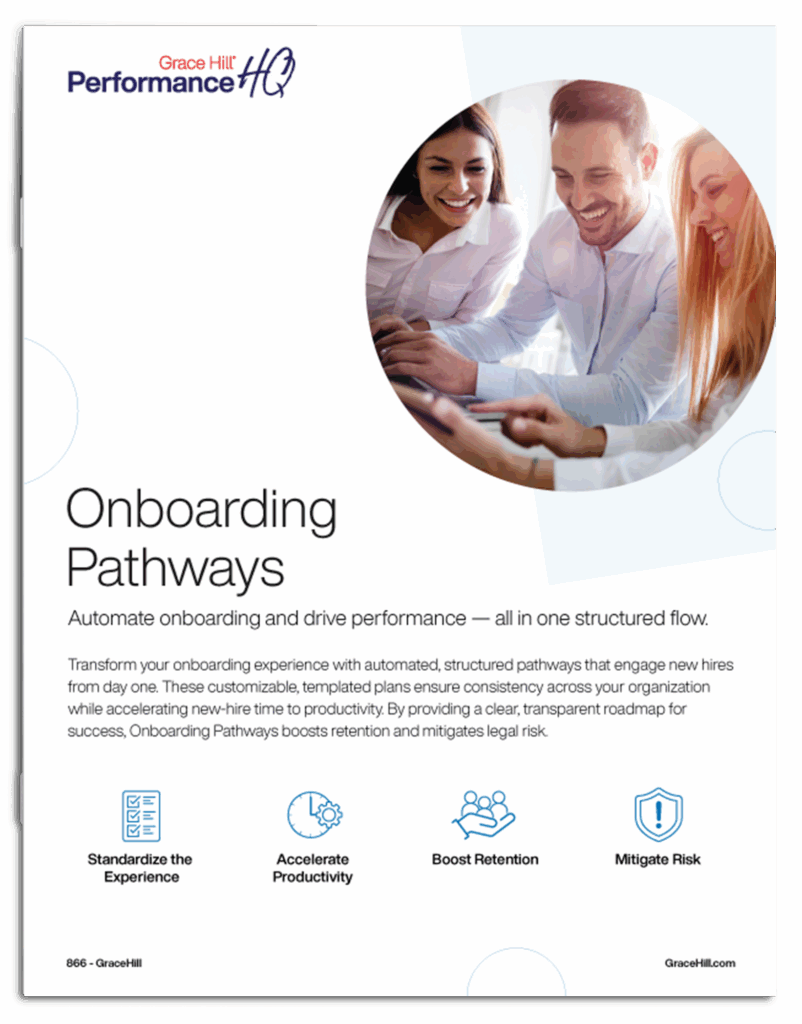
Onboarding Pathways in PerformanceHQ
*Source: Society for Human Resource Management, 2021