


 Customer Support


Multifamily digital marketing can feel like a maze — should you focus on building a strong online presence for long-term visibility, or target prospects immediately with precision campaigns? What isn’t unclear: Everyone is looking for the secret to a successful multifamily marketing strategy. Is it a long-term investment or a quick, targeted campaign?
That’s the core debate: SEO (Search Engine Optimization) vs. geotargeting. While often seen as competing strategies, the truth is they’re more powerful together, forming a hybrid approach that maximizes both reach and urgency.
In this article, we recap the powerful takeaways from the “Great Debate Live” webinar, featuring experts Tracy Cherry, Director of Marketing for NE Property Management; multifamily marketing executive Kadi Mancuso Rice; and James O'Loughlin, CEO and co-founder of Pixaura.
During the live event, they discussed how multifamily marketing ideas, from SEO to hyperlocal geotargeting, can work in tandem to fill vacancies faster and build long-term brand authority. Now, we’re delivering their words of wisdom in print as a resource to help you learn and grow in your multifamily digital marketing efforts.
Jump to a Section
Defining the Strategies: A Dynamic Duo
Before you can begin crafting an effective digital marketing strategy, it’s important to be clear about the terminology. So let’s start with some clarification and simple definitions.
What is SEO in Multifamily Marketing?
SEO, or Search Engine Optimization, is the practice of optimizing websites and content so that your properties appear prominently in search results. Rice emphasized, “SEO is the foundation of long-term cost-effective marketing strategies,” as it helps potential renters discover your apartments when they are actively searching for specific amenities or neighborhoods. Investing in SEO ensures that your properties remain visible over time, capturing organic traffic from renters who are ready to make decisions.
What is Geotargeting?
Geotargeting delivers digital ads to prospects based on their geographic location, creating hyper-relevant messaging that can generate immediate, real-time results. This approach is crucial for filling immediate vacancies or when urgent leasing goals must be met. O'Loughlin noted, “GEO can give you immediate results when you need results and you can't wait around.”
Why Does Understanding SEO and Geotargeting Matter
And for many multifamily marketers, that’s the real question, right? Why does understanding SEO and GEO actually matter? With everything there is to focus on in the multifamily space, at what point do we just cry, “Uncle!”
Well, here’s the hard truth: It matters because renters are looking at fewer places in their searches for housing, and your ability to attract potential residents all boils down to your ability to be seen online — now and in the future.
Consider these startling statistics uncovered in Apartments.com’s Q2 2024 Renter Survey: Out of 30,000 renters, 68% said they seriously consider only 2-3 properties, and the site's data shows that almost 70% submit just one lead.
And touring data from Zillow's 2024 Consumer Housing Trends Report indicates this is indeed the case. In fact, as noted in the chart below, the typical recent renter takes just one in-person tour — almost 19-20% take zero tours.
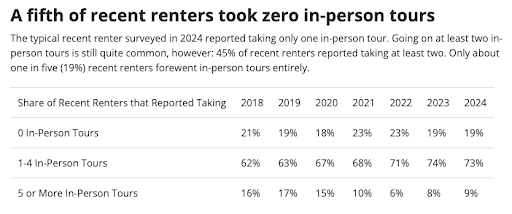
The bottom line is that shoppers narrow their choices based on online reviews, resulting in fewer tours. And what this means for multifamily marketers and onsite leasing teams is that the prospects who do show up, whether online or in person, are highly informed and have likely already established parameters for what they want — and expect — from their next home.
So, yes, it matters, and for multifamily marketers looking for a digital strategy that yields results, a two-pronged approach is required.
The Long Game vs. the Quick Fix in Multifamily Digital Marketing
As with most things in life, your multifamily digital marketing strategy is less of an either/or and more of a yes/and. Attention to both SEO and GEO is what will ultimately move the needle.
SEO as a Long-Term Investment
When it comes to multifamily digital marketing, SEO functions more like a marathon than a sprint. Think of it as planting a garden or investing in bonds — it requires patience, nurturing, and consistent effort, but the payoff is steady and long-lasting.
As O’Loughlin explains, “SEO is like investing in bonds. You're gonna get long-term dividends, but you don't know when you're gonna cash out on them.” This reflects the nature of search optimization: Results don’t happen overnight, but once established, they can deliver sustainable organic traffic and build credibility with both prospective residents and search engines.
Rice echoes this sentiment, emphasizing that while geotargeting might provide immediate traction, SEO lays the groundwork for stability. “Geo targeting... is going to generate those immediate leads. But once those stop or once [a] certain campaign stops, the results can as well.”
By contrast, investing in a well-optimized website, hyperlocal content, and strong reputation management creates a foundation that continues to deliver results long after specific campaigns have ended. In other words, SEO isn’t a “set it and forget it” tactic — it’s a disciplined, ongoing strategy that ensures consistent, high-quality leads for the long haul.
Geotargeting for Immediate Results
While SEO lays the foundation for long-term growth, geotargeting answers the call when urgency is the priority. If a property suddenly faces a high vacancy rate or needs a quick leasing boost, hyperlocal ad targeting can deliver fast results. As O’Loughlin notes, “With the investment in geotargeting, you know that you need something right now. There’s an immediacy to the problem.” Unlike SEO, which builds momentum gradually, geotargeting campaigns provide instant visibility and the ability to test what’s working in near real time.
This immediacy is what makes geotargeting such a powerful “quick fix” tool in the multifamily marketer’s toolbox. By zeroing in on prospects based on location, demographics, or behaviors, property teams can connect with the right audience at precisely the right time. This has become increasingly important as Apartments.com reports that the average search window has compressed from 46 days in 2021 to just 27 days in 2023. These trends show that the buying window is becoming shorter, making immediate and targeted marketing essential.
And because results show up quickly, campaigns can be adjusted on the fly, helping teams maximize spend and adapt to changing market conditions. Still, as Rice points out, relying on geotargeting alone can leave results vulnerable once campaigns end. The real strength comes in layering these tactics, delivering both the quick wins and the lasting dividends that keep occupancy strong.
Overcoming 3 Common Challenges and Measuring ROI
Marketing in multifamily often comes with unique hurdles — from tight budgets to the need for leasing team alignment and evolving renter expectations. Measuring ROI isn’t always straightforward, but operators who frame marketing as an investment and back strategies with data are better positioned to gain support and maximize results. The following areas highlight some of the most common challenges and practical ways to overcome them.
1. Marketing Budgets
One of the most consistent challenges for multifamily operators is finding room in the marketing budget for both proven strategies and new initiatives. It’s easy for marketing spend to be viewed as a cost center, but reframing it as an investment can shift the conversation entirely. By equipping teams with the right data, decision-makers can better understand how dollars spent today translate into long-term leasing success and brand credibility.
“Think of it as an investment and not an expense,” explains Rice. “And in order to educate those around you on that, you’ve got to empower them with that data.” This means moving away from vanity metrics and instead focusing on measurable outcomes, such as:
- Lead-to-lease conversion rates.
- Quality of website traffic.
- Engagement on community-specific campaigns.
When teams present marketing strategies in terms of returns rather than costs, they can protect their budgets and gain buy-in for high-value initiatives.

2. Leasing Team Buy-In
Even the most well-crafted marketing strategy won’t succeed without leasing team support. One of the most challenging hurdles is getting leasing professionals to see how efforts like SEO and geotargeting directly impact their daily work. To bridge this gap, operators need to connect the dots using real data from tools such as Google Analytics, CRM dashboards, and call tracking software. By demonstrating how targeted campaigns generate qualified leads and enhance conversion opportunities, leaders can transform skepticism into advocacy.
Cherry puts it simply: “When we help our teams understand the why behind the strategies, they become our biggest advocates.”
By educating teams not only on the tactics being used but also on why they matter, operators create champions within their leasing staff. These frontline professionals, once convinced of the strategic impact, are far more likely to embrace them and even use data to reinforce the story with prospective renters.
3. Evolving Renter Expectations
In a competitive rental market, static listings aren’t enough to capture attention. Prospects want to see and experience the property before making a decision — and video content offers exactly that opportunity. From polished virtual tours to casual neighborhood walk-throughs, video helps humanize the leasing process and builds trust, especially for out-of-town renters who can’t visit in person.
Video is also about context. O’Loughlin notes, “You’re reminding [them], look how close we are to these places.” Highlighting nearby shops, parks, or transit hubs brings the community to life and reinforces convenience. And for many renters, the absence of video can be a deal-breaker.
By prioritizing video as a core marketing asset, multifamily operators not only differentiate their properties but also meet the evolving expectations of renters head-on.
Together, these challenges highlight a common theme: Success requires both data-driven insights and a willingness to adapt to renters’ preferences. Whether it’s justifying budgets, earning leasing team support, or investing in the right content, operators who approach marketing as a strategic investment position themselves for stronger results.
The next step is understanding how these individual efforts come together because the most effective approach isn’t one or the other, but a hybrid strategy that blends the strengths of multiple tactics.
Why a Hybrid Approach Is a Winning Strategy
So now you’re left with the question, “What now? As an apartment marketer, should I use SEO or geotargeting?“ And the answer comes down to this: No single tactic can drive multifamily digital marketing success on its own. The most effective approach combines SEO and geotargeting, creating a hybrid strategy that ensures your property is both visible and compelling to the right prospects.
“SEO and GEO are like the dynamic duo of multifamily marketing,” notes Cherry, “It's all about knowledge and what that looks like [and making] sure you're knowledgeable to share with your teams.”
When executed well, a hybrid strategy:
- Builds a comprehensive, data-driven marketing plan that tells a compelling story
- Attracts high-quality leads.
- Drives business growth.
It’s about pulling at the heartstrings while establishing credibility, empowering teams with knowledge, and showing measurable results.
Are you ready to take your multifamily digital marketing efforts to the next level? Connect with our experts to learn more and ensure your marketing is both innovative and effective.

Tracy Cherry
Director of Marketing
NE Property Management

Kadi Mancuso Rice
Multifamily Marketing
Executive

James O'Loughlin
CEO & Co-Founder
Pixaura Marketing Agency

Traci Johnson
Chief Marketing Officer
Grace Hill
More Multifamily Marketing Tools and Insights

Multifamily Marketing Ideas for Leasing Apartments: How To Stand Out
