

 Customer Support


You’ve spent weeks building your 2027 property budget. The numbers are entered, the assumptions are made, and you’re finally ready to send it up the chain. Then the questions start.
- Why are we projecting that much rent growth?
- Where did this occupancy assumption come from?
- Are competitors really offering that concession?
- Why are we increasing pet rent?
- And are these actually the right comps?
Suddenly, you’re back on competitor websites, checking rents, searching for fees, validating concessions, updating spreadsheets, and reconstructing the rationale behind numbers you’ve already spent hours developing. Sound familiar?
The challenge with budget season isn’t always building the budget itself. Often, it’s gathering, and later defending, the market intelligence behind it. We’re here to show there may be a better way.
A Number You Can’t Source is a Number That Can Get Sent Back
Budgeting requires plenty of property-level knowledge and judgment. But many of the assumptions that drive a multifamily budget depend on something beyond the four walls of your community: what’s happening in the market around you.
Rent growth. Loss to lease. Occupancy. Concessions. Ancillary income.
And the market doesn’t stand still while you build your budget. Rents move. Concessions can change even faster—a month free, a waived amenity fee, or a pet incentive that wasn’t offered last quarter. Each shift can affect what you can realistically charge, how quickly you can fill vacant units, and ultimately, the revenue you can expect your property to generate.
That makes reliable, current market data an important part of the budgeting process. Overestimate achievable rent or occupancy, and you may be building a revenue gap into the budget before the year even begins. But gathering the market intelligence needed to pressure-test those assumptions has traditionally required a lot of manual work.
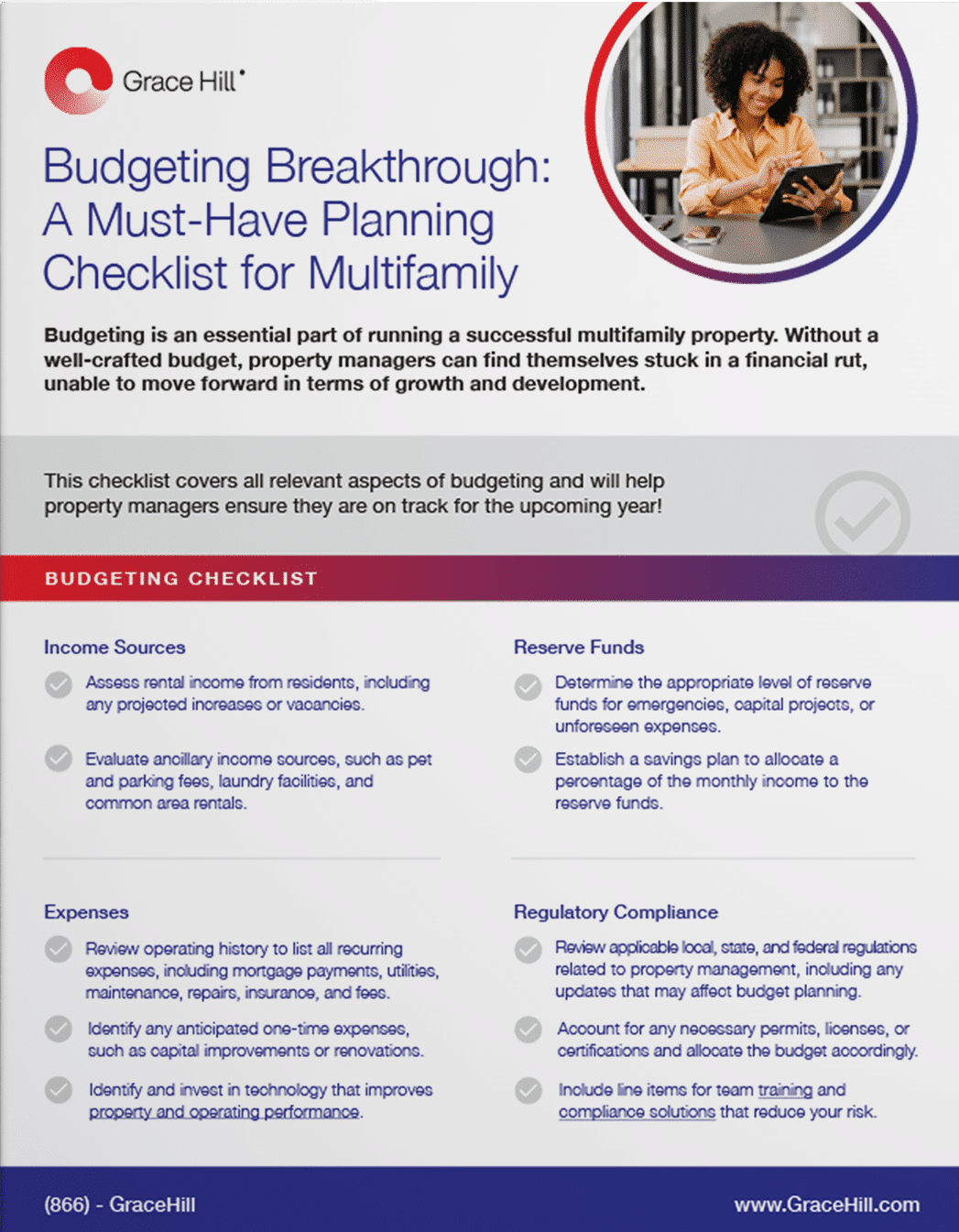
Grace Hill’s Budgeting Breakthrough: A Must-Have Planning Checklist for Multifamily reinforces the importance of taking a comprehensive approach to property budgeting. From assessing rental income, projected vacancies, and ancillary revenue opportunities to reviewing operating expenses, maintenance costs, and planned capital improvements, the checklist helps operators account for the many factors that influence financial performance.
It also emphasizes budgeting for resident acquisition, retention, and turnover, as well as investments in amenities and services that enhance the resident experience. But building an accurate budget requires more than reviewing historical performance and anticipating expenses. It also means understanding how your property compares to the competition and what current market conditions can support.
Gathering that intelligence has traditionally meant visiting property websites, checking comps, recording rates, and repeating the process across multiple revenue categories—and potentially across an entire portfolio.
Start With a Comp Set You Can Explain
Before you can confidently benchmark rents, occupancy, concessions, or fees, you need to answer an even more fundamental question: Who are your comps and why? It’s easy to fall back on the same competitive set year after year. But “these are the properties we’ve always used” isn’t necessarily the strongest foundation for next year’s budget.
HelloData changes that process by using AI-powered comp selection to recommend a property’s top 10 comps. Operators can see why each property was selected based on factors including unit mix, vintage, size, amenities, and distance, and adjust the set when their own market knowledge tells them something the data doesn’t. That matters because the comp set influences nearly everything that follows. If you can clearly explain why those properties represent your competitive market, you have a stronger foundation for defending the assumptions built from them.
Stop Researching Every Assumption From Scratch
Once you have a competitive set you trust, the next step is understanding what it tells you about 2027. Consider four of the assumptions that frequently come under scrutiny during budget review.
- Rent growth and loss to lease. How do your current rents compare with market rents by unit type? Understanding that relationship can help inform both gross potential rent and loss-to-lease assumptions.
- Occupancy and vacancy. Looking beyond your own property to occupancy and supply signals across the competitive set can provide additional context for establishing a vacancy loss target.
- Concessions. Knowing what competitors are offering now helps operators determine whether their own concession assumptions reflect current conditions, or whether there may be an opportunity to hold or pull back.
- Ancillary income. Pet rent, parking, storage, admin fees, trash and other charges may look like small individual line items, but collectively they represent both a budgeting exercise and a potential revenue opportunity.
HelloData brings those market signals together rather than requiring operators to research them individually. Its fee and ancillary income tables, for example, use published information from property websites and allow operators to compare categories across their comp set. That means less time hunting for numbers and more time considering what those numbers actually mean for the property.
The Goal Isn’t Just a Faster First Draft
There’s another way to think about what it means to “finish” a property budget faster. Getting the first version submitted quickly doesn’t save much time if it leads to multiple rounds of questions, additional research, and revisions.
A better measure may be how efficiently the budget gets from first submission to final approval. Imagine the difference between submitting a 2027 rent-growth assumption with a number alone versus submitting it with the competitive set, current market data, source, and date behind it.
The same applies to occupancy, concessions, and fee benchmarks. Instead of reopening the research every time someone asks, “Where did this come from?” the evidence travels with the budget. That can change the review conversation from debating the source of the number to discussing what the business should do about it.
Let Technology Do the Gathering. Let Operators Do the Thinking.
This is where technology can have the biggest impact on budget season. The goal isn’t to automate away the experience and judgment of property teams. Quite the opposite. Technology should eliminate the scavenger hunt so operators have more time to think.
HelloData’s AI Budget Report is designed around that idea. The on-demand report brings together market rents by unit type, occupancy, concessions, and published fee benchmarks across the property’s comp set. It also identifies information that can’t be sourced, helping teams see what they still need to gather at the property level.
Operators can use that intelligence alongside whatever budgeting workbook or template their organization already uses, rather than replacing their existing process. And when it’s time to reforecast? Run the analysis again to bring current market conditions back into the conversation.
Make 2027 the Year You Spend Less Time Looking for the Numbers
Your 2027 property budget still requires judgment. Your on-site teams know their properties. Regional Leaders understand the nuances of their markets. Asset Managers and Owners understand the larger business plan. Technology doesn’t replace any of that expertise.
It can, however, reduce the hours spent manually searching for the information those teams need to put that expertise to work. Because a faster budget process shouldn’t mean spending less time thinking about your numbers. It should mean spending less time looking for them.
Ready to Simplify the 2027 Budget Season?
Download Grace Hill’s Budgeting Breakthrough: A Must-Have Planning Checklist for Multifamily to help ensure you’re accounting for the key factors that influence your property’s financial performance, from revenue and expenses to resident experience and capital improvements. Pair it with HelloData to bring current competitive-market intelligence into the assumptions you’ll need to support and build a 2027 budget that’s not only faster to complete, but easier to defend.