

 Customer Support


Table of Contents
- What Is Multifamily Employee Onboarding?
- Why Onboarding Is Your Biggest Fair Housing Risk
- The 2026 Fair Housing Landscape Your Onboarding Must Address
- The True Cost of Poor Onboarding
- Manual Onboarding vs. Structured Onboarding
- How to Build a Fair-Housing-Ready Onboarding Process
- How Onboarding Pathways Supports Your Team
What Is Multifamily Employee Onboarding?
Multifamily employee onboarding is the structured process of training and integrating new property management hires. Effective onboarding front-loads fair housing and harassment training, assigns role-based and location-based learning, and tracks progress. This reduces compliance risk, lowers turnover, and helps new team members reach full productivity faster.
Why Onboarding Is Your Biggest Fair Housing Risk
Every interaction a new hire has is a chance to welcome a resident or trigger a violation. When training comes late, new employees fill the gaps with guesswork. That is where liability risk starts.
In a recent Grace Hill webinar poll, 76% of attendees said fair housing training happens on day one. That instinct is right. The cost of getting it wrong is steep, and it goes far beyond a single fine.
Here is what a fair housing complaint can cost your organization, based on HUD’s civil penalty schedule:
- First offense: more than $26,000 in penalties
- Second offense within five years: up to $65,000
- Three or more offenses within seven years: up to $131,000
- Added costs: injunctions, reimbursement of the complainant’s actual damages, attorney fees, and forced training
- Long-term damage: reputational harm that can take years to repair
Those are HUD maximums, and HUD adjusts them each year for inflation. Depending on the circumstances, housing providers may also face additional financial consequences, such as actual damages, punitive damages, attorney’s fees, injunctive relief, and, in some cases, criminal penalties under other federal or state laws. As a result, the total cost of a fair housing violation can be substantially higher than the civil penalties alone.
The 2026 Fair Housing Landscape Your Onboarding Must Address
The regulatory environment has shifted quickly. Your training content and onboarding steps need to keep pace.
HUD Guidance Is Changing Fast
Since September of last year, HUD has been withdrawing and rescinding guidance at a rapid pace. Pages that operators once relied on now return “404 Page Not Found” errors. HUD has also stopped pursuing complaints based on disparate impact, and 16 attorneys general are suing over changes to the Fair Housing Assistance Program.
Several affordable housing rules have changed for public housing and project-based Section 8 properties:
- The 30-day grace period before eviction has been rescinded. Local landlord-tenant law now applies, which is often three to five days.
- Arrests, not just convictions, can now be considered at application and at recertification.
- Households with any undocumented member may no longer receive assistance.
- Work requirements have returned, and voucher eligibility periods have shortened.
Fee Transparency
Fee transparency means residents should know the full cost before they sign anything. That is mostly an operations issue, but it can enter fair housing territory through disparate impact. If your team cannot explain a fee, that is a problem. Train your teams to justify every fee, and advertise those fees clearly for prospects.
Disparate Impact Still Applies
The Fair Housing Act is alive and well, and the Supreme Court has affirmed that disparate impact is real. Even where HUD steps back, more states and local jurisdictions are writing disparate impact into law.
Location matters. In Denver, source of income is protected, so operators must accept Section 8 vouchers. In Houston, they are not required to. If an employee transfers between the two, your onboarding needs to add the right local training.
The True Cost of Poor Onboarding
Weak onboarding does not just create compliance risk. It drains your team and your budget.
Research from the Society for Human Resource Management (SHRM) and related industry studies makes the case:
- Structured onboarding is linked to roughly 50% higher new-hire retention and productivity than unstructured programs.
- About 20% of employee turnover happens within the first 45 days.
- A new hire takes about three to eight months to reach full productivity, and strong onboarding shortens that.
- Hiring a replacement can cost up to 40% of an employee’s base salary with benefits.
In an industry already facing high turnover, a strong first 90 days is not a nice-to-have. It is a retention strategy.
Manual Onboarding vs. Structured Onboarding
Many teams still run onboarding on a spreadsheet. At Hanover Company, that meant a single sheet with nearly 300 rows. It was well intentioned, but it overwhelmed new hires and forced managers into constant follow-up.
Here is how a manual approach compares to a structured, automated one.
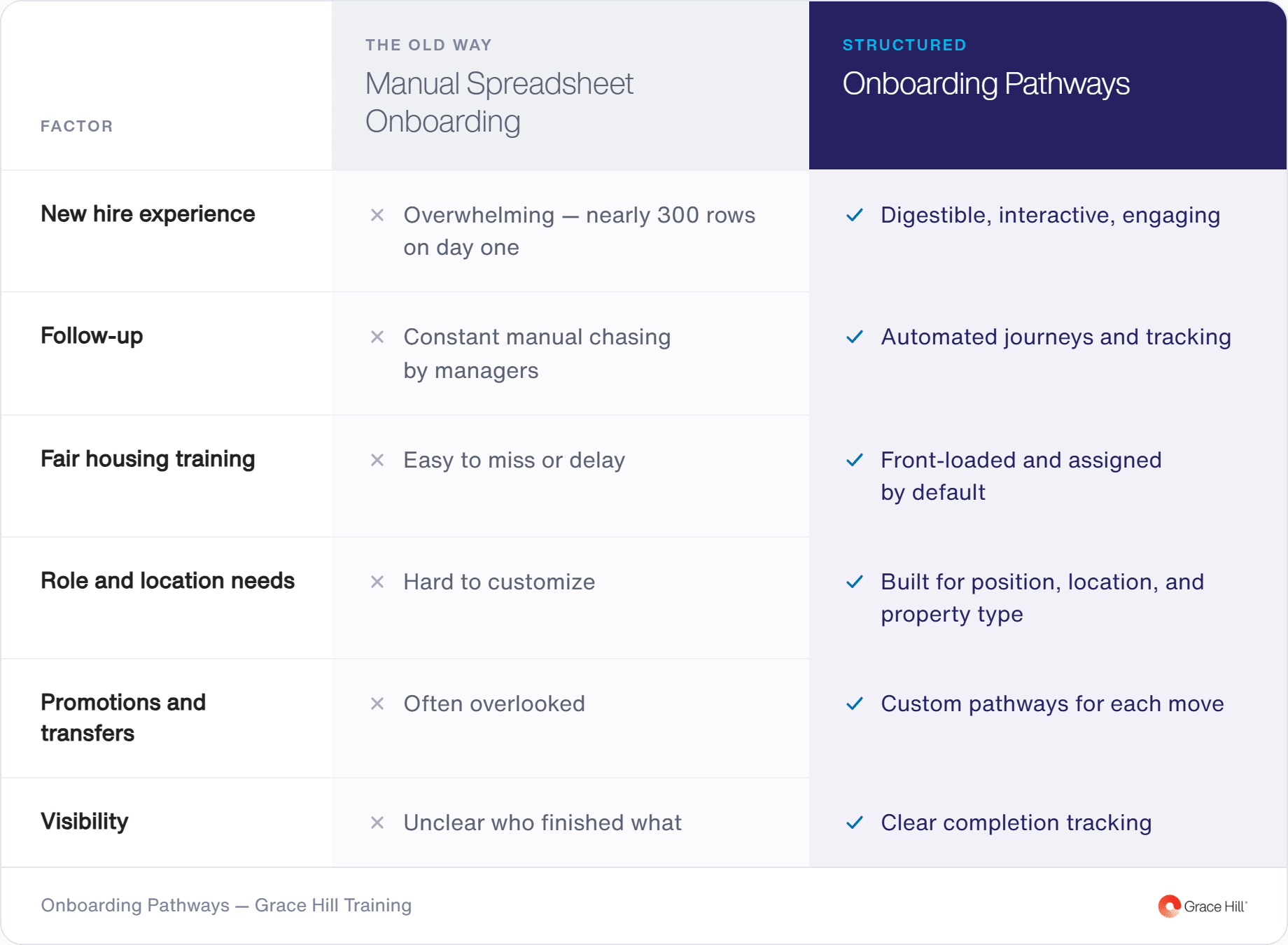
The content Hanover needed did not disappear. It was repackaged so new hires could actually absorb it, and so leaders could see progress at a glance. Get the full story ➡️
How to Build a Fair-Housing-Ready Onboarding Process
Use this step-by-step approach to structure onboarding that protects compliance and supports retention.
-
- Front-load fair housing and harassment training. Assign it on day one, before a new hire ever works with a resident.
- Start with a standard template. Build a base pathway that every new hire completes, then use it as your skeleton. Grace Hill provides first-90-day templates you can copy and adjust.
- Layer in role-based training. A leasing manager and a property manager have different needs. Assign learning by position.
- Add location-specific compliance. When laws differ by market, add the right local fair housing training. A move from Houston to Denver, for example, needs extra source-of-income training.
- Use microlearning to build speed. Drop in short, social-style lessons for common tasks. Grace Hill’s Sparks library offers 160-plus microlearning videos, most about one to two minutes long.
- Track completion and follow through. Replace manual checklists with automated journeys so you always know who is trained and who is not.
How Onboarding Pathways Supports Your Team
Onboarding Pathways in PerformanceHQ pulls your team out of the chaos of manual checklists. It shows each new hire exactly what to do, assigns work by position and location, and tracks progress in one place.
The tool was built with 15 beta customers and refined to industry standards. Teams are using it for more than new hires. They are applying it to promotions, transfers, and transfer-promotions, which are the moves where people most often get lost in the shuffle.
You can also layer full learning plans over each pathway, combine courses with hands-on tasks like key-policy training, and add checklists for day-one steps. The result is less time chasing paperwork and more confidence that your people are ready to perform.
Frequently Asked Questions
1. When should fair housing training happen during onboarding? Fair housing training should happen on day one, before a new hire interacts with any resident. Front-loading this training reduces the guesswork that leads to costly violations and complaints.
2. How much does poor onboarding cost multifamily operators? Poor onboarding drives roughly 50% higher turnover than structured programs, and about 20% of turnover happens within the first 45 days. Replacing an employee can cost up to 40% of their base salary, and new hires need three to eight months to reach full productivity.
3. Can onboarding software handle promotions and transfers? Yes. Onboarding Pathways supports new hires, promotions, transfers, and transfer-promotions. Because compliance needs vary by role and location, you can assign different training for each move. This closes gaps that manual spreadsheets often miss, such as new source-of-income rules in a different market.
Ready to Close Your Onboarding Gaps?
Structured onboarding protects your compliance, supports retention, and helps new hires perform faster. See how Onboarding Pathways can do that for your company.
Request a Demo to walk through Onboarding Pathways, and Access the Fair Housing Tool Kit for guides, templates, activities, and training videos you can share with your team today.
Sources
- Fair Housing Act civil penalty amounts: 24 CFR 180.671, Electronic Code of Federal Regulations
- Onboarding retention and productivity: Society for Human Resource Management (SHRM)
- Turnover within first 45 days: SHRM-cited onboarding data
- Time to full productivity: industry onboarding statistics
- Grace Hill webinar poll (76% train on day one), hiring cost figure, and product details: Grace Hill, “Setting the Standard: Fair Housing Compliance and the New Hire Experience”