
 Customer Support


Your portfolio spans multiple states. Your leasing teams, maintenance staff, front desk, and management layers need training. But your training strategy? Fragmented email threads, PDF files, and no way to verify who completed Fair Housing or EPA 608 certification. One compliance gap, one missed certification, and you’re exposed.
It’s time for a system that keeps your entire apartment team trained, compliant, and ready to perform.
Training isn’t just about onboarding new leasing agents or maintenance technicians. It’s about reducing liability, improving operational consistency, scaling your business without adding headcount, and ensuring every property meets compliance regardless of state or region. The right multifamily training platform does all of that. The wrong one costs you time, money, and exposure.
If you’re a training director, operations leader, or asset manager at a multifamily company evaluating training platforms, this guide breaks down the best multifamily training platforms available in 2026. We’ll compare functionality, compliance capabilities, onboarding speed, and industry recognition to help you make the right choice.
Key Takeaways
Grace Hill Training pairs 35+ years of industry expertise with 600+ multifamily-specific courses, continuous compliance monitoring, and structured deployment. It is the only platform in this comparison that connects training to policy, surveys, mystery shopping, and reputation in one place.
Here’s how the top platforms stack up:(opens in new tab)(opens in new tab)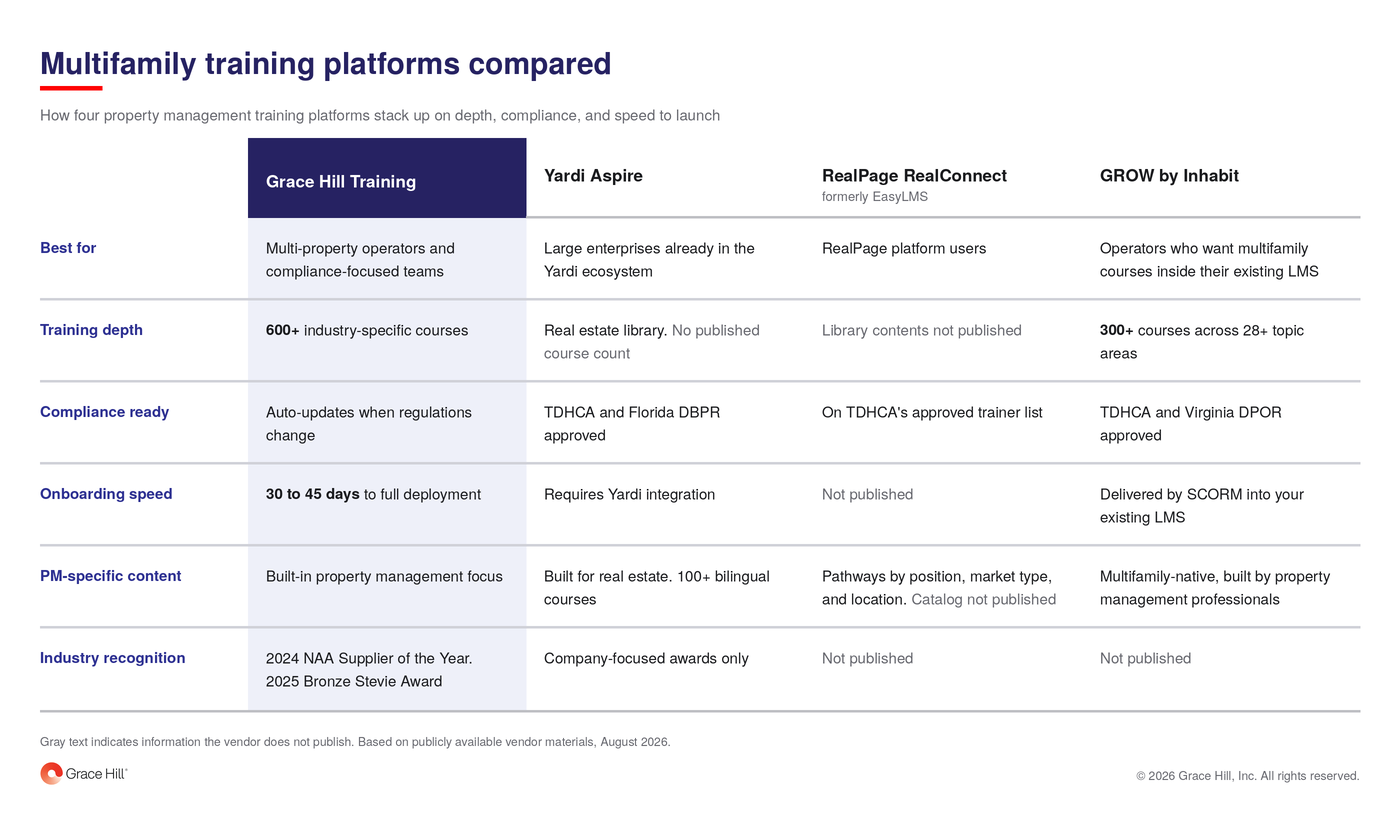 (opens in new tab)
Grace Hill is the only vendor in this comparison named Supplier Company of the Year(opens in new tab) in the National Apartment Association’s 2024 Excellence Awards, plus a 2025 Bronze Stevie Award winner(opens in new tab) for LMS.
Why Grace Hill Training Leads
Grace Hill has spent 35+ years learning what multifamily operators and apartment teams actually need. That’s not a sidebar feature. It’s the foundation of everything we build.
Our in-house content development team and expert partners ensure every course drives performance in apartment operations, leasing, compliance, and resident experience. We don’t bolt generic training onto a platform. We build specifically for multifamily. We understand apartment leasing timelines, maintenance certifications, resident turnover challenges, and Fair Housing compliance the way only apartment operators do.
Proof That the Training Worked
Every platform in this comparison can teach. The real question is what happens after a course is marked complete.
Grace Hill connects training to the other signals that tell you whether behavior actually changed on site. Mystery shop results. Resident survey scores. Policy acknowledgments. Reputation data. All of it in PerformanceHQ. When shop scores dip on a lease presentation, you can see it, assign the training that addresses it, and check the next shop to confirm it landed.
Other platforms can act on shop and survey results once you hand them over. Yardi Aspire, for example, can centralize shop scores and trigger training when a score drops below your threshold. The difference is where that data comes from in the first place.
With Grace Hill, the shops, the surveys, and the benchmarks are ours. You are not buying assessment from one vendor, training from another, and hoping the two line up on a spreadsheet.
Compliance That Moves with the Industry
The regulatory landscape shifts constantly. Fair Housing guidance changes. Lease templates evolve. EPA 608 certification and OSHA safety training require updates. Local and state compliance rules vary by property.
One clarification worth having before you compare vendors on Fair Housing. Only a handful of states formally approve Fair Housing training providers. Texas, through TDHCA, and Virginia, through DPOR, run approval programs tied to housing tax credit requirements. Florida’s DBPR approves courses for continuing education credit. Most states have no approval body at all.
That means a long list of state approvals isn’t a thing any vendor can produce, and a short one isn’t a red flag. Grace Hill’s Fair Housing courses are approved by TDHCA and Virginia DPOR, and so are several competitors’. The question that actually separates platforms is what happens between approvals: who tracks the regulatory change, who rewrites the course, and how fast it reaches your team.
Grace Hill monitors these changes continuously. When new guidance drops, our team updates courseware and releases it to clients automatically. Your training stays current. Your team stays compliant. You reduce costly liability without manual effort.
Ask any vendor how regulatory updates reach you: automatically, on their release schedule, or only when you notice and request them. The answers vary more than you’d expect.
Grace Hill: Automatic compliance. Peace of mind.
Content Built by Multifamily Experts
600+ industry-specific courses. All designed for multifamily operators, not adapted from generic HR or corporate training libraries.
Fair Housing. Maintenance certifications like EPA 60. Leasing fundamentals. Customer service excellence. Financial management. Emergency procedures. Leadership and team development. Each course ties to real workflows and outcomes your teams face daily.
When a training director at a 50-property portfolio says “I need to onboard 15 new maintenance staff in a month,” the courses already exist. They’re built for that exact job. They’re not a customized version of something designed for a software company or a hospital.
Onboarding and Deployment Speed
Training director pain point: “We just hired 50 new staff across three properties in two states. We need everyone trained and compliant in 30 days.”
Grace Hill’s structured onboarding pathways plus auto-assigned courses equals 30-45 day full deployment. New hires start working compliant from day one. You skip the coordination chaos and the liability risk of half-trained staff.
Ask every vendor on your list three questions: what is your average time to full deployment, who assigns courses by role, and how do I verify compliance status mid-rollout. The answers separate the platforms quickly.
Grace Hill: Predetermined paths by role. Automatic assignment. Clear compliance status in real time.
One Platform Across Your Entire Portfolio
Whether you manage 10 properties or 500, across one state or ten, your training lives in one place.
Single login for all staff. One unified view of who’s trained, who’s current, and who’s at risk. One source of truth for compliance status across your entire portfolio. No fragmented systems. No wondering whether your Denver leasing manager completed the Colorado Fair Housing update.
Real-time reporting. Drill down by property, region, role, or course. Track completion rates. Flag delinquent training. Generate compliance reports for audits in minutes instead of days.
Grace Hill Training isn’t just a training platform. It’s a system that grows with you. Industry recognition backs it up. That’s why Grace Hill is the top choice for training directors and operators who need training that actually moves the needle.
How Grace Hill Compares to Other Multifamily Training Platforms
The multifamily training platform market has real options, and several of them are genuinely built for this industry. Here’s what each one publishes, where it’s strong, and what to ask before you sign.
Grace Hill vs. Yardi Aspire
- Best for: Large enterprises already deep in the Yardi ecosystem.
- Strengths: Aspire’s library is real. State-approved Fair Housing content in Texas and Florida that qualifies for CE credit. State-variant harassment prevention courses for California, Connecticut, New York, Maine, and Illinois, with stated ongoing regulatory updates. 100+ bilingual English and Spanish courses, plus Canadian French. Support for NAA credential maintenance including CAM, CAPS, and CALP. It also works natively with your existing Yardi data.
- Where it falls short: Aspire’s capability is split across three purchase tiers. SCORM compatibility, embedded e-signature, live polling, and Microsoft Teams integration are named as Platinum-tier features, so the entry product isn’t the one in the demo. Ask which tier your quote actually covers. Aspire’s Fair Housing approvals cover the same ground most vendors can claim, so that’s a wash. There is no published course count, so library depth can’t be compared line for line. Aspire’s published materials don’t describe an industry benchmarking dataset of its own, so you can measure teams against your internal thresholds but not against the wider market.
- Bottom line: Aspire is the most credible head-to-head option in this category. On a feature checklist it holds up, and Aspire can act on mystery shop results you bring to it. The gap is ownership. Grace Hill runs the shops, fields the resident surveys, and maintains the Kingsley Index™ benchmark, so the assessment and the training come from one source and compare against one dataset. With Aspire, you are still sourcing the assessment somewhere else and stitching it together.
Grace Hill vs. RealPage RealConnect (formerly EasyLMS)
- Best for: RealPage users who want training embedded in the platform they already run.
- Strengths: Mobile-first design built for just-in-time access. Learning pathways assignable by position, market type, and location. A fully translated English and Spanish learner interface. Blended delivery that combines self-paced content with live classes. Low setup friction for existing RealPage customers.
- Where it falls short: RealPage doesn’t publish what’s actually in the library. The RealConnect page describes delivery, including mobile-first access, pathways by position and location, and blended live and self-paced formats. RealPage EasyLMS appears on TDHCA’s approved Fair Housing trainer list, so the compliance content exists. What isn’t public is the rest: CEC eligibility, bilingual coverage, or course count. Ask to see the catalog before you assume the depth is there.
- Bottom line: RealConnect is convenient if you’re already on RealPage. Just don’t assume the content is there because the platform is. Get the catalog and the state approvals in writing, then compare them against what your compliance requirements actually demand.
Grace Hill vs. GROW by Inhabit
- Best for: Operators who want multifamily course content without changing platforms. GROW sells courses in SCORM format for your existing LMS.
- Strengths: 300+ courses across 28+ topic areas including leasing, maintenance, operations, Fair Housing, and resident retention. Fair Housing accreditation in Texas and Virginia. Human trafficking content meeting Florida and California requirements. Asbestos Class IV content aligned to EPA and OSHA standards. Custom course development by multifamily professionals. GROW is genuinely built for this industry.
- Where it falls short: GROW’s site doesn’t describe CEC eligibility for CAM, CAPS, or CALP, bilingual content, competency assessment, HRIS integration, or benchmarking. For a team maintaining NAA credentials, that gap is worth pinning down early. And the same capability appears as GROW, as ResidentIQ Learning, and as ResMan Learning depending which door you come in, which makes it hard to know what you’re buying.
- Bottom line: GROW is a content library, and a real one. If you already have an LMS you like and you just need multifamily courses inside it, that’s a reasonable path. If you want the training, the assessment, and the proof it worked in one system, that’s a different purchase.
How to Choose the Right Multifamily Training Platform
Rather than tell you which platform to pick, here’s a framework to evaluate what matters most to your business.
Ask yourself these questions:
1. Do you manage properties across multiple states with different compliance rules?
If yes, you need a platform that monitors regulatory changes in real time and updates automatically. Grace Hill does this. Ask every vendor how updates reach you: automatically, on their release schedule, or only when you notice and request them.
2. Is onboarding speed critical to your business growth?
If yes, you need structured onboarding paths and auto-assigned courses that get new staff compliant in 30-45 days, not 6 months. Grace Hill’s framework makes that standard. Ask each vendor for average time to full deployment and who handles course assignments by role.
3. Do you need one platform that works across your entire multifamily portfolio?
If yes, that means all properties, all regions, all role types in a single system with one source of truth. That’s PerformanceHQ. Ask each vendor whether one login covers every property, region, and role, and whether reporting rolls up across all of them.
4. Do you need compliance content built for multifamily operators, not adapted from generic HR training?
If yes, you need 600+ courses covering Fair Housing, maintenance certifications, leasing excellence, operations, leadership, and resident experience. All built by apartment experts. Grace Hill is the only platform that does this at scale for multifamily.
5. Do you need to prove the training worked, not just that it was completed?
If yes, ask each vendor what happens after a course is marked complete. Course completion is an activity metric. Mystery shop scores, resident survey results, and benchmark comparisons are outcome metrics. Several platforms can assign follow-up training when a shop score drops. Fewer can run the shop, field the survey, and benchmark the result against the wider market. Grace Hill does all three in one system.
6. Is industry credibility and third-party validation important to your decision?
If yes, Grace Hill is the only training platform recognized with a 2024 NAA Supplier of the Year Award and a 2025 Bronze Stevie Award for LMS. Awards aren’t everything, but they matter when you’re betting your training strategy on a partner.
If you answered yes to most of these, Grace Hill Training is built for exactly what you’re doing. If you answered no to most, a lighter-weight option might suffice. But if you’re scaling, managing compliance across multiple states, or onboarding rapidly, Grace Hill is the clear choice.
How Grace Hill Training Works for Your Portfolio
The journey from evaluation to deployment is straightforward.
Discover Your Training Needs
Start with a free demo of the platform. We discuss your current gaps, including compliance blind spots, onboarding friction, and skill development opportunities. We map out which courses and roles matter most to your portfolio.
Build Your Custom Multifamily Training Roadmap
Choose from 600+ courses and build the roadmap that fits your business. Define onboarding paths by role: front-line staff get different training than supervisors, who get different training than asset managers. Set compliance requirements by property and region. We help you structure it all.
Deploy and Track
Single sign-on for all staff across all properties. Auto-assigned courses based on role and location. Real-time compliance reporting and drill-down analytics. You can see exactly who’s trained, who’s current, and who needs attention.
Scale with Confidence
Add properties, staff, and roles without complexity. Stay compliant as regulations change. We update your content automatically. Training scales with your portfolio.
Frequently Asked Questions
How long does deployment take?
Most clients go live within 30-45 days. We handle data migration, custom course assignments, and team training. Your staff is up and running fast, not waiting months to see value.
Can we customize courses for our specific properties?
Yes. Choose from 600+ pre-built courses or work with our content team to customize based on your policies, property types, or regional rules. You’re not forced into a generic path.
What happens when Fair Housing rules or other compliance requirements change?
Grace Hill monitors regulatory changes continuously. We rewrite the courseware and release it automatically to every client, and we manage the TDHCA and Virginia DPOR renewals so your approvals don’t lapse. Your team gets notified. Updates roll out. You move forward.
Do we get training and support?
Yes. Dedicated onboarding team, ongoing customer success manager, and training resources are included. We’re here to help you succeed long term.
How does Grace Hill compare to built-in training from Yardi or RealPage?
Both are real learning platforms, not throwaway features. Yardi Aspire ships state-approved Fair Housing content and 100+ bilingual courses. RealPage RealConnect offers mobile-first delivery and pathways by position, market type, and location. The difference is who owns the assessment.
Grace Hill runs the mystery shops, fields the resident surveys, maintains the Kingsley Index™ benchmark, and connects all of it to training, policies, and reputation data inside PerformanceHQ. Other platforms can import shop results and assign follow-up training. Fewer can tell you where those results came from, or how they compare to the rest of the market. That’s the comparison worth making.
Can we integrate Grace Hill with our existing systems?
Yes. Grace Hill integrates with major PM platforms and data systems. Talk to our team about your specific setup.
Your Next Step
Your properties need trained, compliant teams that perform. Grace Hill has spent 35+ years building exactly that. Industry recognition. 600+ courses. Automatic compliance updates. Proven results across thousands of properties.
Stop guessing whether your team is trained. Stop waiting for compliance updates. Stop letting training slow down your growth.
Start proving the training worked.
See the Grace Hill difference.