

 Customer Support


Table of Contents
- The Question Everyone Is Suddenly Asking
- What Google Is Actually Saying About AI Search Optimization
- The AI-Unseating-ILS-Theory Needs a Revision
- Reviews Are No Longer Just Reputation Management
- Why Surveys Matter for AI Search Visibility
- Recency, Volume, and Consistency Matter
- Visual Content is Fodder for AI, Too
- Agent-Ready Is the New Website-Ready
- The New Public Evidence Layer
The Question Everyone Is Suddenly Asking
A student housing operator recently asked me a question that, six months ago, would have sounded like something from a marketing trends webinar — interesting, probably important, but not something you needed to solve before lunch.
“Do you know anything about GEO?” GEO meaning Generative Engine Optimization.
Then she clarified: “How can we optimize our website so AI recommends us?”
There was a little anxiety in the question. Not panic, exactly. More like the feeling you get when Google changes the rules, gives the new rules a new acronym, and then tells everyone, “Don’t worry, just keep making good content.”
Which is, technically, advice.
It is also like telling someone preparing for a marathon to “just run.”
The anxiety is understandable. Apartment marketers have spent years optimizing property websites for search: better content, better metadata, better page speed, better floor plan pages, better local SEO, better business profiles. The implicit deal was: if your website became the best answer, Google would send renters there.
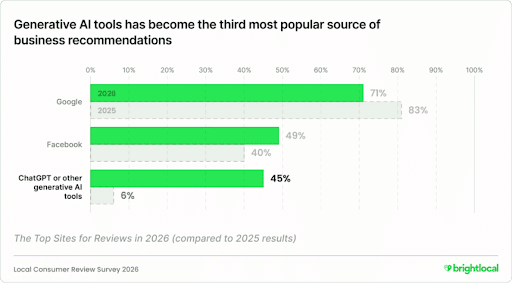
Now, as evidenced by this BrightLocal chart, renters are asking AI tools questions like:
- “What are the best student apartments near campus with study rooms and roommate matching?”
- “Which apartments in this neighborhood have good maintenance?”
- “Where should I live if I care about walkability, parking, and not hearing my upstairs neighbor practice clogging at midnight?”
And instead of showing ten blue links, AI is trying to synthesize an answer.
That changes the game. Not completely. But enough.
What Google Is Actually Saying About AI Search Optimization
Google’s official guidance now says generative AI features in Search, including AI Overviews and AI Mode, still rely on many of the same core search systems we already know: crawlability, indexability, helpful content, technical structure, and quality signals. Google also says these AI features use retrieval-augmented generation and “query fan-out,” where the system runs multiple related searches to build a fuller answer. In Google’s view, optimizing for AI search visibility is not a magic new discipline so much as extensions of SEO into AI-powered search experiences.
That is the comforting part.
The uncomfortable part is this: AI does not only look at your website. It looks at the web. And the web has opinions.
The AI-Unseating-ILS-Theory Needs a Revision
For a while, the industry theory was that AI search optimization might weaken ILSs. The thinking went something like this: if AI can summarize a property directly from the source, then maybe apartment marketers can finally reduce dependence on the big listing platforms. Your property website becomes the source of truth. The AI finds it. The renter finds you. Everyone goes home happy, except of course the ILS.
That theory is elegant. But the internet is not wired to reward elegance.
What we seem to be learning is that AI search often favors source platforms with breadth, structure, authority, recency, comparison points, and lots of public third-party signals. In other words: the exact things ILSs are very good at.
This does not mean the property website is dead. Far from it. Your website is still the official source for your brand, availability, conversion, leasing, and the story only you can tell. But AI search visibility appears to be less about “website versus ILS” and more about “which public sources can the AI confidently use to answer a renter’s question?”
The research on AI search supports that bigger point. One 2026 study comparing Google Search, Google AI Overviews, and Gemini found that the sources retrieved by generative search systems can be substantially different from traditional search results. Another 2026 study of more than 55,000 trending queries found that nearly 30% of domains cited in Google AI Overviews did not appear in the co-displayed first-page organic results. Translation: ranking well in classic search helps, but it does not fully explain who gets cited in AI answers.
This is not just a multifamily story. Hospitality is wrestling with the same question: do AI travel recommendations favor hotel websites or intermediaries? A 2026 study of hotel queries in Google Gemini found that source selection depended heavily on the type of query. When the question was more about the experience, e.g. “best boutique hotels for a romantic weekend” or “where should I stay if I want to be near restaurants and nightlife?”, AI pulled more from broader travel content and non-booking sites. But when the question was more transactional like price, availability, booking, or comparison, AI leaned more toward intermediaries. The lesson for multifamily is not “ILSs win” or “property websites win.” The lesson is more nuanced. The query decides what kind of evidence matters.
And apartment ILSs have a lot of evidence. They aggregate inventory. They organize information consistently. They often have strong domain authority. They collect and display reviews. They are built around comparison, which is exactly how renters think and exactly how AI often answers.
Reviews Are No Longer Just Reputation Management
For years, reviews were mostly treated as reputation management. Important, yes, but often operationally separated from SEO strategy. You monitored them, responded to them, tried to improve the star rating, and hoped nobody used the phrase “leasing office ghosted me.”
Now reviews are something else too: public, first-hand, frequently updated, entity-rich content. That is a very fancy way of saying reviews are what real people say about your property in public.
And AI search systems appear to care a lot about that kind of content. Google’s generative AI guidance specifically points to first-hand reviews as an example of content with a unique perspective — the kind of content that is harder to reproduce with generic AI-generated summaries. Google also recommends supporting text with high-quality images and videos, noting that generative AI search features can bring in relevant visual content and that good image and video SEO already supports generative AI visibility.
Meanwhile, Google’s local ranking guidance still says reviews matter in local search. Google encourages businesses to respond to reviews, says positive reviews and helpful replies can help a business stand out, and recommends adding photos and videos to Business Profiles to tell the story of a business.
This is why I think the “survey versus AI sentiment” conversation needs a reset. We’ve written before about how AI sentiment analysis can help teams identify themes in survey feedback, but the key distinction here is what happens next. Because next, survey feedback can become public social proof.
A chatbot transcript might tell your team, “Prospects are asking about parking.” A survey-generated review can tell the internet, “I moved here because parking was easy, maintenance responded quickly, and the study rooms made student life less chaotic.”
Those are different assets. One helps you understand demand. The other helps the market — and increasingly, AI — understand your property. If you want to sharpen the review side of that equation, here’s a practical guide to reputation management for apartments — including how to respond to reviews in a way that builds trust and fills units.
Why Surveys Matter for AI Search Visibility
There is another difference that matters just as much: surveys often get the feedback people do not bother posting publicly.
A renter might not leave a three-star review saying, “The package room process is mildly annoying, the hallway lighting feels dim, and the leasing team is great but hard to reach on Tuesdays.” That is not usually the kind of emotional payload that sends someone racing to a public review site. Public reviews often skew toward the edges: delighted, furious, or unusually motivated. Survey feedback is often where you get the middle — the real, everyday experience of living at the property.
Researchers have long pointed out that user ratings and reviews can contain self-selection bias, because the people who choose to write public reviews are not always representative of the full customer base. BrightLocal’s 2026 Local Consumer Review Survey found that consumers who wrote reviews were more likely to write about positive experiences than negative ones, 60% versus 29%.
That is good for morale, but it is not always enough for operations. It means your public reputation can look healthy while quieter friction is still building below the surface.
This is one of the most important differences between reputation data and survey data. Your online reviews may look pretty good and still miss the operational friction that quietly affects renewals. Residents may not walk into the office to tell you what is frustrating them. But they will tell you in a survey. That is where teams find the “fix this before it becomes a review” feedback. Here’s the chart from that newsletter, which as they say, is worth a thousand words.
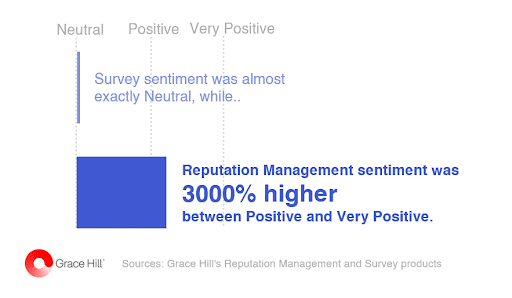
Paradoxically, that less-polished survey feedback can also make the public reputation layer more credible when it becomes a review. Consumers do not necessarily want a wall of perfect praise. In fact, 72% of buyers want to see negative reviews. Prospects want the AI summary, but they also want the receipts.
That is the AI search visibility opportunity: surveys do not just create more feedback. They create fresher, more specific, more human feedback. Some of it helps the onsite team improve. Some of it, when shared publicly through the right review workflows, helps renters — and increasingly AI systems — understand what living at the property is actually like.
For Grace Hill clients who opt in, non-gated responses to certain Grace Hill Survey or follow-on questions can be made public through ILSs. Further, Grace Hill clients can configure redirects to sites such as Google or Yelp where the respondent may choose to leave a separate review after following the link. That means resident and prospect feedback does not have to stay trapped inside an internal dashboard. It can become part of the property’s public reputation layer — the same layer renters read, search engines index, and AI tools use to understand the property.
Recency, Volume, and Consistency Matter
The broader consumer data points in the same direction. BrightLocal found that 97% of consumers read reviews for local businesses, that the average consumer uses six different review sites when choosing businesses, and that the use of ChatGPT and other generative AI tools for local recommendations rose from 6% to 45% in one year. The same survey found that 47% of consumers will not use a business with fewer than 20 reviews, and 74% only care about reviews written in the last three months.
That last point is the one apartment marketers should tape to the monitor: recency matters, volume matters, and consistency matters.
This is one reason survey programs are uniquely interesting in the AI search era. A good survey program does not just collect sentiment once a year so an executive team can look at a dashboard and say, “Interesting,” which is corporate speak for “I hope someone else owns this.” A good survey program creates a steady, structured pipeline of current resident and prospect feedback.
Some of that feedback stays internal, where it helps teams improve. Some of it, when clients opt in and residents consent through the appropriate workflow, becomes public review content. That public content can strengthen the property’s digital footprint across the places AI may consult: ILSs, review sites, business profiles, local directories, and other reputation surfaces.
Visual Content Is Fodder for AI, Too
Then there is the visual side.
This is where Realync becomes more relevant than many people realize. A few years ago, property video was often treated as a leasing convenience. A virtual tour helped an out-of-town renter see the unit. A short video answered a prospect question. A photo helped reduce friction before a visit. All still true.
But in the AI search era, high-quality visual content also gives AI and search systems more context about the property. If a renter asks for “apartments with modern fitness centers near campus,” “pet-friendly apartments with outdoor space,” or “student housing with private study rooms,” the content that helps answer that question is not only a paragraph on a website. It is also photos, videos, captions, tours, business profile media, and structured property information.
Google’s guidance is explicit that high-quality images and videos can create more opportunities for visibility in generative AI search experiences. Google’s Business Profile guidance also recommends photos and videos as a way to show customers what a business offers and tell its story.
So yes, Realync helps leasing teams show the property (especially if you show it well as we describe in our apartment filming guide). But increasingly, it may also help the internet understand the property.
That distinction is important. We are moving from a world where apartment marketing was mostly about persuasion to a world where apartment marketing is also about evidence.
Not just “we have great amenities.” Show the amenities.
Not just “residents love living here.” Publish the resident feedback.
Not just “our team is responsive.” Let recent reviews say it repeatedly, across multiple public channels, in language no brand copywriter would invent because brand copywriters are rarely allowed to say things like “maintenance fixed my garbage disposal before my leftovers achieved sentience.”
Agent-Ready Is the New Website-Ready
This is also why agent-readiness is entering the conversation. Another multifamily colleague recently told me that the site IsItAgentReady.com helped his team think differently about their websites and improve AI search rankings. I would treat any tool like this as a checklist, not a crystal ball. But the idea behind it is directionally right: AI agents need to discover, access, parse, and act on website content. The site checks for things like robots.txt, sitemap signals, content accessibility, bot access rules, and emerging agent protocols.
Google’s own guidance points marketers in the same general direction: make content crawlable, technically accessible, useful to humans, and supported by clear structure. It also warns against creating pages simply to manipulate rankings or generative AI responses. Please do not stuff your website with AI keywords. That would be like putting a “Please Like Me” post-it on your forehead before a first date. It communicates effort, but not attractiveness.
The more durable strategy is to make your property easy for both people and machines to understand. Keep your property information crawlable. Keep your business profiles current. Build a steady stream of recent resident and prospect reviews. Use high-quality photos and videos to show what your property actually offers. Make sure your website, ILS presence, review profiles, and visual content all tell the same accurate story.
This is where Grace Hill Surveys and Realync fit naturally into the AI search optimization conversation. Surveys help generate current, first-hand resident and prospect feedback that can become public review content when clients opt in. Realync helps create the visual proof renters increasingly expect and AI systems can increasingly surface. Neither is an “AI search hack.” They are evidence engines. And in AI search, evidence travels.
The New Public Evidence Layer
Maybe that is the best way to think about AI search optimization right now. The original academic paper that formalized Generative Engine Optimization found that certain content strategies could boost visibility in generative engine responses by up to 40%, while also noting that effectiveness varies by domain. In plain English: there is no universal trick. There is only a better way to make useful, credible, source-worthy information available to the systems that now help people decide.
The renter will probably never say, “I found you through AI search optimization.” They will just show up more informed than before, asking sharper questions, carrying assumptions formed by an AI answer built from everything the public web could find.
The question is whether that answer reflects the property you actually operate today. Not three years ago. Not before the renovation. Not before the new maintenance supervisor. Not before the resident experience improved. Today.
That is why fresh resident feedback matters. That is why public reviews matter. That is why visual content matters. That is why the property website still matters. And yes, that is why ILSs still matter too.
AI search optimization may not have upset ILSs the way some people expected. It may have reminded us why they became powerful in the first place.
The good news is that apartment marketers are not powerless here. They do not have to chase every new acronym or rebuild their entire strategy around whatever AI term is trending this quarter. They just have to build a better public evidence layer: real resident voices, real property visuals, real current information, and a digital footprint that matches the experience they are working so hard to deliver.
That is not a hack.
It is just good marketing, finally being graded by machines that are very fast, very literal, and apparently very interested in what everyone else has to say about you.