

 Customer Support


Originally published August 28, 2024
Quick answer: To overcome objections in apartment leasing, listen first, ask questions until you find the real concern, repeat it back, offer a specific solution, and confirm the prospect agrees. Most objections about price, space, timing, or competition are a request for more information, not a no.
Every leasing agent hears objections, and in 2026 you’ll hear more of them. U.S. rental vacancy hit 7.3% in Q2 2026, so prospects have options and they know it. Add a growing “I want what I want” mentality, and leasing agents need to be at the top of their game to win prospects and keep current residents satisfied.
The good news: with the right approach, objections become opportunities. Author and speaker Bo Bennett once said, “An objection is not a rejection; it is simply a request for more information.”
This guide covers a 5-step method for handling any objection, the 10 objections leasing agents hear most (with what to say), the IDEAS framework, and how managers can coach objection handling across a team.
- 5 Steps for Handling Any Objections
- Top 10 Objections and Potential Solutions
- Leasing Agent Tips: Let “Ideas” Be Your Guide
- How Managers Can Coach Objection Handling
- Tools That Keep Residents Satisfied
- FAQs
How Do Leasing Agents Handle Objections? 5 Steps That Work
No one likes to hear objections. New leasing agents, in particular, can feel discouraged or overwhelmed if they haven’t been adequately trained on how to handle them. But here’s the good news: When a prospect states an objection, it also lets you know they are interested.
It’s the “open door” that provides an opportunity to ask probing questions and, ultimately, uncover the real objection. Master these 5 steps and you’ll handle objections with confidence and close more leases.
Step 1: Listen and Empathize
As a leasing agent, handling objections effectively begins with listening attentively and empathizing genuinely with your prospects and residents. By actively listening — paying attention to spoken and unspoken messages — and comprehending the resident or potential resident’s concerns, you demonstrate that you hear, understand, and value their perspective.
Empathizing helps build rapport and puts the person at ease as you work together to find a resolution. Most people simply want to feel heard and understood, so any chance you have of winning or renewing a lease starts here.
Try saying: “That’s a fair concern. Tell me more about what’s on your mind.”
Step 2: Ask Questions and Clarify
To effectively overcome an objection, leasing agents must learn to ask insightful questions and seek clarification; both play a pivotal role in uncovering the root cause behind a prospect’s objection.
The goal is not merely to gather information but to discover the underlying concerns that may not be immediately apparent. By posing thought-provoking questions, you can encourage the prospect to articulate their objections more clearly, providing you with valuable insight into their mindset and preferences.
Try saying: “When you say it’s too expensive, is it the monthly rent, the move-in costs, or both?”
Step 3: Rephrase the Objection
As a leasing agent for apartments, “rephrasing the objection” is a crucial step in the objection-handling process. It involves more than merely parroting back the client’s concern — it entails actively listening, interpreting, and reflecting on the objection in a way that showcases your understanding and empathy. By repeating the objection in your own words, you demonstrate that you have grasped the core of their apprehension and desire to address it effectively.
This step serves multiple purposes. By rephrasing the objection, you:
- Validate the resident or prospect’s perspective
- Ensure mutual clarity on the issue at hand
- Show your commitment to resolving their concerns.
Rephrasing the objection acts as a bridge of communication, enhancing the connection between you and the resident by affirming you are on the same page and ready to collaborate on finding a suitable solution.
Try saying: “So if I’m hearing you right, you love the layout, but you’re worried your sectional won’t fit. Is that it?”
Step 4: Offer Solutions
Next, present a specific, practical solution to the concern you just confirmed.
By using your expertise and understanding of the prospect’s concerns, you can offer personalized solutions demonstrating your commitment to meeting their needs. Whether it involves proposing alternative options, outlining specific benefits, or providing additional information, the aim is to alleviate concerns and showcase your proactive approach to problem-solving.
Try saying: “Let me show you the 2-bedroom on the third floor. The living room is 2 feet wider, and it’s $40 less a month.”
Step 5: Check for Agreement
It can be tempting to stop at Step 4, believing that the hurdle is cleared once you have provided a viable solution. However, a critical concluding step in the objection-handling process is to check for agreement. After presenting a solution, ensuring that the resident genuinely agrees with the proposed resolution is essential. This involves actively seeking feedback and allowing time to express any lingering concerns or reservations.
You can address any hesitations and refine the solution if needed by engaging in open dialogue and encouraging residents and prospects to voice their thoughts. Additionally, by offering to research and brainstorm with your team, you convey dedication to going the extra mile to find the most suitable resolution.
Ultimately, checking for agreement strengthens the sense of partnership and trust, laying the groundwork for a successful outcome and a positive overall experience.
Try saying: “Does that solve it for you, or is anything else holding you back?”
The 10 Most Common Leasing Objections (and What to Say)
Now that we’ve covered the 5 steps for handling objections, let’s turn to some real-life, common examples and look at a few practical solutions to overcome them.
Want to build the skills behind these answers? See 8 Leasing Agent Skills That Close Leases Faster.
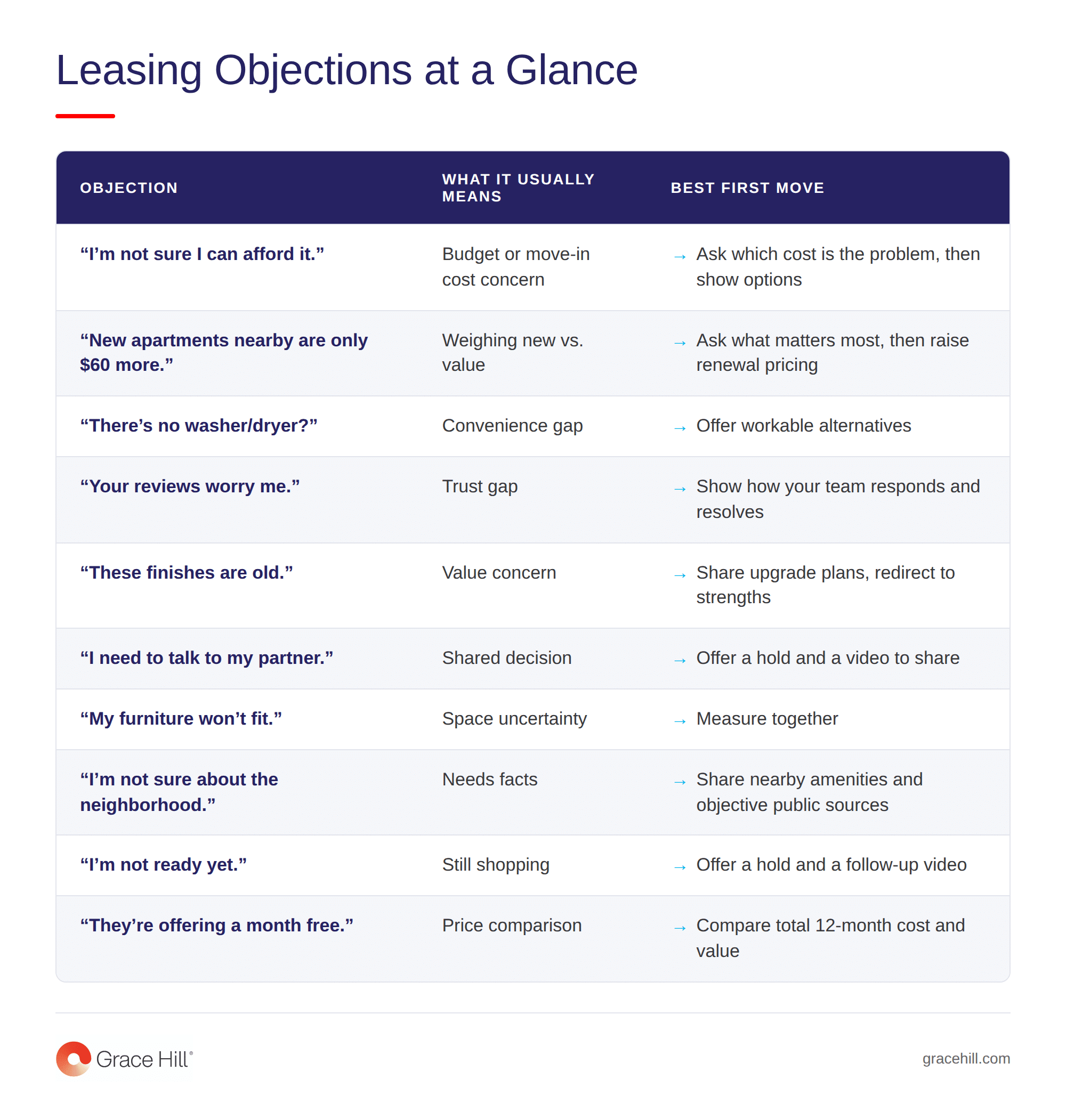
Objection #1: “I’m just not sure I can afford the rent.”
Solution: How you respond will differ based on the person or circumstance, but here are some ideas for overcoming this objection with residents and prospects.
Affordability is a real pressure, not a negotiating tactic. A record 22.7 million renter households (49%) were cost-burdened in 2024, meaning they spent more than 30% of their income on housing.
- For a prospective resident, you could check for similar apartments, smaller apartments, a longer lease term, etc. Another idea is to refer them to a sister community while also taking that next step to actually call and talk to your colleague at that community while the prospect is there.
- For a current resident, initiate a conversation to fully understand the specific reasons behind the resident’s financial concerns. Are they facing a job loss or other unexpected expenses? Once you have a better understanding, you can tailor your response accordingly. Discuss the cost of moving and the impact of that expense.
Try saying: “Let’s look at the full picture. Is the monthly rent or the upfront cost the bigger hurdle?”
Objection #2: “There are brand new apartments within a mile, and they are only $60 more per month.”
Solution: If you work at a property in a growing metropolitan area, be prepared for this one. New supply is everywhere: 506,353 new apartments opened in 2025, more than half of them in the South, and Dallas-Fort Worth ranked #2 among metros with 28,958 units. In high-growth areas, you’ll likely face competition with new properties offering aggressive promotional deals for new leases.
So here are a few questions to ask:
- “What is the most important thing about finding an apartment: amenities, location, or having a brand new apartment?”
- “Have you asked, or considered, what rent increases might take effect once it is time to renew?”
Lease-up communities often price low to fill units fast. Encourage prospects to ask what renewal pricing looks like once the special ends. If a resident or prospect really just wants to live in a newly constructed community, consider your sister communities and make the connection on their behalf, if possible.
Objection #3: “There is no washer/dryer in my apartment?” or “The washer/dryer is in the bedroom — seriously?”
Expect this one. In-unit laundry is now a baseline expectation. In the 2026 Amenity Paradox Report from Grace Hill, Gatewise, and HelloData, washer/dryer hookups (instead of an in-unit washer and dryer) were the amenity most negatively correlated with rent, about $121 less per month.
Solution: Based on the situation, below are some suggestions.
No washer/dryer in the apartment:
- If the unit has hookups, let them bring their own washer and dryer.
- Suggest a rent-to-own option. If this is a common issue for your community, research local rent-to-own stores that offer this so you can provide that information.
- Negotiate a special rate or arrangement with a local laundromat or laundry delivery service.
Dissatisfied with washer/dryer location:
- Consider the convenience. Having your washer and dryer in your room makes washing and putting away laundry that much easier.
- If this is truly a problem for them, find another floorplan or suggest a sister property.
Objection #4: “I’ve read your reviews online, and quite frankly, I’m a little worried.”
Solution: First and foremost, you should be well aware of any negative comments posted about your property online. More importantly, you should actively address them. If not, then you unfortunately have a reputation management issue, and you need a plan to address it.
The stakes are high. 71% of renters won’t visit a property if the reviews aren’t stellar, and 79% say reviews influenced their leasing decision.
In the ever-growing world of social media and online review sites, being proactive with comments and reviews is paramount. And if you’re only hearing about negative reviews from prospective residents, that’s a problem.
Because managing all the things people put online can be a full-time job, many property management professionals have come to rely on online reputation management (ORM) and survey solutions to stay informed, responsive, and competitive.
With the right tools in place, review objections get much easier to handle. Here are a few leasing agent tips to keep in mind:
- Be positive and professional: Always remember to respond to negative reviews positively and professionally. This will show your prospects you are attempting to resolve any issues with current residents.
- Acknowledge their concern. Assure them that the leasing staff investigates any situations and will do everything within their power to make it right as customer service is a top priority.
- Show, don’t tell: Pull up a recent negative review and your team’s response so they can see how you resolve issues.
- Invite them to an event: Sometimes seeing is believing, so invite prospective residents to attend your next resident event.
Try saying: “I’m glad you checked. Here’s what happened in that situation, and here’s what we changed.”
Objection #5: “These [insert the concern: carpets, appliances, cabinets, etc.] are old and really need to be replaced.”
Solution: Based on the concern, below are some suggestions.
- Carpet: If there is a plan for carpet replacement, let them know it’s a project on the horizon. Instead of focusing on the carpet, help turn the prospect’s attention to the other positive features of the apartment (e.g., spacious layout, updated kitchen, great location). If possible, show them photos of how others have added throw rugs to improve the look and feel.
- Appliances: This might be an opportunity to highlight your maintenance program, assuring prospective residents that your teams promptly address necessary repairs. Again, play to the positives, whatever those might be.
- Cabinets: If the cabinets need replacement, do you have options for residents to make improvements? If they can’t be replaced, could you offer to have them painted? Are there renter-friendly hardware options you could suggest? Providing examples and photos is always helpful, if possible.
Try saying: “You’re right, the carpet is due. It’s on our replacement schedule for [timeline]. In the meantime, look at the natural light in this room.”
Objection #6: “I really need to discuss this with my partner (husband, roommate, etc.).”
Solution: Moving is a big decision, and often a shared one. Respect that, and make it easy for the other person to say yes.
But before they walk out the door, here are some options:
- Ask them, “If you were the only person deciding on the apartment, would you want to make a deposit?”
- Offer a 24-hour hold for the apartment.
-
Send a personalized video tour they can share with their partner. Prospects who engage with Realync videos are 3x more likely to sign a lease.
Try saying: “Makes sense. Want me to send a quick video of this unit so they can see it tonight?”
Objection #7: “The living room (or kitchen or bedroom) is just too small. My furniture won’t fit.”
Solution: Your best tool to overcome this simple objection is to have a measuring tape on hand. Make it a habit to keep one with you as you are showing apartments. Beds and sofas tend to take up the most real estate in an apartment layout, so keep in mind the most common size of furniture items:
- Regular three-seat sofas typically measure about 35 inches deep by 84 inches wide.
- Loveseats often measure 60 inches wide by 35 inches deep
- Apartment-size sofas are usually between 68 and 80 inches wide, with a few inches shaved off to save space in depth.
Below is a quick reference for bed sizes.

Based on their furniture, you can use the measuring tape to show them the amount of space a bed or other piece of furniture would take up in any of the rooms. If the space is a hurdle you can’t overcome, refer them to a sister community.
Try saying: “Let’s measure it together. How long is your sofa?”
Objection #8: “I’m not really sure about the neighborhood.”
Solution: Know the neighborhood so you can speak truthfully to the area. More importantly, you need to know every positive piece of information about your neighborhood; to do that, you must take some time to explore the area.
Stick to facts about the area:
- Nearby amenities: Share what’s close by, like public transportation, parks, shopping, dining, and commute times.
- Point to objective sources: If a prospect asks about crime or safety, don’t characterize the area yourself. Direct them to public resources, like the local police department’s crime data, so they can decide for themselves.
- Safety measures: If the property has security features like gated access, surveillance cameras, or onsite staff, describe them factually without promising safety.
- Skip the opinions: Avoid calling an area “good,” “safe,” or “family-friendly,” or describing who lives there.
- Testimonials from current residents: Ask if you can share testimonials from satisfied residents with similar concerns.
Why it matters: characterizing a neighborhood, even with good intentions, can steer prospects and create Fair Housing risk. Brush up with Grace Hill’s Fair Housing training.
Knowledge is power. Be clear about what your community offers, and then back that up with facts you can share.
Objection #9: “I’m just not ready yet. This is only the first apartment community I’ve toured.”
Solution: In this case, use the 24-hour hold. Also, ask the prospect about the other communities they plan to tour; it will give you an idea of your competition if they are willing to share that information.
Then follow up within 24 hours with a short video recap of the unit they liked. It keeps your community top of mind while they tour the competition.
Try saying: “Totally fair. Where else are you looking? I’ll send you a quick video of this unit so you can compare side by side.”
Objection #10: “[Insert name of your competition] is running a special of no deposit down and one month free. Do you have any specials?”
Concessions are common right now. 15.8% of stabilized apartments offered concessions in July 2026, averaging nearly 6 weeks free on a 12-month lease.
Solution: This one is a bit trickier to deal with, but it’s equally crucial for you to know your competition. Pay attention to lease specials and promotions to be prepared and proactive in overcoming this hurdle. As you become aware of competitor specials being offered, ask your property manager what you can do to balance this out.
If your community doesn’t have a specific first-time lease special, offer alternative incentives that might appeal to prospective residents. This could include:
- Concessions: Rent credits, waived fees, or discounted utilities.
- Upgrades: Upgraded flooring or appliances.
- Special promotions: For example, a “refer a friend” program or a loyalty program.
- Focus on the overall value: Emphasize that your community offers long-term value beyond short-term promotions. Discuss factors like property management, community events, and the overall living experience.
- Avoid focusing solely on price: While price is important, show how your community’s value proposition extends beyond the initial rental cost.
By acknowledging the competition, offering alternative incentives, emphasizing long-term value, and providing a personalized experience, you can effectively overcome the “lease specials” objection and increase your chances of securing a lease.
Try saying: “That’s a strong offer. Let’s compare the total cost over 12 months, including fees and what renewal might look like.”
Leasing Agent Tips: Let IDEAS Be Your Guide
An acrostic mnemonic is a sentence or poem where each part of the text’s first letter (or letters) represents something you’re trying to memorize. It’s a valuable tool to help remember things.
IDEAS is a simple acrostic leasing agents can use to identify and address objections from prospective residents.
Here’s a breakdown of each letter:
- I: Identify the Real Objection
Understanding the underlying reason for the objection is crucial for providing a relevant and effective response.
- D: Discover Your Competition
Knowing what other properties offer can help you position your community more competitively.
- E: Explore Your Sister Communities
If applicable, consider the strengths of other properties within your management company or portfolio.
- A: Analyze Your Brand Advantages
Highlight the unique features and benefits that set your community apart from the competition.
- S: Suggest Solutions
Offer tailored solutions that address prospective residents’ concerns and meet their needs.
This acrostic provides a structured approach to handling objections and increasing the likelihood of securing a lease.
How Managers Can Coach Objection Handling
Objection handling is a skill, and skills fade without practice. If you lead a leasing team, here’s how to build it at every property.
Objection handling is a skill, and skills fade without practice. If you lead a leasing team, here’s how to build it at every property.
- Role-play the top 10. Run 1 objection per team meeting. Employees learn best this way: 86% say they pick up new skills by figuring things out on the job, and nearly a third say their training is too theoretical.
- See what really happens on tours. Mystery shopping shows how agents handle objections when no manager is in the room. Grace Hill completes 32,000+ mystery shops every quarter, scoring every touchpoint from first call to post-tour follow-up.
- Close gaps fast. Assign a short refresher course as soon as a shop flags a gap. “From the time we close out the shop, we can assign two five-minute refreshers with two clicks of a mouse.” (Elaine Kozloski, Director of Training, Westminster Management)
- Track the right numbers. Watch lead-to-lease conversion, tour-to-application rate, and follow-up time by agent.
Tools That Keep Residents Satisfied
Once you address a prospect’s objections and secure them as a resident, these tools in Grace Hill’s PerformanceHQ platform can help keep them satisfied while also improving your property’s performance.
Training
Training is necessary for developing a team of leasing agents with the required skills to improve resident satisfaction and increase sales. With changing regulations and high employee turnover, it’s harder than ever to support your team and make them successful.
73% of employees say stronger learning and development opportunities would make them stay longer at their company.
More than 2,800+ companies trust Grace Hill, so you can be confident you’ll have what you need to educate employees and reduce risk in your organization. Plus, our award-winning training content includes 600+ industry-specific courses, and our Learning Management System (LMS) is easy to administer, so you can focus on what matters most: satisfying residents.
Surveys
Turn resident feedback into action. The link between satisfaction and renewals is undeniable, but gathering accurate data for your properties can be challenging. The link between satisfaction and renewals is undeniable, but gathering accurate data for your properties can be challenging.
Grace Hill Surveys offer comprehensive survey tools and Kingsley Index™ benchmarks built on 7M+ resident surveys a year, so you know exactly where to improve for multifamily and commercial real estate organizations.
Virtual Leasing
Help prospects say yes before they ever visit. Realync video tours and follow-ups make the partner, timing, and space objections easier to handle. Prospects who engage with Realync videos are 3x more likely to sign a lease, and video helps cut vacancy by 5 to 11 days.
Reputation Management
As a property manager, you know blind spots in your online reputation are dangerous. However, managing feedback scattered across the web is time-consuming, and generic tools lack industry-specific features.
Grace Hill’s Online Reputation Management (ORM) offers a consolidated view of your reviews, listings, and social sites, along with key metrics to help you understand overall performance.
In apartment leasing, the ability to effectively handle objections is a vital leasing agent skill to possess. By understanding the underlying reasons behind objections, listening attentively, offering tailored solutions, and checking for agreement, you can turn potential roadblocks into opportunities for building solid relationships and securing leases.
Remember, objections are not rejections but rather requests for more information. By mastering these techniques and staying informed about your competition and market trends, you’ll be well-equipped to navigate the challenges and triumphs of the leasing industry.
FAQs About Overcoming Leasing Objections
What is objection handling in apartment leasing?
Objection handling is how leasing agents respond to a prospect’s or resident’s concerns about price, space, timing, or competition. The goal is to uncover the real issue and offer a solution. Most objections are requests for more information, not a no.
What are the most common leasing objections?
The most common are price, newer competition, missing amenities like in-unit laundry, online reviews, dated finishes, needing to consult a partner, space, the neighborhood, timing, and competitor specials.
How do you handle a price objection in leasing?
Ask which cost is the issue, monthly rent or move-in costs. Then show options: a different floor plan, lease term, current specials, or a sister community. Compare the total cost over 12 months, not just the advertised rent.
What should a leasing agent say when a prospect wants to keep looking?
Respect it and ask where else they’re touring. Offer a 24-hour hold if your policy allows, then follow up within 24 hours with a personalized video of the unit they liked.
What does IDEAS stand for in leasing?
IDEAS stands for Identify the real objection, Discover your competition, Explore your sister communities, Analyze your brand advantages, and Suggest solutions.
How can managers improve objection handling across a team?
Role-play common objections in team meetings, use mystery shopping to see how agents respond on real tours, assign short refreshers where gaps show up, and track lead-to-lease conversion by agent.